Salesforce consulting services are the advisory and delivery work that turns a Salesforce license into a system your teams actually use. That covers assessing your processes and data, configuring and customizing the platform, integrating it with other systems, migrating data, automating workflows, and adding AI features such as Einstein and Agentforce. The expensive failures rarely come from missing features. They come from skipped decisions: unclear processes, dirty data, unowned integrations and low adoption. This guide shows how to spot those risks early and how to pick a partner without relying on a ranked list.
What Salesforce consulting services actually cover
People use "consulting," "implementation" and "managed services" as if they were one thing. They are three different jobs. Consulting decides what to build and in what order. Implementation builds it. Ongoing support keeps it working as the business and the platform change.
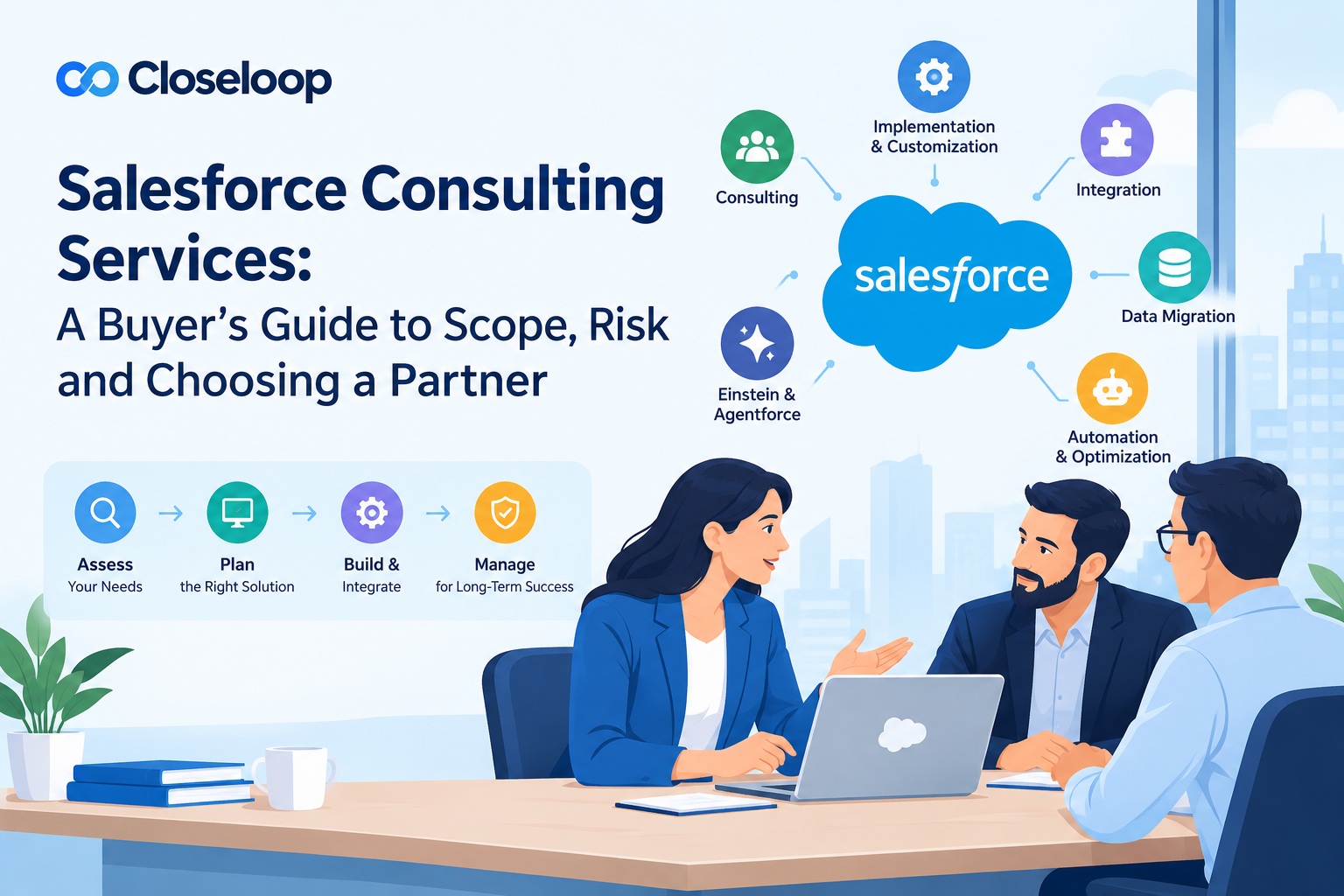
On its Salesforce page, Closeloop splits the work into six lines: consulting, implementation and customization, integration, data migration, automation and optimization, and Einstein and Agentforce. It works across Sales Cloud, Service Cloud and Marketing Cloud. That split is useful as a checklist even if you never hire them, because a proposal that skips one of those lines usually leaves the gap for you to fill later.
Closeloop's team offers a Salesforce consulting and implementation assessment that starts with your workflows, data and integrations.
The Five Gates: where Salesforce projects go wrong
This is our own working model, so treat it as an opinion rather than an industry standard. A Salesforce project should clear five gates, in order, before anyone calls it done. The order matters because each gate depends on the one before it.
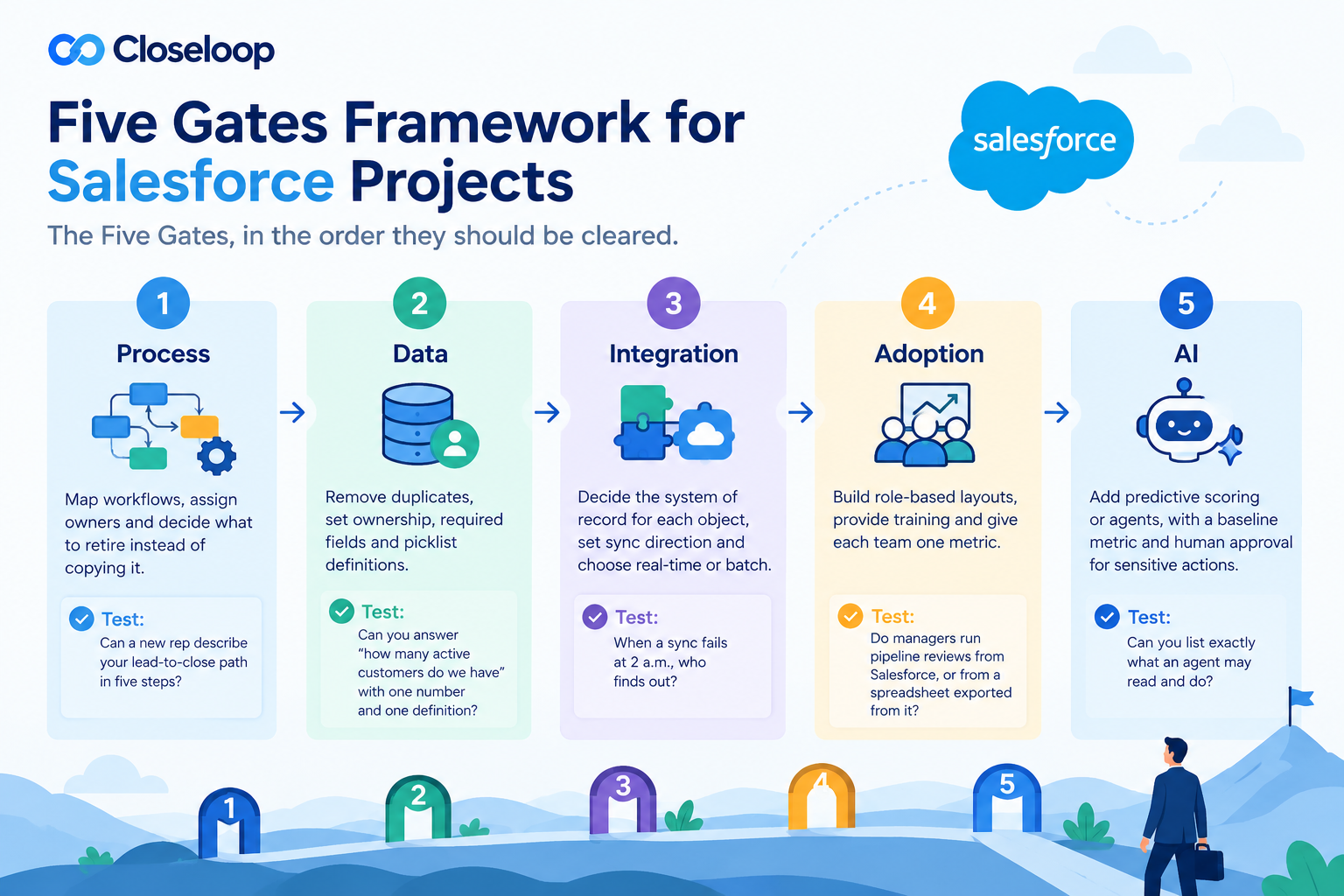
Gate 1: Process. Map workflows as they run today, name one owner per process, and decide what to retire instead of copying it. Test: can a new rep describe your lead-to-close path in five steps?
Gate 2: Data. Settle duplicates, record ownership, required fields and picklist definitions. Test: can you answer "how many active customers do we have" with one number and one definition?
Gate 3: Integration. Decide the system of record for each object, the direction of every sync, and whether it runs real time or in batch. Test: when a sync fails at 2 a.m., who finds out?
Gate 4: Adoption. Build role-based page layouts and training, and give each team one metric. Test: do managers run pipeline reviews from Salesforce, or from a spreadsheet exported from it?
Gate 5: AI. Only after the first four, add predictive scoring or agents, with a baseline metric and human approval for sensitive actions. Test: can you list exactly what an agent may read and do?
AI sits last on purpose. A model grounded in duplicate accounts and unowned fields gives confident wrong answers faster. Closeloop's own page says the same in different words, listing "AI-ready Salesforce data" as a service in its own right. For the executive view, see its post on what enterprise leaders need to know about Salesforce AI.
Clicks before code: a build ladder, and why limits decide it
Salesforce runs many customers on shared infrastructure, so it enforces limits on custom code. The Apex documentation lists per-transaction caps, including 100 SOQL queries in synchronous code (200 in asynchronous code) and 50,000 records retrieved by queries in one transaction. Read the full Apex governor limits reference before approving any custom-code design. A trigger that works with ten test records can fail on a 200-record data load. salesforce
Build ladder for Salesforce showing five rungs from standard configuration to external service with when to climb and risks
Our suggested ladder: standard configuration first, then Flow, then an AppExchange package, then Apex or Lightning components, and finally an external service when volume or logic outgrows the platform. One detail from the documentation that buyers miss: certified managed packages get their own set of limits, while code from an uncertified AppExchange package does not. That makes package choice a technical decision, not only a feature comparison. salesforce
Release management is the other quiet risk. Salesforce ships seasonal releases, and the preview window is short. For Winter '27, Salesforce told admins to refresh sandboxes before August 27 to join the preview, with production upgrades arriving in waves from early September into October. A consultant who does not test your integrations and automations in a preview sandbox is leaving that test to your users. Ask any candidate how they handle this. salesforce
Also Read: Common Salesforce CRM Challenges Businesses Face and How to Solve Them
The six services, one by one
The graphic below maps each Closeloop Salesforce service to the situation that usually triggers it.
Table graphic mapping six Salesforce consulting services and four AI services to what they cover and when to use them
Salesforce consulting. An assessment of processes, org, data, integrations and future needs, ending in a roadmap. Buy it when you are starting, or when an existing org has grown messy.
Implementation and customization. Configuring Sales Cloud, Service Cloud or Marketing Cloud around your workflows. Closeloop reports a Cordance Sales Cloud engagement that improved lead management by 20% and pricing accuracy by 15%, and a Service Cloud engagement that raised agent productivity 30% and cut response times 25%. Those are vendor-reported results. The case studies are Cordance Salesforce and Cordance Service Cloud.
Salesforce integration. Connecting Salesforce to ERP, ecommerce, marketing, finance and support systems. Closeloop's system integration work uses Boomi, Celigo and MuleSoft.
Data migration. Moving and organizing data while keeping integrity high enough for reporting, automation and AI. In practice: use external IDs, load parent records before children, rehearse at full volume in a sandbox, and plan how automation behaves during bulk loads so you do not hit the limits above. See Closeloop's data migration roadmap and data migration services.
Automation and optimization. Approvals, routing, notifications and workflow rules, tuned as requirements change. Pair this with business process automation when a process crosses systems.
Einstein and Agentforce. Predictive insights and AI agents connected to CRM data. More on this below.
After go-live, Closeloop lists post-implementation work: performance monitoring, workflow updates, adoption support and training, new features, dashboard refinement and scalability planning. Ask for that scope in writing, because support is where many budgets run dry.
Salesforce and NetSuite: where quote-to-cash gets decided
The question many mid-market companies reach is how Salesforce and an ERP should share customers, orders and revenue. This is where NetSuite Implementation Services, NetSuite Integration Services and Custom NetSuite Development meet Salesforce consulting services. A typical split: Salesforce owns the opportunity, quote and customer relationship, while NetSuite owns the sales order, invoice and revenue recognition.
Both platforms enforce limits, so design for them. Salesforce limits apply per transaction, as above. NetSuite governs concurrency, and Oracle advises every integration to check its available limit through the governanceLimits operation so it does not exceed the threads available. The Oracle governanceLimits documentation explains it. Closeloop reports a Celigo-based Salesforce and NetSuite integration for Cordance with a 90% reduction in data inaccuracy and an 80% increase in revenue recognition efficiency. Read the Cordance Celigo case study or the NetSuite Salesforce integration guide. oracle
Keep Custom NetSuite Development light. Our rule of thumb, nothing more: configure first, use middleware second, script third. Closeloop's NetSuite implementation services cover consulting, custom development, implementation and migration.
Einstein and Agentforce: where to start
Closeloop's page splits AI into four services: Agentforce implementation, Einstein predictive insights, AI-ready data, and AI workflow integration. The concepts differ. Einstein predicts and recommends. Agentforce builds agents that can act. Salesforce describes the Einstein Trust Layer as including dynamic grounding, zero data retention and toxicity detection, alongside Agentforce guardrails that combine user-defined safeguards with Salesforce-managed protections. Salesforce's own Agentforce overview lays out those controls .
Salesforce start with a narrow, reviewable job, such as a service agent that retrieves knowledge articles and hands off to a person, or lead scoring you can compare with rep judgment. Avoid agents that send customer-facing commitments, such as pricing or credits, until you have logged real conversations and measured error rates. Write down permissions first, since an agent can only be as safe as the access you give it. For wider context, see Closeloop's Generative AI and AI integration services and its post on AI in CRM.
Salesforce in logistics: an honest scope
If you run a freight, 3PL or distribution business, Salesforce can hold shipper accounts, quotes, service cases and account health. It does not replace a TMS or WMS. Those live elsewhere and feed Salesforce through integration. Logistics And Transportation Software Development projects therefore often pair a Salesforce CRM with custom operational software. Closeloop's logistics software development team builds that operational layer, and its logistics case studies (proof of delivery, yard management, quoting) are custom builds rather than Salesforce projects. A solid Logistics Software Development Service plan decides early which system owns the shipment record and which owns the customer record.
Beyond Salesforce: the rest of Closeloop's service stack
Few Salesforce programs stand alone. Closeloop's wider offering fills the gaps:
- Custom software development and software engineering: custom software development for workflows Salesforce should not host, built on Java, MERN or LAMP stacks.
- CRM alternatives: HubSpot implementation and custom CRM development when Salesforce is more platform than you need. The Salesforce vs HubSpot vs Zoho comparison helps here.
- Digital commerce: storefronts and B2B ordering tied back to CRM and ERP.
- Cloud and data: cloud engineering (AWS, Azure, Google Cloud, DevOps, platform engineering) and data engineering (Databricks, lakes, warehouses).
- Mobile: mobile app development for field teams who need Salesforce data on a phone.
- Product strategy: product strategy and consulting, including prototyping, before you commit to a build.
How to choose a partner (and what to ignore in the rankings)
Search for the Best Software Development Company in USA or the Top Software Development Companies in USA and you meet the same problem as in Salesforce searches: ranked lists, mostly by vendors. One list explains why its own publisher sits at the top of its shortlist. Another states its criteria openly, namely service expertise, delivery capability, certifications, industry experience and customer reputation, but gives no scoring. Use lists to build a shortlist, then judge fit yourself. ascendixgirikon
Comparison table of Salesforce partner types: boutique, global integrator, full-service software firm and in-house
A Salesforce-only boutique offers deep platform knowledge and may struggle when work spills into custom code, ERP or cloud. A global integrator brings scale and process, usually at higher cost and with more layers. A full-service software development company offers one team across Salesforce, integrations, data and custom builds, but you should confirm certified Salesforce depth. Among Custom Software Development Companies in USA, ask to meet the people who would actually configure your org.
Questions that separate firms fast:
- How do you test against the preview sandbox each release?
- Which system owns each object after integration, and what happens on a failed sync?
- What is your plan for duplicates before migration?
- Who owns admin training after go-live, and how do you measure adoption?
- What does the support scope include, in writing?
Red flags: a fixed price before discovery, no questions about your ERP, and case studies with percentages but no baselines. Closeloop's posts on why to hire a Salesforce partner and hiring Salesforce developers add detail.
Six common mistakes
- Copying the old process into Salesforce. You pay to preserve the friction.
- Migrating dirty data. Duplicates become permanent.
- Skipping the integration owner. Failed syncs sit unseen.
- Customizing before configuring. Code is slower to change and hits limits.
- Training once, on go-live day. Adoption fades by month two.
- Switching on AI first. See Gate 5.
Conclusion
Closeloop is a Silicon Valley software development company in USA, listed on the Inc. 5000, with 175+ engineers and consultants, 70+ enterprise and growth-stage clients, 250+ projects delivered and four offices across the US and India. Its Salesforce work sits alongside NetSuite, integration, data, cloud and custom development, which helps when your CRM must connect to everything else. Its site shows Salesforce consulting partner and AWS Advanced Consulting Partner badges. For the full cost picture, see its guide on how to calculate Salesforce implementation costs. Closeloop's FAQ puts simple deployments at 3 to 6 months and enterprise deployments with custom integrations at 6 to 12, which is a vendor estimate.
Trade-offs to weigh: Closeloop manages accounts from California with a global engineering team, so ask about working-hour overlap, and verify any claim, including ours, through reviews and reference calls. If you are comparing the Best Software Development Company in USA for a mixed Salesforce, NetSuite and custom project, that is the right way to compare.
Author

Swetha GP

VP of Delivery
She is a VP of Delivery at Closeloop. A communicator, business analyst, and engineering aficionado. Besides handling client relations, and engineering duties, she loves to pour her thoughts on paper. She writes about engineering, technologies, frameworks, and everything related to the software domain. She reads, spends time with family, and enjoys a good walk in nature in her free time. Her dream destination is Greece.
Frequently Asked Questions
Connect with our experts to discuss your requirements. For any queries, reach out to sales@closeloop.com
Stay abreast of what's trending in the world of technology
Logistics and Transportation Software Development: A Practical Guide for US Operators
Logistics and transportation software development is the work of designing, building and...
Generative AI Development Services: How Enterprises Can Turn AI Ideas Into Business Applications
Generative AI is changing how enterprises approach software development, customer engagement,...
Cloud Migration Strategies for Secure and Scalable Business Operations
Businesses increasingly depend on digital systems to manage applications, store information,...
NetSuite Integration Challenges and How Businesses Can Overcome Them
Most NetSuite projects do not struggle because of NetSuite itself. They struggle at the...