Salesforce can bring sales, service, marketing, and customer data into one place. Yet simply having a powerful CRM does not guarantee better results. A business can invest heavily in Salesforce and still deal with duplicate records, poor adoption, confusing reports, disconnected systems, or workflows that create more work instead of removing it.
That is where the real challenge begins.
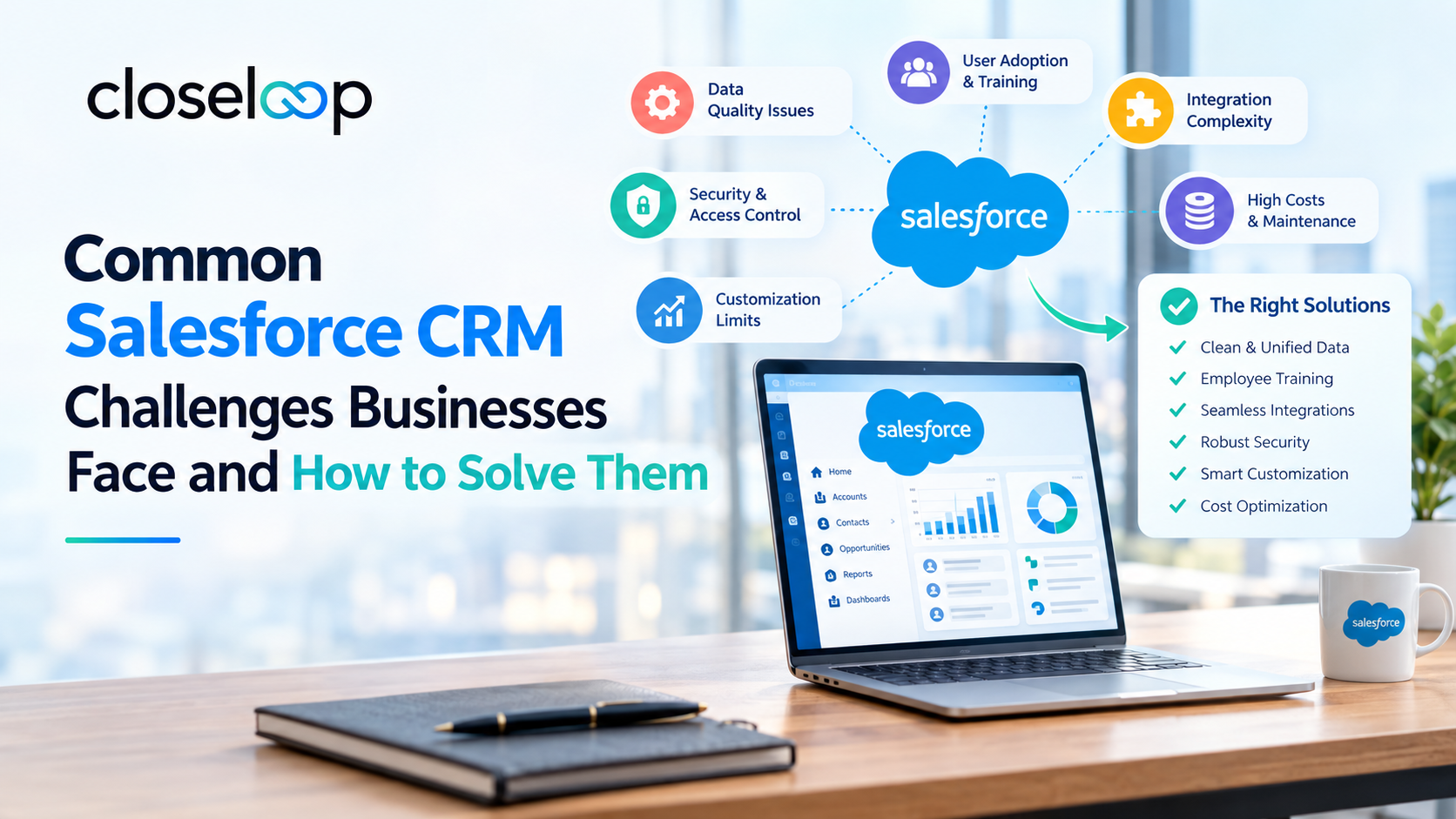
Most Salesforce problems are not caused by the platform itself. They usually come from unclear processes, weak data practices, limited user training, or a CRM setup that no longer matches the way the business operates. Understanding these issues early can help teams get more value from their investment. In many cases, Salesforce Implementation Service can help businesses address these gaps through better planning, configuration, integration, and process alignment.
1. Duplicate and Inaccurate Customer Data
Imagine a sales manager searching for a customer and finding three records for the same company. One contains an old phone number. Another has recent sales activity. The third has information entered by a different department. Now the CRM has become a source of confusion.
Duplicate records and incomplete information can affect forecasting, reporting, customer communication, and marketing campaigns. Over time, these small errors can become a much bigger operational problem.
How to solve it
Businesses should establish clear data ownership and validation rules. Standardize important fields and define which information teams are responsible for maintaining.
Before importing existing records, clean and organize them. This is particularly important when moving information from spreadsheets, legacy CRMs, or multiple databases. Closeloop's data migration services can help businesses maintain data quality while moving information between systems.
Regular data-quality reviews can then catch new problems before they spread.
Also Read: Salesforce Data Hygiene for LastPass Case Study
2. Salesforce Does Not Match Business Processes
Every company has its own sales cycle, approval process, customer journey, and reporting needs. Problems arise when Salesforce is configured around generic assumptions instead of actual business operations.
For example, a company may require multiple approval stages before a quote reaches a customer. If the CRM does not reflect that process, employees may create workarounds outside Salesforce.
This is one area where Salesforce Implementation Service can be valuable because the focus should be on understanding business requirements before making technical changes.
How to solve it
Map the existing workflow before changing the system.
Ask simple questions:
1. What happens first?
2. Who approves it?
3. Where does information move next?
4. Which steps are manual?
5. Where do delays normally occur?
Then configure Salesforce around those answers.
The goal is not to customize everything. Too much customization can make the system difficult to maintain. Instead, focus on changes that solve genuine operational problems.
3. Integration Gaps Create Data Silos
Salesforce rarely operates alone. Businesses may also rely on ERP systems, accounting platforms, eCommerce applications, marketing tools, communication software, and data platforms.
When these systems do not communicate properly, employees end up entering the same information multiple times. That creates delays and introduces errors.
How to solve it
First, identify which systems need to exchange information and determine which platform should be the source of truth for each type of data.
Then define:
1. What information needs to move
2. How frequently it should sync
3. What should happen when something fails
Closeloop's enterprise system integration services can support connected workflows across business applications and third-party platforms.
A good integration is not simply about connecting two APIs. It is about making information flow in a way that supports the business process.
4. Complicated Reports and Unreliable Forecasts
Executives want clear answers.
1. How much business is in the pipeline?
2. Which opportunities are likely to close?
3. Where are deals getting stuck?
Yet Salesforce reporting can become difficult when teams use inconsistent fields, outdated records, or different definitions for the same metric.
A dashboard may look impressive while the underlying data tells a different story.
How to solve it
Start with the business questions rather than the charts.
Define the metrics leadership actually needs.
Standardize how teams record information and make sure required fields support those metrics.
Then build dashboards around clear business outcomes.
Reports should help someone make a decision. If a dashboard has dozens of charts but nobody knows what action to take, it needs to be simplified.
Closeloop's discussion of why some companies get more value from Salesforce also highlights the importance of aligning CRM activity with measurable business outcomes rather than simply tracking usage.
5. Treating Go-Live as the Finish Line
One of the biggest Salesforce mistakes is assuming the project ends when users log in for the first time. It does not.
Teams change. Products change. Customer journeys change. New applications are added. Reporting requirements evolve. Salesforce itself continues to develop.
How to solve it
Create a continuous improvement process.
Collect feedback from users and review adoption, data quality, automation performance, and reporting needs at regular intervals.
A strong Salesforce roadmap should evolve with the business.
For companies planning a new deployment or a major CRM overhaul, Salesforce Implementation Services can provide structured support across planning, configuration, integration, migration, testing, training, and rollout. Closeloop's implementation approach is built around understanding business workflows first and then shaping the Salesforce environment around those requirements.
A Practical Way to Prevent Salesforce Problems
Most CRM challenges can be reduced by following a few straightforward principles.
Start with business goals.
Do not configure Salesforce simply because a feature exists.
Clean your data early.
Bad information will not become better after migration.
Design for users.
A technically impressive CRM can still fail if employees find it frustrating.
Connect systems carefully.
Decide where information belongs before deciding how systems should exchange it.
Keep customization under control.
Build what the business genuinely needs and review it over time.
Measure outcomes.
Track improvements in sales velocity, data accuracy, service response, productivity, or other meaningful metrics.
Keep learning after launch.
Salesforce should grow as the organization grows.
Turning Salesforce Into a Useful Business System
Salesforce is powerful, but technology alone does not solve CRM problems. The real value comes from how well the platform fits business processes, how accurately it captures information, and how confidently teams use it.
When challenges appear, the answer is rarely to add another feature immediately. Sometimes the better solution is to simplify a workflow, clean the database, change a permission, improve training, or connect two systems properly.
That practical mindset can make a major difference.
For businesses planning a new deployment or a major CRM overhaul, Closeloop takes a broader approach that considers business workflows, data, integrations, automation, and user needs together. Its goal is not simply to put Salesforce in place but to help create a system that employees can actually use and managers can rely on.
In the end, a successful CRM environment should make work clearer, not harder. When customer information is reliable, processes are connected, reports are useful, and employees know how to use the system, Salesforce becomes much more than a database. It becomes a practical foundation for better decisions and stronger customer relationships. That is where Salesforce Implementation Service can help turn a difficult CRM environment into a more organized and useful business system.
Author

Swetha GP

VP of Delivery
She is a VP of Delivery at Closeloop. A communicator, business analyst, and engineering aficionado. Besides handling client relations, and engineering duties, she loves to pour her thoughts on paper. She writes about engineering, technologies, frameworks, and everything related to the software domain. She reads, spends time with family, and enjoys a good walk in nature in her free time. Her dream destination is Greece.
Stay abreast of what's trending in the world of technology
When Standard NetSuite Workflows Fall Short: Implementation, Integration, and Customization...
NetSuite is one of the most capable cloud ERP platforms available, but no out-of-the-box...

From Business Bottlenecks to Digital Products: How to Evaluate Software Development Partners in the...
Every growing business eventually hits a wall. Spreadsheets multiply, teams re-enter the same...

The Hidden Cost of Disconnected Logistics Systems: A Software Architecture Approach to End-to-End...
A shipment leaves the warehouse on time, yet the customer calls twice asking where it is....

The Role of APIs and Integrations in Modern Custom Software Development
No application works alone anymore. Your CRM talks to your billing tool, your mobile app...