NetSuite is one of the most capable cloud ERP platforms available, but no out-of-the-box setup can match every company's way of working. Approval chains get awkward, order data arrives late from other systems, and teams start exporting reports to spreadsheets just to get a straight answer. When that happens, the issue is rarely the platform itself. It is usually how the platform was configured, connected, and extended. Well-planned NetSuite implementation services can resolve many of these gaps, and this guide explains how to tell which gaps need configuration, which need integration, and which call for custom development.

Why Standard NetSuite Workflows Fall Short
NetSuite ships with strong core modules for finance, inventory, order management, and CRM. Because it is designed to serve many industries, its default workflows are intentionally general. Problems appear when your business has rules that the defaults don't anticipate.
Common signs your workflows are outgrowing the standard setup:
- Manual workarounds: Staff re-key data, maintain side spreadsheets, or email approvals that should live in the system.
- Slow month-end close: Reconciliation takes days because data from other tools doesn't flow in cleanly.
- Inconsistent data: Customer, pricing, or inventory records differ between NetSuite and other platforms.
- Rigid approvals: A purchase or discount rule your business relies on can't be modeled with default settings.
For example, a wholesale distributor may need tiered pricing that changes by customer contract, region, and order volume. A default price-level setup can handle part of that, but not all of it. Recognizing where the standard system stops is the first step toward fixing it properly.
Start With the Right Foundation: Implementation Done Well
Many workflow problems trace back to the original rollout. A rushed implementation that copies old processes into a new system carries inefficiency forward. A strong implementation begins with process discovery, maps real workflows, cleans data before migration, and configures roles, permissions, and saved searches around how people actually work.
What a Solid Implementation Includes
- Discovery and process mapping: Document current and desired workflows before configuring anything.
- Data migration and cleanup: Remove duplicates and fix errors before they enter the new system.
- Configuration first: Use native features such as SuiteFlow, custom fields, and custom records wherever they meet the need.
- Training and adoption: Even a perfect configuration fails if teams don't use it.
If you are still choosing who should lead this work, this comparison of top NetSuite implementation companies in the USA can help you build a shortlist. And if you want a deeper walkthrough of phases, timelines, and costs, the complete NetSuite implementation services guide covers the process end to end.
When Integration Becomes the Real Fix
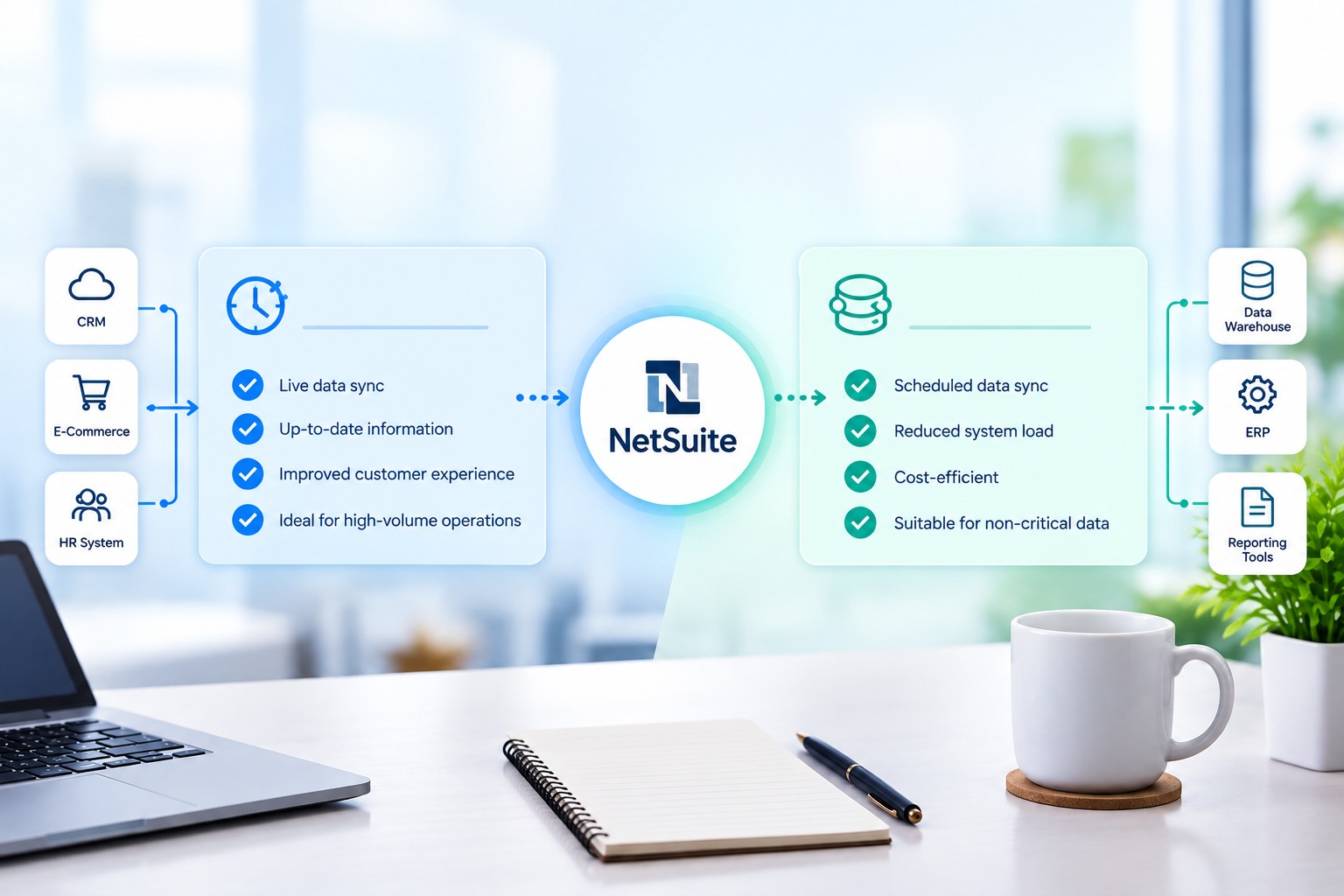
NetSuite rarely operates alone. Most businesses also run an e-commerce storefront, a CRM, a warehouse system, a payment gateway, and a BI tool. When these systems don't share data reliably, even a well-configured NetSuite account will feel broken. This is where NetSuite integration services deliver the most value.
Industry research consistently shows that disconnected systems create data silos that slow decisions and increase errors. The concept of enterprise application integration exists precisely to solve this: connecting separate applications so they exchange data in a consistent, automated way.
Integration Scenarios That Pay Off Quickly
- E-commerce to ERP: Orders, inventory levels, and customer records sync between your storefront and NetSuite in near real time, preventing overselling and manual entry. Retailers building storefront experiences often pair NetSuite with digital commerce solutions so product, pricing, and order data stay consistent across channels.
- Adobe Commerce and NetSuite: A merchant running a complex catalog on Adobe Commerce can sync products, stock, and fulfillment status with NetSuite, so customers see accurate availability and finance sees accurate revenue.
- CRM and billing: Closed deals in the CRM automatically create customers, subscriptions, and invoices in NetSuite.
- Warehouse and shipping: Fulfillment updates flow back into NetSuite so inventory and order status are always current.
Choosing an Integration Approach
There are three common patterns: point-to-point connections, middleware or iPaaS platforms, and custom API-based integrations. Point-to-point is quick for two systems but becomes tangled as you add more. Middleware scales better, and custom APIs offer the most control for unusual requirements. When several platforms need to work together under one architecture, a broader system integration strategy keeps everything maintainable as the business grows.
Also Read: NetSuite Implementation vs Custom ERP Development: Which Is Right for Your Business?
When Configuration and Integration Aren't Enough: Custom NetSuite Development
Some requirements simply cannot be met with settings or connectors. This is where custom NetSuite development comes in. Using SuiteScript, SuiteTalk web services, and RESTlets, developers can extend the platform to match business logic that is unique to your company.
Examples of where custom development makes sense:
- Complex pricing and quoting engines that apply contract-specific rules automatically.
- Custom approval workflows with multi-level, conditional routing based on amount, department, or vendor risk.
- Specialized reporting dashboards that combine financial and operational data in ways saved searches can't.
- Industry-specific modules, such as lot tracking for food manufacturers or project billing for service firms.
A useful rule of thumb: configure before you customize, and customize before you rebuild. Native configuration is easiest to maintain and upgrade-safe. Custom code adds power but also responsibility, so it should be documented, version-controlled, and tested against each NetSuite release. Software that is heavily customized without discipline can accumulate technical debt, making every future change slower and more expensive.
A Practical Decision Framework
Use this quick guide to decide your next move:
- Is the feature available but not set up? Reconfigure it through implementation or optimization.
- Is the data stuck between systems? Invest in integration.
- Is the business rule unique and unsupported? Build a custom solution.
- Is it a mix? Sequence the work: foundation first, integration second, customization last.
Whichever path you take, define success metrics up front, such as faster order processing, shorter close cycles, or fewer manual entries, so you can measure whether the change actually worked.
Conclusion
Standard NetSuite workflows are a starting point, not a ceiling. When your processes outgrow the defaults, the right mix of thoughtful implementation, reliable integration, and carefully scoped customization turns NetSuite from a system you work around into one that works for you. The key is choosing the right lever for each gap rather than defaulting to custom code or endless workarounds.
Teams that want an experienced hand across all three areas can lean on Closeloop, which helps businesses plan, connect, and extend their ERP environments around real operational needs. If your NetSuite setup is holding your team back, get in touch with our team today to discuss your workflow challenges and find the right path forward.
Author

Swetha GP

VP of Delivery
She is a VP of Delivery at Closeloop. A communicator, business analyst, and engineering aficionado. Besides handling client relations, and engineering duties, she loves to pour her thoughts on paper. She writes about engineering, technologies, frameworks, and everything related to the software domain. She reads, spends time with family, and enjoys a good walk in nature in her free time. Her dream destination is Greece.
Stay abreast of what's trending in the world of technology
From Business Bottlenecks to Digital Products: How to Evaluate Software Development Partners in the...
Every growing business eventually hits a wall. Spreadsheets multiply, teams re-enter the same...

The Hidden Cost of Disconnected Logistics Systems: A Software Architecture Approach to End-to-End...
A shipment leaves the warehouse on time, yet the customer calls twice asking where it is....

The Role of APIs and Integrations in Modern Custom Software Development
No application works alone anymore. Your CRM talks to your billing tool, your mobile app...
How Software Development Companies Help Businesses Modernize Legacy Systems
Outdated software quietly drains budgets, slows teams down, and blocks growth. Many...