Choosing between NetSuite Implementation and Custom ERP Development is one of the most consequential decisions a growing business will make. One path gives you a proven, ready-to-configure platform. The other gives you a system built entirely around your own processes. Neither option is universally "better" the right choice depends on your industry, budget, timeline, and how unique your operations really are.
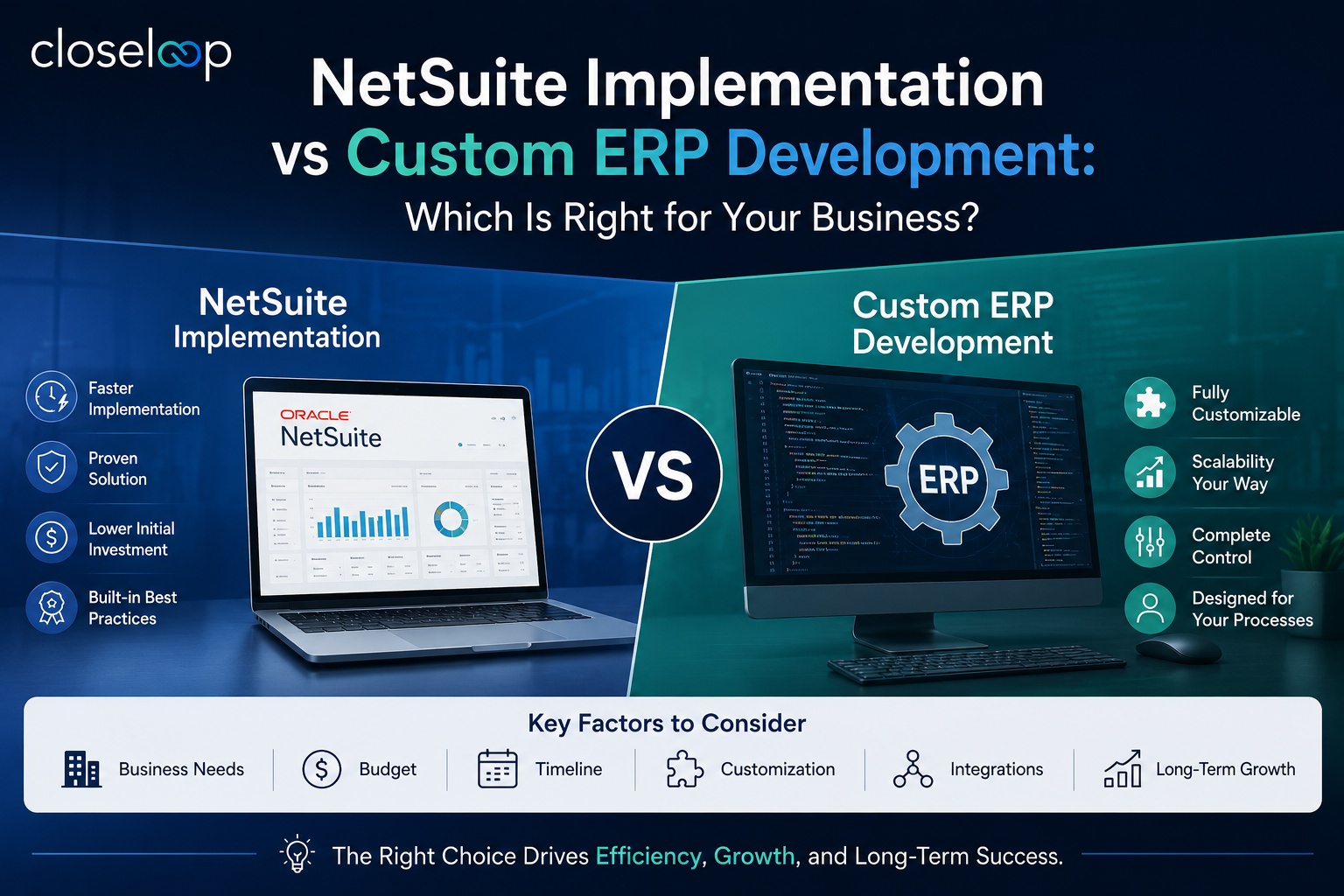
This guide breaks down both approaches across the factors that matter most: scalability, customization, implementation complexity, integrations, automation, security, and long-term maintenance.
NetSuite Implementation vs Custom ERP Development: Quick Answer
If you need a fast, reliable, industry-tested ERP solution, NetSuite implementation is usually the better fit. If your business has highly unique workflows that off-the-shelf software can't accommodate, custom ERP development may be worth the added time and investment.
Most growing businesses start with NetSuite because it reduces risk and speeds up time-to-value. Custom ERP development tends to make sense for businesses with specialized operations think niche manufacturing processes, proprietary logistics models, or regulatory requirements no standard platform fully supports.
Comparison Table: NetSuite Implementation vs Custom ERP Development
| Factor | NetSuite Implementation | Custom ERP Development |
|---|---|---|
| Time to launch | Weeks to a few months | Several months to over a year |
| Upfront cost | Lower to moderate | Higher, project-dependent |
| Customization depth | Configurable within NetSuite's framework | Unlimited, built around your exact processes |
| Scalability | Built-in, cloud-native scaling | Depends on architecture decisions made during development |
| Maintenance | Handled largely by NetSuite/partner updates | Owned entirely by your business or dev partner |
| Integrations | Pre-built connectors plus custom APIs | Built from scratch, fully tailored |
| Security | Enterprise-grade, managed by NetSuite | Dependent on your development and security practices |
| Best for | Standard to moderately complex operations | Highly specialized or unique business models |
What Is NetSuite Implementation?
NetSuite is a cloud-based ERP platform that covers finance, inventory, order management, and CRM in one system. Implementation involves configuring the platform, migrating data, building integrations, and training your team to match your existing business processes.
Advantages of NetSuite Implementation
- Faster deployment compared to building software from scratch
- Lower initial cost since you're configuring existing software, not writing new code
- Built-in scalability as a cloud-native platform that grows with transaction volume
- Regular updates managed by NetSuite, reducing your maintenance burden
- Strong ecosystem of pre-built integrations and NetSuite customization options via SuiteScript and SuiteFlow
Limitations of NetSuite Implementation
- Configuration flexibility has boundaries highly unusual workflows may require workarounds
- Licensing costs scale with users and modules
- Deep customizations still depend on skilled NetSuite consultants to implement correctly
Also Read: Cordance NetSuite: Streamlining Equity Rollups with NetSuite ERP
What Is Custom ERP Development?
Custom ERP development means building an ERP system from the ground up, tailored precisely to your business processes rather than adapting to a pre-built platform.
Advantages of Custom ERP Development
- Complete flexibility every module, workflow, and interface is built around your exact needs
- No licensing constraints tied to user counts or module restrictions
- Full ownership of the codebase and system architecture
- Tailored automation designed specifically for your operational logic
Limitations of Custom ERP Development
- Significantly longer implementation timelines
- Higher upfront development cost
- Ongoing maintenance, security, and updates are entirely your responsibility
- Requires a skilled, dedicated development team for long-term support
Also Read: How Closeloop Transformed Finance and Workflow Systems for LastPass
Scalability: Which Option Grows Better With Your Business?
NetSuite is built on cloud infrastructure designed to scale automatically as your transaction volume, users, and data grow. Custom ERP scalability depends entirely on the architecture decisions made during development a well-architected custom system can scale effectively, but it requires deliberate planning and experienced engineering from day one.
Customization: How Far Can Each Option Go?
NetSuite customization is extensive, using tools like SuiteScript, SuiteFlow, and SuiteBuilder to modify workflows, forms, and dashboards. However, it operates within NetSuite's core architecture. Custom ERP development has no such boundaries, since the entire system is written specifically for your business, though this freedom comes with added complexity and cost.
Integrations and Automation
Both approaches support integration with tools like CRM systems, payment gateways, and eCommerce platforms. NetSuite offers a large library of pre-built connectors alongside custom API development, which often accelerates integration timelines. Custom ERP systems require every integration to be built individually, offering precise control but demanding more development time.
Automation capabilities in NetSuite come largely pre-configured and can be extended through scripting. Custom ERP automation is designed entirely from scratch, which allows for highly specific workflow automation but requires more initial engineering effort.
Security and Compliance
NetSuite is backed by enterprise-grade security infrastructure, regular audits, and compliance certifications maintained by Oracle NetSuite. Custom ERP security depends entirely on the practices of your development team this can be equally strong, but the responsibility for maintaining it long-term sits with your organization rather than a platform vendor.
Maintenance and Long-Term Ownership
With NetSuite, platform updates, security patches, and core maintenance are largely handled by NetSuite itself, with your implementation partner managing custom configurations. With custom ERP development, your business (or your development partner) owns all ongoing maintenance, updates, and bug fixes indefinitely.
Ideal Use Cases
When NetSuite Implementation Makes Sense
- Your business processes align reasonably well with standard ERP workflows
- You need to launch within a few months, not a year or more
- You want predictable, subscription-based costs
- You value built-in compliance and security management
When Custom ERP Development Makes Sense
- Your operations involve highly specialized or proprietary processes
- Off-the-shelf platforms consistently require excessive workarounds
- You have long-term budget and engineering resources for ongoing ownership
- Your competitive advantage depends on software that competitors can't replicate
Key Factors for Choosing the Right ERP Approach
- Budget realities - Custom development typically requires greater upfront investment.
- Timeline pressure - NetSuite implementation is generally faster to deploy.
- Process uniqueness - The more standard your workflows, the stronger the case for NetSuite.
- Internal technical resources - Custom ERP requires sustained engineering support.
- Growth trajectory - Consider whether your ERP solution needs to support rapid scaling within the next few years.
- Integration needs - Evaluate how many existing systems need to connect to your new ERP.
Common Mistakes Businesses Make When Choosing Between the Two
Choosing Custom Development Without Sustained Engineering Resources
Custom ERP systems require ongoing maintenance. Businesses that underestimate this often struggle post-launch.
Assuming NetSuite Can't Be Customized
Many businesses avoid NetSuite assuming it's too rigid, when in reality extensive NetSuite customization is possible through scripting and configuration.
Ignoring Total Cost of Ownership
Comparing only upfront costs, rather than five-year maintenance and scaling costs, often leads to the wrong decision.
Skipping a Proper Requirements Assessment
Jumping into either option without mapping core business processes first frequently results in rework, regardless of which path is chosen.
If you're also exploring custom software options beyond ERP, this list of top-rated custom software development companies in the USA can help you evaluate development partners more broadly.
Conclusion
For most growing businesses, NetSuite implementation offers the fastest path to a reliable, scalable ERP system without the long-term burden of building and maintaining custom software. Custom ERP development remains the right choice when your operations are genuinely unique enough that no configurable platform can fully support them.
Whichever direction fits your business, working with an experienced partner matters more than the platform itself. Closeloop works with growing businesses on both NetSuite implementation and custom ERP development, helping teams choose and build the approach that fits their long-term goals.
Author

Swetha GP

VP of Delivery
She is a VP of Delivery at Closeloop. A communicator, business analyst, and engineering aficionado. Besides handling client relations, and engineering duties, she loves to pour her thoughts on paper. She writes about engineering, technologies, frameworks, and everything related to the software domain. She reads, spends time with family, and enjoys a good walk in nature in her free time. Her dream destination is Greece.
FAQs: NetSuite Implementation vs Custom ERP Development
Still weighing NetSuite implementation against custom ERP development? Connect with our experts to assess your business processes and find the right path. For any queries, reach out to sales@closeloop.com
Stay abreast of what's trending in the world of technology
When Standard NetSuite Workflows Fall Short: Implementation, Integration, and Customization...
NetSuite is one of the most capable cloud ERP platforms available, but no out-of-the-box...

From Business Bottlenecks to Digital Products: How to Evaluate Software Development Partners in the...
Every growing business eventually hits a wall. Spreadsheets multiply, teams re-enter the same...

The Hidden Cost of Disconnected Logistics Systems: A Software Architecture Approach to End-to-End...
A shipment leaves the warehouse on time, yet the customer calls twice asking where it is....
The Role of APIs and Integrations in Modern Custom Software Development
No application works alone anymore. Your CRM talks to your billing tool, your mobile app...