Every growing business eventually hits a wall. Spreadsheets multiply, teams re-enter the same data in three systems, and off-the-shelf tools stop matching how you actually work. At that point, the question shifts from "should we build software?" to "who should we build it with?" Choosing among the many custom software development companies in USA is one of the highest-impact decisions a leadership team can make, because the wrong partner can add cost and delay instead of removing bottlenecks.
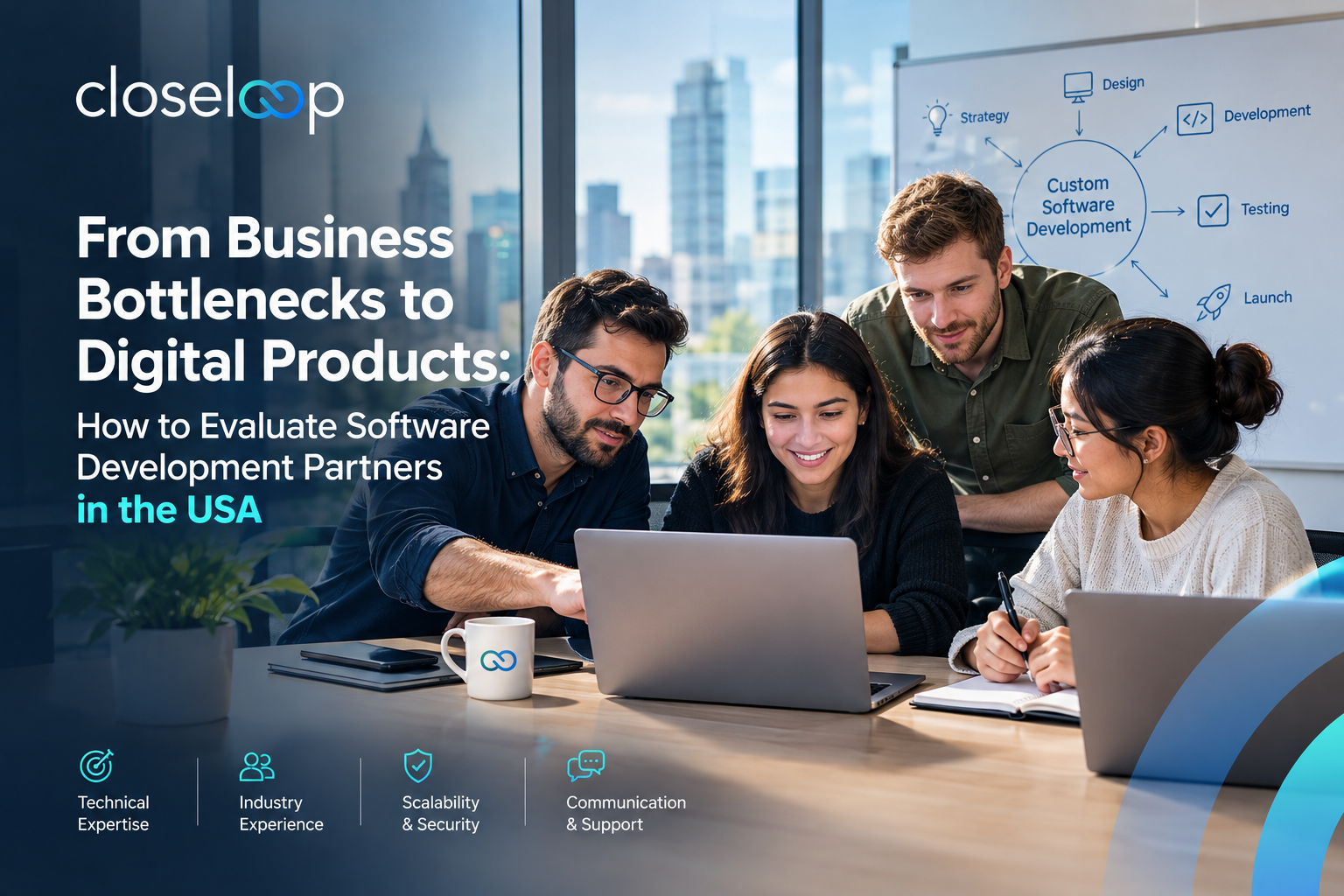
This guide walks through how to move from a business problem to a digital product, and how to evaluate a development partner at each step.
Why Business Bottlenecks Are Often Software Problems in Disguise
Many operational problems are not people problems. They are system problems. Consider these common patterns:
- A logistics company dispatches loads through email and phone calls. Delays grow with every new client because nothing is automated.
- A healthcare clinic network stores patient intake data in separate tools, so staff retype information and make avoidable errors.
- A mid-sized distributor relies on a spreadsheet-based inventory process that breaks whenever two people edit it at once.
In each case, the bottleneck isn't effort. It's the absence of a system built around the workflow. When off-the-shelf tools require too many workarounds, a tailored solution usually costs less over time than the manual labor it replaces.
Step 1: Define the Problem Before You Define the Product
The best partner conversations start with a problem statement, not a feature list. Before contacting vendors, document:
- The bottleneck: What process is slow, error-prone, or expensive?
- The impact: How much time, revenue, or customer satisfaction is at stake?
- The users: Who will use the product daily: employees, customers, or partners?
- The constraints: Budget range, timeline, compliance needs, and existing systems.
A strong development company will challenge your assumptions and refine this brief with you. A weak one will simply quote a price. That difference tells you a lot early on.
Step 2: Understand What Custom Development Actually Covers
Custom software is more than writing code. A capable partner supports the full lifecycle: discovery, UX design, architecture, development, quality assurance, deployment, and ongoing maintenance. Understanding the range of customized software development services helps you judge whether a vendor can truly support you from idea to launch, or only handle one slice of the work.
Ask each shortlisted company how they handle every phase, and who owns it. Gaps in this answer often become gaps in your project later.
Step 3: Evaluate Partners on What Really Matters
Rankings and "best of" lists are a useful starting point, but they should not be your only filter. Whether you are reading a roundup of the top software development companies in USA or asking for referrals, judge every candidate against the same criteria.
Technical Depth and Relevant Experience
Look for case studies in your industry or with a similar level of complexity. A team that has built a multi-tenant SaaS platform will approach your project differently than one that has only built brochure websites. Ask about architecture decisions, scalability, and how they have handled integrations with legacy systems.
Process and Communication
Good partners are transparent about how work happens. Ask whether they follow an agile software development approach, how often you will see working demos, and who your day-to-day contact will be. Regular sprint reviews and clear reporting prevent the "surprise at the end" problem that derails many projects.
Code Quality and Long-Term Maintainability
Cheap, rushed development often creates what engineers call technical debt: shortcuts that save time now but make every future change slower and costlier. Ask how a vendor handles code reviews, automated testing, documentation, and handover. You should own your code and be able to maintain it, with or without your original partner.
Security and Compliance
If your product handles payments, health records, or personal data, security cannot be an afterthought. Ask about secure development practices, data protection, and experience with the regulations relevant to your industry, such as HIPAA or SOC 2.
Scalability Fit for Your Stage
A startup validating an MVP and an enterprise modernizing core systems need very different things. Reading about how custom software development differs for startups and enterprises can help you pinpoint what your own stage demands and which vendors suit it.
Step 4: Check for Modern Capabilities Like AI
Digital products are increasingly expected to be intelligent, not just functional. Customers and employees now expect recommendations, automation, and instant answers inside the tools they use. A forward-looking partner should be able to advise on where AI adds real value and where it doesn't.
For example, a retail business might use generative AI development to produce personalized product descriptions or power a conversational shopping assistant. A finance team might rely on AI integration services to embed document processing and predictive insights into existing platforms without rebuilding everything from scratch.
You don't need AI in every product. But a partner who can discuss it honestly, including its limits, shows the kind of strategic thinking you want on your side.
Also Read: Closeloop vs Traditional Software Development Companies: What's the Difference?
Step 5: Compare Proposals Beyond the Price Tag
When proposals arrive, resist the urge to sort by the lowest number. Instead, compare:
- Scope clarity: Are deliverables, milestones, and assumptions clearly written?
- Team composition: Who exactly will work on your project, and at what seniority?
- Pricing model: Fixed price, time and materials, or a dedicated team, and which suits your level of uncertainty?
- Post-launch support: What happens after go-live? Are maintenance and updates included or separate?
- References: Will they connect you with past clients willing to speak candidly?
The best software development company in USA for your project is not necessarily the biggest or the cheapest. It is the one whose strengths line up with your problem, your timeline, and your working style.
Step 6: Start Small, Then Scale
Even after you've chosen a partner, de-risk the engagement. Begin with a paid discovery phase or a focused pilot that tackles your most painful bottleneck. This gives both sides a chance to test communication, quality, and fit before a larger commitment. If you'd like to compare vendors side by side, this breakdown of top-rated custom software development companies in the USA is a useful reference for building your shortlist.
Red Flags to Watch For
- Vague answers about who will do the actual work
- No questions asked about your business goals
- Unrealistically fast timelines or suspiciously low quotes
- Reluctance to share references or past work
- No clear plan for testing, documentation, or support
Conclusion
Turning a business bottleneck into a successful digital product depends less on the technology itself and more on the partner guiding it. Define your problem clearly, evaluate vendors on depth, process, security, and long-term fit, and validate the relationship with a small pilot before scaling. Done well, this approach saves money, shortens delivery time, and leaves you with software your team actually wants to use. Closeloop works with businesses across industries to design, build, and scale software that solves real operational challenges, from first idea to long-term support.
If you're ready to replace manual workflows with a product built around your business, talk to the Closeloop team and let's map out your first step together.
Author

Swetha GP

VP of Delivery
She is a VP of Delivery at Closeloop. A communicator, business analyst, and engineering aficionado. Besides handling client relations, and engineering duties, she loves to pour her thoughts on paper. She writes about engineering, technologies, frameworks, and everything related to the software domain. She reads, spends time with family, and enjoys a good walk in nature in her free time. Her dream destination is Greece.
Stay abreast of what's trending in the world of technology
When Standard NetSuite Workflows Fall Short: Implementation, Integration, and Customization...
NetSuite is one of the most capable cloud ERP platforms available, but no out-of-the-box...

The Hidden Cost of Disconnected Logistics Systems: A Software Architecture Approach to End-to-End...
A shipment leaves the warehouse on time, yet the customer calls twice asking where it is....
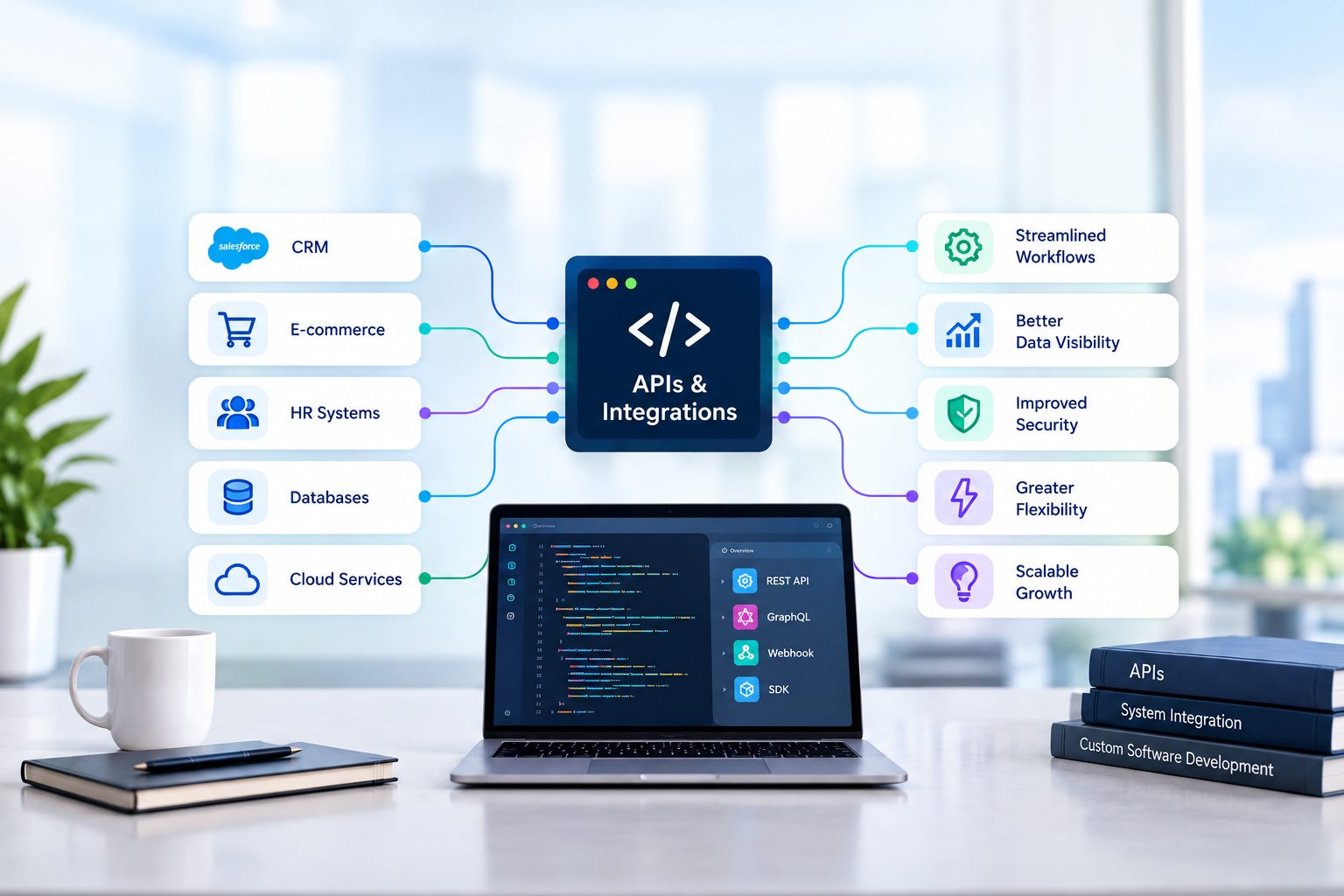
The Role of APIs and Integrations in Modern Custom Software Development
No application works alone anymore. Your CRM talks to your billing tool, your mobile app...
How Software Development Companies Help Businesses Modernize Legacy Systems
Outdated software quietly drains budgets, slows teams down, and blocks growth. Many...