A shipment leaves the warehouse on time, yet the customer calls twice asking where it is. Dispatch sees one status, the warehouse sees another, and finance invoices from a third. This is what disconnected systems cost a logistics business every day, and it rarely shows up as a single line item. Thoughtful logistics and transportation software development replaces this patchwork with a connected architecture, so every team works from the same real-time picture. This article breaks down the hidden costs of fragmentation and the architectural choices that restore end-to-end visibility.
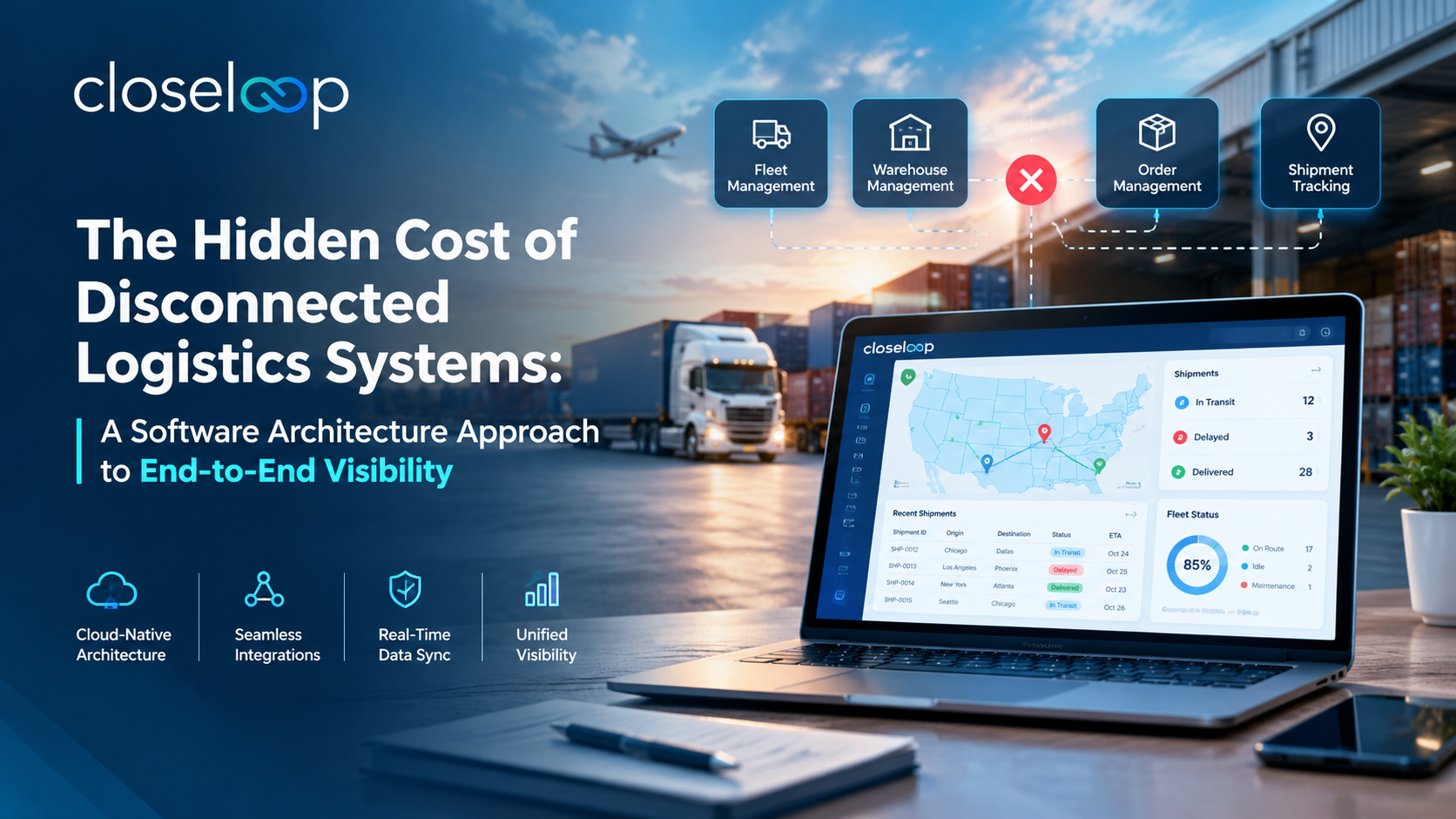
The Hidden Costs of Disconnected Logistics Systems
Most logistics companies did not choose to run disconnected systems. They accumulated them: a TMS bought for dispatch, a separate WMS for the warehouse, spreadsheets for carrier rates, and an accounting tool bolted on later. Each system works on its own, but the gaps between them are where money leaks.
Costs You Can See
- Manual data entry: Staff re-key shipment details across platforms, creating delays and typos.
- Detention and demurrage fees: Late status updates mean missed pickup windows and avoidable penalties.
- Billing disputes: Mismatched proof-of-delivery and invoice data slow payment cycles.
Costs You Don't See
- Slow decisions: Managers wait for reports compiled by hand instead of acting on live data.
- Customer churn: Shippers expect tracking and proactive alerts, and they move to providers who deliver them.
- Employee burnout: Dispatchers spend their days chasing updates rather than solving problems.
- Supply chain fragility: Research on the bullwhip effect shows how small information delays can amplify into large inventory and capacity swings across a supply chain. Disconnected systems create exactly those delays inside your own operation.
Consider a regional freight broker managing 400 loads a week. If each load needs 15 minutes of manual status chasing and rework, that is 100 hours of lost capacity weekly, before counting late fees or lost customers.
Why Visibility Fails: The Architectural Root Causes
Visibility problems are usually architecture problems, not effort problems. Common root causes include:
- Data silos: Each application stores its own version of the customer, shipment, or carrier record.
- Point-to-point integrations: Quick connections between two systems become a tangled web as you add more.
- Batch updates: Data syncs overnight, so decisions are made on yesterday's reality.
- No single source of truth: Teams argue about whose number is correct instead of acting.
Fixing the symptoms, such as another dashboard or another report, rarely helps. The fix is structural.
A Software Architecture Approach to End-to-End Visibility
A connected logistics platform is built in layers, each solving a specific part of the visibility problem.
Layer 1: A Unified Data Foundation
Start with a central data model for shipments, orders, assets, carriers, customers, and locations. Every application reads from and writes to this shared foundation rather than keeping private copies. This is the "single source of truth" that ends reconciliation debates.
Layer 2: API-First Integration
Modern architectures expose each function through well-defined APIs. Carriers, ELD and telematics devices, customer portals, and ERP systems connect through these interfaces instead of fragile custom scripts. An event-driven approach pushes updates the moment something changes, such as a pickup scan, a geofence entry, or a delivery confirmation, rather than waiting for a nightly batch.
Layer 3: Workflow and Process Automation
Once data flows reliably, routine decisions can be automated: assigning loads to carriers by rules, triggering exception alerts, generating documents, and releasing invoices on proof of delivery. Applying business process automation here frees dispatchers and coordinators for work that actually needs human judgment.
Layer 4: Real-Time Visibility and Analytics
On top of the unified, automated foundation sit dashboards, tracking portals, and predictive analytics. Because the data is current and consistent, ETAs become more accurate, exceptions surface early, and leaders can see on-time performance, cost per mile, and carrier reliability without waiting for a monthly report.
Build, Buy, or Blend? Choosing the Right Approach
Off-the-shelf logistics platforms are fast to launch, but they force your processes into their model. Fully custom builds fit perfectly but demand more investment. Many companies land in the middle: adopt proven components where they fit and build custom modules where their process is a competitive advantage, such as proprietary routing rules, specialized freight types, or unique customer SLAs. A tailored build through custom software development makes sense when your workflow is the thing that sets you apart.
When evaluating a logistics software development service, look for:
- Domain understanding: Familiarity with dispatch, warehousing, last-mile delivery, and compliance realities.
- Integration expertise: Proven experience connecting TMS, WMS, ERP, telematics, and carrier APIs.
- Scalability planning: An architecture that handles seasonal peaks without re-engineering.
- Security and compliance: Role-based access, audit trails, and data protection built in from the start.
- Post-launch support: Monitoring, updates, and enhancements as your network grows.
If you are comparing vendors, this list of top logistics software development companies in the USA is a helpful place to begin your shortlist.
Also Read: Build vs Buy Logistics Software: Which Approach Is Right for Your Business?
Connecting the Customer Side of Logistics
Visibility is not only an internal concern. Shippers and consignees want to know where their freight is, and sales teams need context on account health and service history. Linking customer data to operational data lets account managers answer questions without calling dispatch. A well-implemented CRM platform can hold customer interactions, contracts, and service history in one place, while a custom CRM development project can add logistics-specific features such as quote-to-shipment workflows, rate tables, and automated delivery notifications that generic tools lack.
Where AI Fits Into the Picture
Once your data is unified, artificial intelligence becomes practical rather than theoretical. Predictive ETAs, demand forecasting, dynamic route optimization, and anomaly detection all depend on clean, connected data. Without that foundation, AI models simply learn from the same inconsistencies that already hurt your operations. To see what is possible, explore the role of AI in logistics software development, and plan your architecture so these capabilities can be added in stages.
A Phased Roadmap to Get Started
You don't need to replace everything at once. A phased approach reduces risk and shows value early:
- Audit: Map your current systems, data flows, and the points where information gets stuck.
- Prioritize: Pick the one or two gaps that cost the most, such as status updates or billing delays.
- Integrate first: Connect existing systems through APIs before replacing anything.
- Automate: Add rules and workflows around the most repetitive tasks.
- Expand: Add analytics, customer portals, and AI features once the foundation is stable.
Track measurable outcomes at every stage: fewer manual touches per shipment, faster invoice cycles, improved on-time delivery, and lower detention costs. For a broader look at the results companies see, read how logistics software transforms modern supply chains.
Conclusion
Disconnected logistics systems carry a cost that compounds quietly through delays, errors, disputes, and lost customers. The remedy is not another standalone tool but a connected architecture built on unified data, API-driven integration, smart automation, and real-time visibility. Approached in phases, it delivers value quickly without disrupting daily operations.
Closeloop helps logistics and transportation businesses design and build software that connects their operations from first mile to final delivery. If fragmented systems are slowing your team down, talk to our logistics software experts and let's map out a path to end-to-end visibility.
Author

Swetha GP

VP of Delivery
She is a VP of Delivery at Closeloop. A communicator, business analyst, and engineering aficionado. Besides handling client relations, and engineering duties, she loves to pour her thoughts on paper. She writes about engineering, technologies, frameworks, and everything related to the software domain. She reads, spends time with family, and enjoys a good walk in nature in her free time. Her dream destination is Greece.
Stay abreast of what's trending in the world of technology
When Standard NetSuite Workflows Fall Short: Implementation, Integration, and Customization...
NetSuite is one of the most capable cloud ERP platforms available, but no out-of-the-box...

From Business Bottlenecks to Digital Products: How to Evaluate Software Development Partners in the...
Every growing business eventually hits a wall. Spreadsheets multiply, teams re-enter the same...

The Role of APIs and Integrations in Modern Custom Software Development
No application works alone anymore. Your CRM talks to your billing tool, your mobile app...
How Software Development Companies Help Businesses Modernize Legacy Systems
Outdated software quietly drains budgets, slows teams down, and blocks growth. Many...