Artificial intelligence has moved from an experimental add-on to a core requirement in modern supply chains. Companies that once relied on manual planning and static systems are now turning to intelligent, data-driven platforms to stay competitive. This shift is a major reason why Logistics And Transportation Software Development has evolved so quickly in recent years, with AI now sitting at the center of route planning, demand forecasting, warehouse operations, and fraud prevention. Understanding how AI actually fits into these systems helps businesses make smarter technology investments instead of chasing buzzwords.
Why AI Matters in Logistics Today
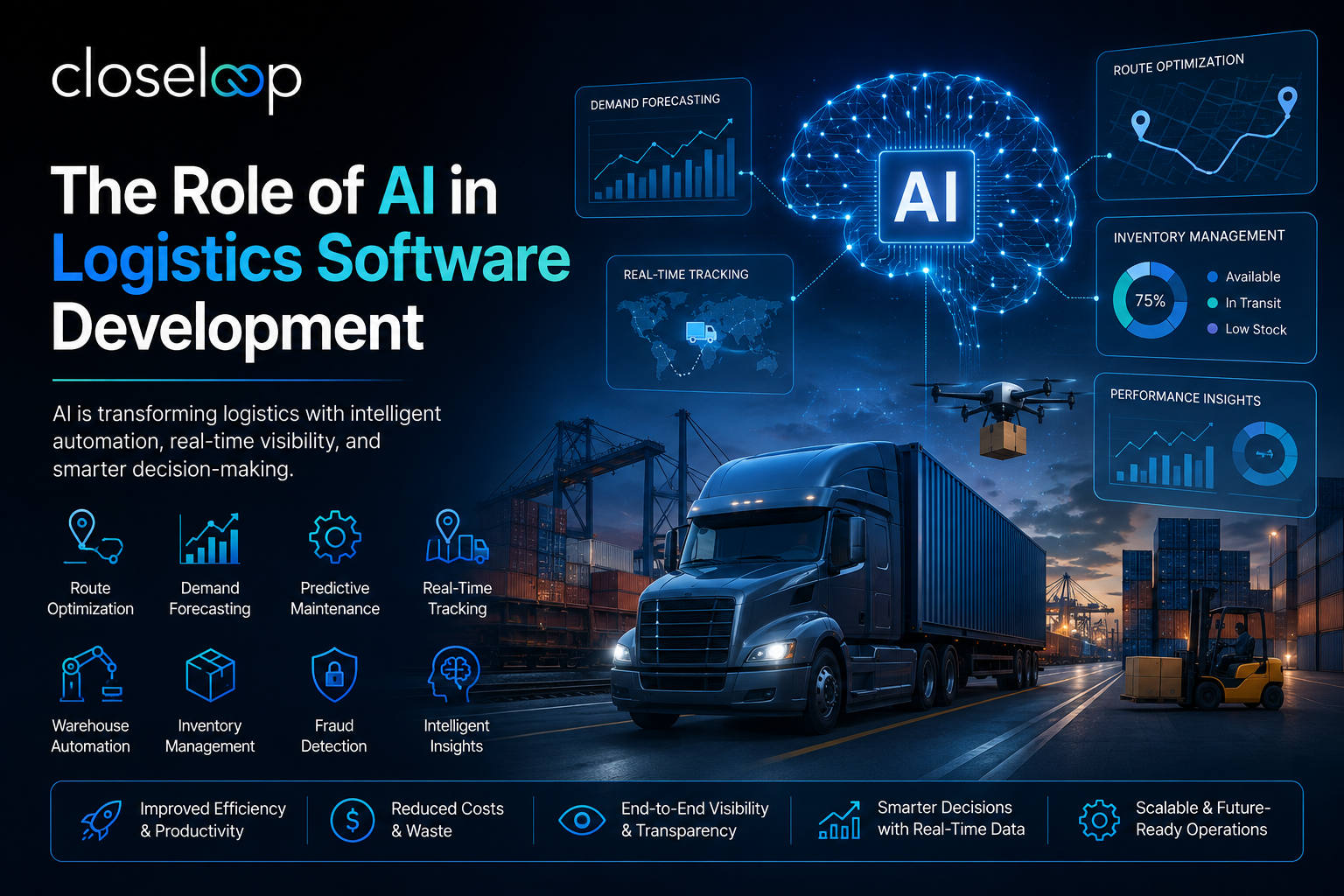
Logistics is a data-heavy industry by nature. Every shipment, vehicle, warehouse, and customer interaction generates information that can be used to improve efficiency, if it is processed correctly. Traditional software can store and display this data, but it cannot learn from it or predict what happens next. AI closes that gap by identifying patterns humans would miss and turning raw data into actionable decisions in real time.
Route Optimization
One of the most visible applications of AI in logistics is route optimization. Machine learning models analyze traffic patterns, weather conditions, delivery windows, vehicle capacity, and historical performance to calculate the most efficient routes for drivers. Unlike static routing tools, AI-based systems adjust in real time when conditions change, rerouting vehicles around accidents or delays before they cause missed delivery windows.
Demand Forecasting
Accurate demand forecasting used to rely heavily on historical averages and manual judgment. AI models now factor in seasonality, market trends, promotional activity, and even external signals like weather or local events to predict demand with far greater precision. This allows businesses to plan inventory, staffing, and transportation capacity well ahead of actual need, reducing both stockouts and excess inventory.
Predictive Maintenance
Vehicle and equipment downtime is one of the costliest disruptions in logistics. AI-powered predictive maintenance uses sensor data from vehicles and warehouse machinery to detect early signs of wear or failure. Instead of following a fixed maintenance schedule, fleet managers can service equipment exactly when it needs attention, reducing unplanned breakdowns and extending asset life.
Real-Time Shipment Tracking
Customers and business partners now expect constant visibility into where their shipments are and when they will arrive. AI enhances real-time tracking by combining GPS data, IoT sensors, and historical delivery patterns to generate more accurate estimated arrival times. When delays occur, AI systems can automatically notify affected parties and suggest alternative plans, which significantly improves customer trust and communication.
Warehouse Automation
Warehouses are increasingly relying on AI-driven robotics and automation systems to handle picking, packing, and sorting tasks. Computer vision allows robots to identify and handle different product types accurately, while machine learning algorithms optimize storage layouts based on order frequency and seasonal demand. The result is faster order fulfillment with fewer errors and lower labor strain.
Also Read: Upright: Building Custom Inventory Management Software for Multi-Warehouse Operations
Inventory Management
AI transforms inventory management from a reactive process into a proactive one. By continuously analyzing sales velocity, supplier lead times, and demand fluctuations, AI systems can recommend optimal reorder points and stock levels automatically. This reduces the manual guesswork that often leads to overstocking or costly stockouts, particularly for businesses managing inventory across multiple warehouses. A deeper look at how these systems fit into broader supply chain strategy is available in how logistics software transforms modern supply chains.
Fraud Detection
Logistics operations are frequent targets for fraud, from fake delivery claims to manipulated invoices and cargo theft. AI-based fraud detection systems analyze transaction patterns and flag anomalies that deviate from normal behavior, often catching issues that would go unnoticed in manual audits. This is especially valuable for businesses handling high shipment volumes across multiple carriers and regions, where manual monitoring simply cannot scale.
Intelligent Decision-Making
Beyond individual use cases, AI's biggest long-term impact on logistics is enabling intelligent decision-making across the entire operation. Instead of relying on isolated dashboards and manual analysis, AI-powered platforms can synthesize data from routing, inventory, maintenance, and customer service into unified recommendations. This allows logistics managers to make faster, more informed decisions rather than reacting to problems after they occur.
Key Benefits of AI in Logistics
The advantages of integrating AI into logistics software are significant and measurable. Businesses typically see improvements in operational efficiency, since AI reduces manual work and automates repetitive decisions. Visibility improves across the supply chain, giving stakeholders accurate, real-time information instead of outdated reports. Scalability becomes easier because AI systems can handle growing data volumes and complexity without a proportional increase in staff. Finally, overall supply chain performance improves as forecasting, routing, and maintenance decisions become more precise and less prone to human error.
Also Read: Grocery Supply Company: Simplifying Route Execution and Inventory Tracking for High-Volume Fleets
Practical Use Cases Across the Industry
Different segments of the logistics industry are applying AI in ways tailored to their specific challenges. Freight carriers use AI for load matching and dynamic pricing based on real-time capacity and demand. Third-party logistics providers use it to optimize multi-client warehouse operations and predict labor needs. E-commerce fulfillment centers rely on AI-driven demand sensing to prepare for seasonal spikes. Even last-mile delivery services use AI to balance speed, cost, and driver availability across dense urban routes.
Challenges of Implementing AI in Logistics
Despite its benefits, AI adoption in logistics comes with real challenges. Data quality is a major hurdle, since AI models are only as good as the data they are trained on, and many logistics companies still struggle with fragmented or inconsistent data across systems. Integration with legacy software can also be difficult, particularly for businesses running older transportation or warehouse management systems that were not built with AI compatibility in mind. According to Wikipedia, artificial intelligence systems require substantial and well-structured data to perform reliably, which underscores why data readiness is often the first obstacle companies must address.
Cost and talent are additional barriers. Building or implementing AI-driven logistics software requires specialized expertise that many in-house teams do not have, which is why partnering with an experienced logistics software development services provider is often the more practical path. There is also the ongoing challenge of change management, since staff need training and confidence in AI-generated recommendations before fully trusting automated systems over manual judgment.
Future Trends in AI-Powered Logistics
Looking ahead, AI in logistics is expected to become even more autonomous and interconnected. Self-optimizing supply chains, where AI systems continuously adjust routing, inventory, and staffing without manual intervention, are becoming increasingly feasible. Autonomous vehicles and drones are likely to play a larger role in last-mile delivery as the underlying AI and sensor technology matures. Digital twins, which are virtual models of physical supply chain operations, are also gaining traction as a way to simulate and test decisions before applying them in the real world. The concept of a digital twin, as described on Wikipedia, involves creating a real-time virtual representation of a physical system, a technique that is increasingly being applied to warehouses and transportation networks.
Choosing the Right Development Partner
Successfully integrating AI into logistics software depends heavily on choosing a development partner who understands both the technology and the operational realities of the industry. Businesses evaluating potential partners often compare specialized providers against traditional software vendors, and resources like Closeloop vs traditional software development companies can help clarify what sets a dedicated logistics technology partner apart. It is equally important to review a provider's track record before committing to a long-term engagement, which is why many businesses look into Closeloop's experience as a trusted logistics software partner before moving forward.
For companies still comparing vendors, a broader market view can also be useful. A resource like this roundup of top logistics software development companies in the USA offers a helpful starting point for evaluating options beyond a single provider.
Conclusion
AI is no longer a futuristic concept in logistics. It is actively reshaping how businesses plan routes, forecast demand, maintain equipment, track shipments, automate warehouses, manage inventory, and detect fraud. Companies that adopt AI-powered logistics software gain a real advantage in efficiency, visibility, and scalability, while those that delay risk falling behind competitors who are already using data to make smarter decisions. As the technology continues to mature, working with an experienced partner becomes even more important for building solutions that are practical, secure, and built to scale. Businesses ready to explore what AI-powered logistics software can do for their operations can start that conversation with Closeloop, whose home page at closeloop.com outlines their broader software development capabilities.
Author

Swetha GP

VP of Delivery
She is a VP of Delivery at Closeloop. A communicator, business analyst, and engineering aficionado. Besides handling client relations, and engineering duties, she loves to pour her thoughts on paper. She writes about engineering, technologies, frameworks, and everything related to the software domain. She reads, spends time with family, and enjoys a good walk in nature in her free time. Her dream destination is Greece.
Stay abreast of what's trending in the world of technology
When Standard NetSuite Workflows Fall Short: Implementation, Integration, and Customization...
NetSuite is one of the most capable cloud ERP platforms available, but no out-of-the-box...

From Business Bottlenecks to Digital Products: How to Evaluate Software Development Partners in the...
Every growing business eventually hits a wall. Spreadsheets multiply, teams re-enter the same...

The Hidden Cost of Disconnected Logistics Systems: A Software Architecture Approach to End-to-End...
A shipment leaves the warehouse on time, yet the customer calls twice asking where it is....
The Role of APIs and Integrations in Modern Custom Software Development
No application works alone anymore. Your CRM talks to your billing tool, your mobile app...