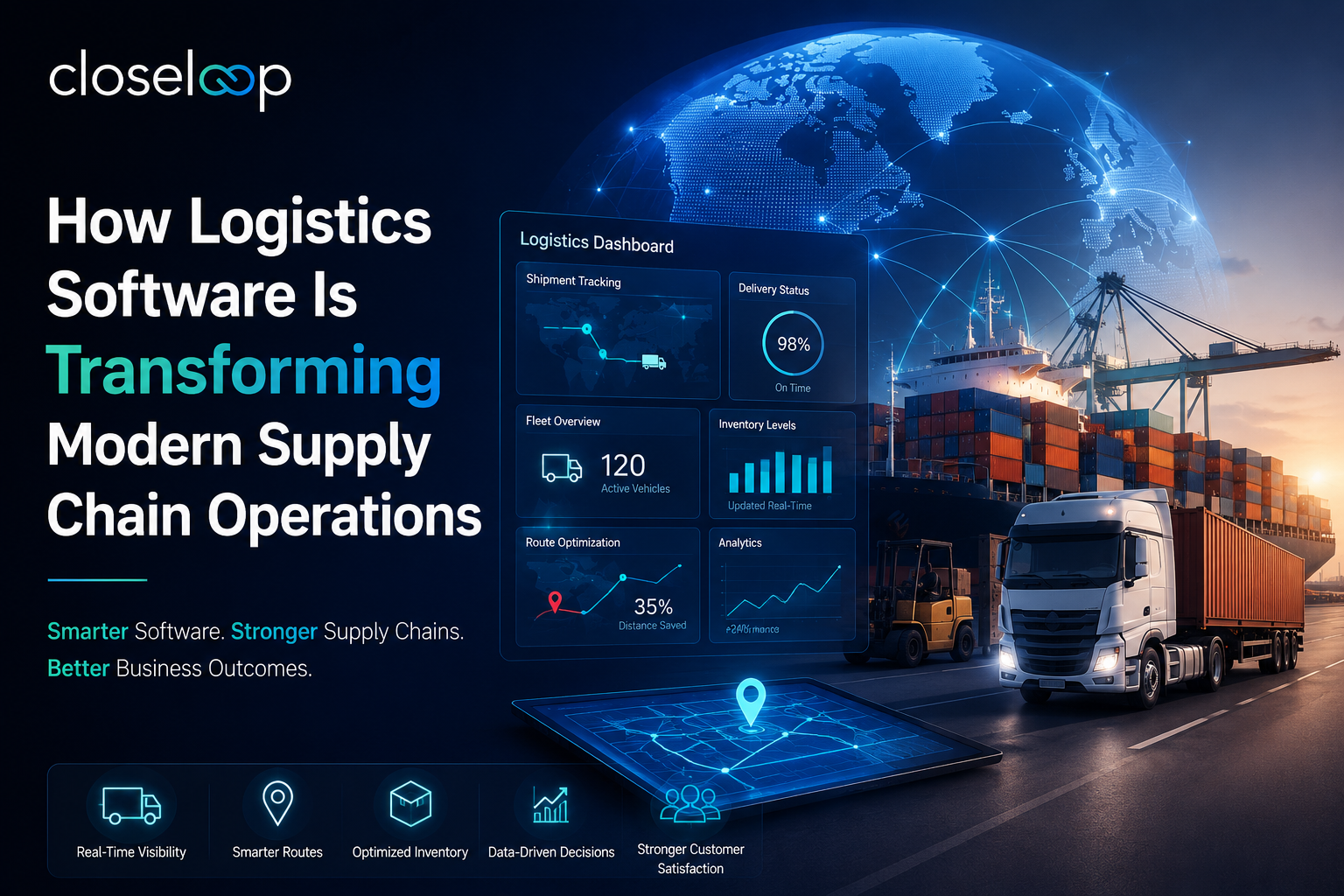
Supply chains today run on data, speed, and precision not spreadsheets and phone calls. Rising customer expectations, volatile fuel costs, labor shortages, and increasingly complex delivery networks have pushed logistics companies to rethink how they operate. The result is a wave of digital transformation powered by a dedicated Logistics Software Development Service that replaces manual, disconnected processes with intelligent, automated systems.
From warehouse floors to last-mile delivery routes, custom-built platforms are giving logistics and transportation companies the visibility, automation, and scalability they need to compete. In this article, we'll break down exactly how logistics software is reshaping supply chain operations, the technologies driving this change, and what to look for in a development partner.
According to a market report by Precedence Research, the global logistics software market is projected to grow from around $17.60 billion in 2026 to nearly $34.68 billion by 2035, expanding at a CAGR of 7.83% underlining just how quickly logistics companies are shifting budget and priority toward digital platforms.
Why Traditional Supply Chain Systems Are Falling Behind
Many logistics companies still rely on legacy systems, siloed spreadsheets, or off-the-shelf tools that were never designed for today's transaction volumes or customer expectations. These outdated setups create real, measurable problems:
- No real-time visibility into shipments, inventory, or fleet status
- Manual data entry that slows down operations and introduces costly errors
- Disconnected systems that can't talk to ERPs, CRMs, or third-party carriers
- Limited scalability, making it difficult to add new warehouses, routes, or partners
- Poor customer experience, driven by delayed updates and slow exception handling
These gaps don't just create friction they directly impact revenue, customer retention, and operational cost. This is exactly why more logistics and transportation businesses are turning to custom-built platforms instead of forcing generic software to fit specialized workflows.
Core Logistics Software Modules at a Glance
| Logistics Software Module | Primary Function | Key Benefit |
|---|---|---|
| Warehouse Management System (WMS) | Real-time inventory tracking and picking optimization | Fewer stock discrepancies, faster fulfillment |
| Transportation Management System (TMS) | Route optimization and fleet scheduling | Lower fuel costs, better delivery times |
| Supply Chain Integration (APIs) | Connects WMS, TMS, ERP, and CRM platforms | Eliminates duplicate data entry |
| Analytics and Business Intelligence | Real-time dashboards and predictive analytics | Faster, data-driven decision making |
| Mobile Applications | Scanning, proof of delivery, route updates | Extends visibility into the field |
| AI and Automation | Demand forecasting and smart dispatching | Reduced manual workload, higher accuracy |
Real-World Results: Logistics Software in Action
The impact of custom logistics software isn't theoretical it shows up directly in day-to-day operations. A wholesale grocery distributor that replaced paper-based delivery logs with a custom proof-of-delivery mobile app eliminated paper records entirely and cut delivery processing time by roughly 60%, while gaining real-time visibility into routes and exceptions.
Also Read: Digitizing Proof of Delivery for Grocery Supply Company
An automotive logistics provider managing multi-yard vehicle operations saw manual data entry drop by 95% after moving to a real-time yard management platform, along with fully accurate service and damage logging and faster dispatch cycles.
A transportation company that had relied on spreadsheets for years moved to a cloud-based, AI-ready logistics platform and saw quoting cycles speed up by roughly 30%, quote-to-cost accuracy improve by about 25%, and planning effort drop by 40%.
These outcomes reflect a consistent pattern: when logistics companies replace manual, disconnected processes with purpose-built software, efficiency gains and cost reductions follow almost immediately, not years down the road.
Technologies Powering Modern Logistics Platforms
The transformation happening across supply chains isn't driven by a single tool it's the result of several technologies working together.
Cloud Computing makes logistics platforms scalable, highly available, and accessible from anywhere, which matters when drivers, warehouse staff, and office teams all need the same real-time data without friction.
Also Read: How Closeloop Built a Centralized, AI-Ready Logistics Platform for D2D Global
IoT and Connected Devices GPS trackers, telematics, RFID tags, and warehouse sensors feed live location and condition data into the system, so fleet and inventory status is always current rather than updated in batches.
Big Data and Analytics turn raw operational data into dashboards, predictive models, and performance reports that help teams see what's actually happening instead of relying on assumptions.
API and Enterprise Integrations connect logistics software with ERPs, CRMs, WMS, TMS, payment gateways, and carrier systems, so information moves automatically instead of getting stuck between disconnected tools.
Automation and Workflow Orchestration handles scheduling, dispatch, invoicing, and notifications in the background, cutting down on the manual clicking and chasing that slows teams down.
Together, these technologies are what separate a modern, AI-ready logistics platform from a basic digital version of the same manual process.
The Role of AI and Automation in Modern Logistics
Artificial intelligence has moved from an experimental technology to a practical necessity in logistics. Businesses that adopt AI-driven automation are able to:
- Forecast demand more accurately using historical and real-time data
- Optimize delivery routes dynamically based on traffic, weather, and fuel costs
- Predict vehicle maintenance needs before breakdowns cause delays
- Automate order processing, dispatching, and billing workflows
- Detect anomalies and exceptions faster than manual monitoring ever could
When combined with cloud computing and IoT-connected devices like GPS trackers and telematics sensors, AI enables logistics companies to build supply chains that are not just faster, but genuinely more resilient capable of adapting to disruptions instead of being derailed by them.
Measurable Benefits of Custom Logistics Software
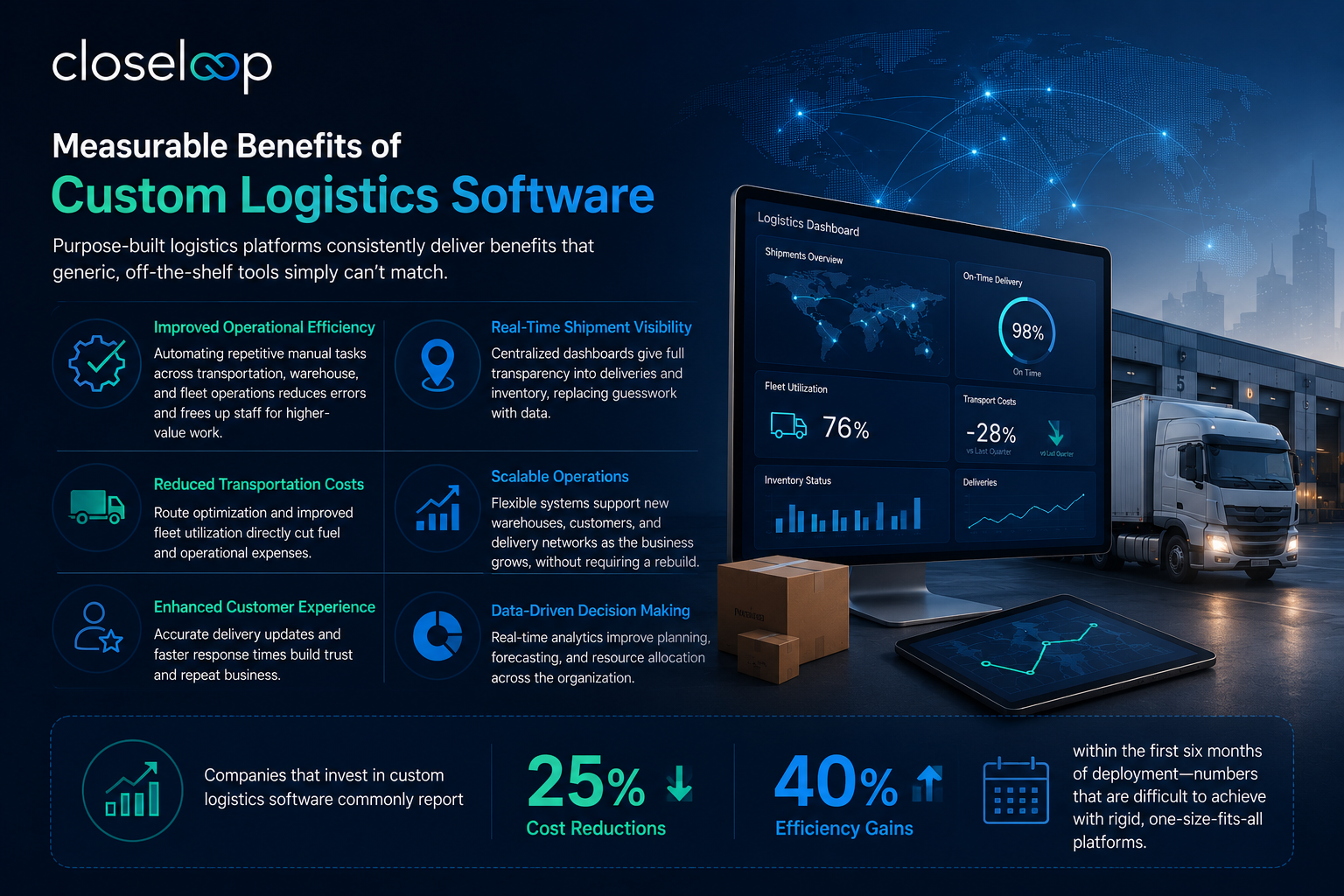
Purpose-built logistics platforms consistently deliver benefits that generic, off-the-shelf tools simply can't match:
Improved Operational Efficiency Automating repetitive manual tasks across transportation, warehouse, and fleet operations reduces errors and frees up staff for higher-value work.
Real-Time Shipment Visibility Centralized dashboards give full transparency into deliveries and inventory, replacing guesswork with data.
Reduced Transportation Costs Route optimization and improved fleet utilization directly cut fuel and operational expenses.
Scalable Operations Flexible systems support new warehouses, customers, and delivery networks as the business grows, without requiring a rebuild.
Enhanced Customer Experience Accurate delivery updates and faster response times build trust and repeat business.
Data-Driven Decision Making Real-time analytics improve planning, forecasting, and resource allocation across the organization.
Companies that invest in custom logistics software commonly report cost reductions of around 25% and efficiency gains of up to 40% within the first six months of deployment numbers that are difficult to achieve with rigid, one-size-fits-all platforms.
Digital Transformation Is Bigger Than Logistics Software Alone
While logistics-specific platforms solve day-to-day operational challenges, they work best as part of a broader modernization strategy. Many logistics companies pair their logistics software investment with a wider digital transformation initiative that modernizes legacy infrastructure across the entire business, not just the supply chain.
Similarly, because logistics platforms rarely operate in isolation, many businesses rely on custom software development to build the surrounding systems customer portals, internal tools, and reporting platforms that connect seamlessly with their core logistics stack.
And because manual, repetitive processes still eat up valuable time even after a WMS or TMS is in place, business process automation is often the missing piece that ties everything together automating invoicing, compliance monitoring, and exception handling across departments.
Choosing the Right Logistics Software Development Partner
Not every software vendor understands the operational nuances of logistics and transportation. The right partner should bring:
- Domain expertise in warehouse operations, fleet management, and supply chain workflows
- Proven integration experience with ERPs like SAP, Oracle, and NetSuite
- A track record of measurable ROI, not just delivered code
- Scalable architecture that supports growth from hundreds to hundreds of thousands of daily transactions
- AI and automation capabilities, not just basic CRUD applications
Also Read: How Closeloop Transformed ACG's Yard Operations With 100% Visibility and 90% Efficiency Gains
If you're researching vendors, it's worth reviewing an independent breakdown of the top logistics software development companies in the USA to compare experience, case studies, and specializations before making a decision. For businesses evaluating providers beyond logistics specifically, this list of top-rated custom software development companies in the USA is also a useful reference point.
What's Next: Future-Proofing Supply Chain Operations
Logistics software isn't a one-time upgrade it's an ongoing capability that needs to evolve as market conditions, customer expectations, and delivery volumes shift. Companies that treat their platforms as flexible, long-term infrastructure tend to handle disruption far better than those still patching legacy systems.
Looking ahead, a few priorities stand out for logistics and transportation businesses:
- Adapting to changing demand with systems flexible enough to absorb shifting shipping volumes and new customer expectations without a full rebuild
- Supporting sustainable growth by scaling to new warehouses, fleets, and markets without operational strain
- Increasing resilience through dependable cloud infrastructure and automated workflows that reduce downtime
- Enabling smarter collaboration between drivers, dispatchers, warehouse teams, and customers on one connected platform
- Accelerating digital transformation by moving away from disconnected legacy tools toward integrated, AI-ready systems
Businesses that get ahead of these priorities now will be far better positioned to handle the next wave of supply chain disruption, whatever form it takes.
Conclusion
Logistics software is no longer a nice-to-have it's the operational backbone of any supply chain that wants to remain competitive. From warehouse automation and route optimization to AI-driven forecasting and real-time analytics, the businesses winning today are the ones treating software as core infrastructure, not an afterthought.
Closeloop has spent more than 15 years building logistics and transportation software for companies ranging from growing startups to Fortune 500 enterprises, delivering measurable results across warehouse management, fleet operations, and supply chain integration. If your current systems are holding your operations back, a Logistics Software Development Service built around your specific workflows can be the difference between reacting to disruptions and staying ahead of them.
Author

Swetha GP

VP of Delivery
She is a VP of Delivery at Closeloop. A communicator, business analyst, and engineering aficionado. Besides handling client relations, and engineering duties, she loves to pour her thoughts on paper. She writes about engineering, technologies, frameworks, and everything related to the software domain. She reads, spends time with family, and enjoys a good walk in nature in her free time. Her dream destination is Greece.
Frequently Asked Questions
Ready to modernize your logistics operations with custom software? Connect with our experts to discuss your requirements. For any queries, reach out to sales@closeloop.com
Stay abreast of what's trending in the world of technology
When Standard NetSuite Workflows Fall Short: Implementation, Integration, and Customization...
NetSuite is one of the most capable cloud ERP platforms available, but no out-of-the-box...

From Business Bottlenecks to Digital Products: How to Evaluate Software Development Partners in the...
Every growing business eventually hits a wall. Spreadsheets multiply, teams re-enter the same...

The Hidden Cost of Disconnected Logistics Systems: A Software Architecture Approach to End-to-End...
A shipment leaves the warehouse on time, yet the customer calls twice asking where it is....
The Role of APIs and Integrations in Modern Custom Software Development
No application works alone anymore. Your CRM talks to your billing tool, your mobile app...