Every logistics and transportation company eventually reaches the same fork in the road: keep patching together spreadsheets and generic tools, or invest in real software to run the business. Once that decision is made, a second question follows immediately should you build a custom solution or buy an off-the-shelf platform? The answer shapes everything from your budget to your long-term competitiveness, which is why Logistics And Transportation Software Development has become such a critical conversation for fleet operators, freight forwarders, warehouse managers, and third-party logistics (3PL) providers alike. Companies like Closeloop work with logistics businesses on both sides of this decision, and this guide breaks down exactly what to consider before you commit.
What "Build vs Buy" Really Means in Logistics
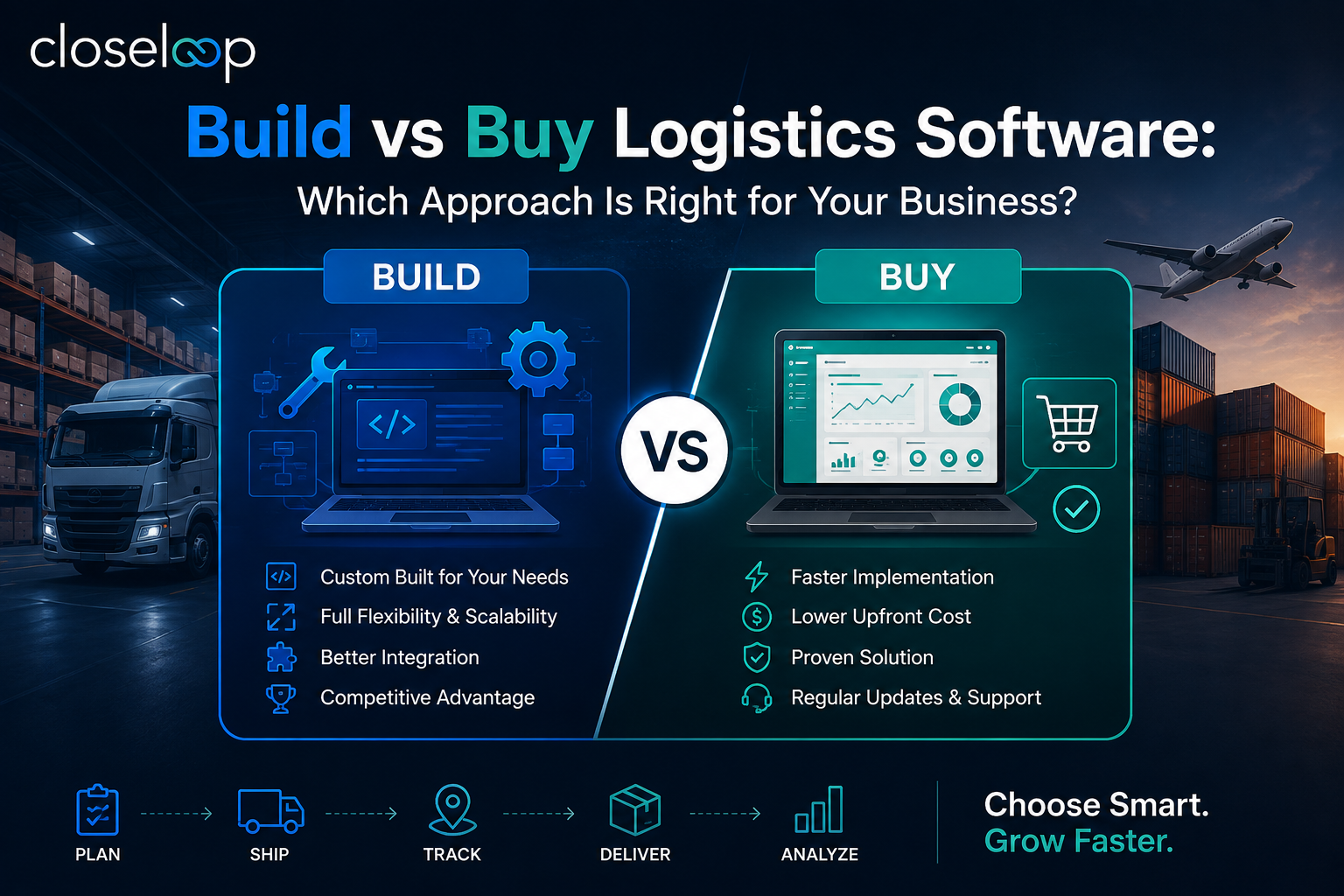
"Build" means developing custom logistics software tailored to your specific operations: a transportation management system (TMS), warehouse management system (WMS), route optimization engine, or freight visibility platform built from the ground up around your workflows.
"Buy" means licensing or subscribing to an existing commercial solution, a SaaS product built by a vendor and sold to many companies with similar needs, often configurable but not fundamentally customizable.
Neither option is universally "better." The right choice depends on your company's size, growth trajectory, operational complexity, budget, and how much your workflows differ from the industry norm.
Advantages of Building Custom Logistics Software
Full alignment with your operations. Custom software is designed around your exact processes your routing rules, your compliance requirements, your customer-facing portals instead of forcing your business to adapt to someone else's product logic.
Competitive differentiation. If your logistics operation has a unique value proposition (specialized cold-chain handling, unusual delivery windows, complex multi-modal freight), custom software can encode that advantage directly into your systems rather than working around a generic tool.
Ownership and control. You own the codebase, the data architecture, and the product roadmap. You are not dependent on a vendor's release schedule or subject to sudden pricing changes or feature deprecations.
Deep integration capability. Custom-built systems can be architected from day one to integrate cleanly with your ERP, accounting software, IoT sensors, telematics, and EDI partners, rather than relying on whatever connectors a vendor happens to support.
Limitations of the Build Approach
Building custom software isn't free of trade-offs:
- Higher upfront investment. Custom development requires a meaningful budget for discovery, design, development, and testing before you see a return.
- Longer time to launch. Where a SaaS product can be deployed in days, a custom TMS or WMS typically takes months to reach production readiness.
- Ongoing technical ownership. You are responsible for maintenance, bug fixes, security patching, and infrastructure either in-house or through a development partner.
- Requires the right expertise. Success depends heavily on choosing an experienced logistics software development services provider that understands both the technology and the domain-specific challenges of freight, fleet, and warehouse operations.
Also Read: Grocery Supply Company: Simplifying Route Execution and Inventory Tracking for High-Volume Fleets
Advantages of Buying Off-the-Shelf Logistics Software
Speed to value. Most SaaS logistics platforms can be configured and live within weeks, which matters when operational pain is already costing you money.
Lower initial cost. Subscription pricing spreads cost over time and avoids a large capital outlay, making it more accessible for smaller operators.
Vendor-managed maintenance. Updates, security patches, and infrastructure scaling are handled by the vendor, reducing the burden on your internal team.
Proven, tested functionality. Established platforms have already been refined across many customers, which can mean fewer bugs and a more predictable user experience out of the box.
Limitations of the Buy Approach
- Limited customization. Configuration only goes so far; if your workflow doesn't match the vendor's assumptions, you either compromise your process or pay for expensive workarounds.
- Integration constraints. You're limited to the APIs and connectors the vendor has chosen to build, which can create friction with legacy systems or specialized hardware.
- Recurring costs that scale with usage. Per-seat or per-shipment pricing can become expensive as your operation grows.
- Vendor lock-in. Migrating away from a mature SaaS platform later can be disruptive and costly, especially once your data and workflows are deeply embedded in it.
For a deeper look at how commercial platforms fit into a broader digital strategy, Closeloop's overview of how logistics software transforms modern supply chains is a useful next read.
Comparing the Two Approaches Across Key Factors
Scalability
Off-the-shelf platforms scale well for standard growth more users, more shipments, more locations as long as your processes stay within the vendor's supported model. Custom software, when architected properly, can scale in ways that are specific to your business, such as supporting entirely new service lines or geographies without waiting on a vendor's roadmap. According to Wikipedia, scalability in software systems refers to a system's capacity to handle a growing amount of work by adding resources, a principle that applies differently depending on whether you control the underlying architecture.
Customization
This is where the two approaches diverge most sharply. Buy-side solutions offer configuration (toggling features, setting rules within predefined limits), while build-side solutions offer true customization (rebuilding logic to match how your business actually operates). Businesses with highly standardized operations rarely need the latter; businesses with unique service models often can't function well without it.
Integration
Custom systems can be designed for integration from the start, connecting to telematics, IoT devices, EDI networks, and third-party APIs on your terms. Off-the-shelf tools depend on the vendor's existing integration marketplace, which may or may not cover your specific tech stack.
Security
Both approaches can be secure, but the responsibility differs. With a bought solution, security is largely the vendor's responsibility, governed by their infrastructure and compliance certifications. With custom software, security is your responsibility (or your development partner's), which offers more control but also more accountability. Given how much sensitive data flows through logistics systems shipment details, customer information, financial transactions this is a factor that deserves serious diligence regardless of which path you choose. For general context on secure software practices, Wikipedia's entry on software security outlines the foundational principles that apply to both custom and commercial systems.
Maintenance
SaaS platforms bundle maintenance into the subscription patches, upgrades, and uptime are the vendor's job. Custom software requires an ongoing maintenance plan, whether through an internal team or a long-term relationship with a development partner who understands the system's architecture.
Business Requirements
Ultimately, this is the deciding factor. A company with standard, well-understood logistics processes (basic parcel tracking, simple route planning) rarely benefits from the cost and complexity of custom development. A company with specialized, differentiated, or rapidly evolving operations often finds that off-the-shelf tools become a ceiling on growth rather than an accelerator.
Which Approach Fits Your Type of Business?
Small and mid-sized carriers or brokers with standard operational needs are usually better served by buying an established platform the cost and speed advantages outweigh the loss of customization.
Growing 3PLs and freight forwarders with multiple client-specific workflows often reach a tipping point where configuration limits start hurting service quality, making custom or hybrid solutions worth exploring.
Enterprise fleet operators and large-scale supply chain businesses with complex, high-volume, multi-modal operations typically benefit most from custom-built systems, since the long-term efficiency gains and competitive differentiation justify the investment.
Niche logistics operators cold chain, hazardous materials, last-mile in dense urban areas frequently find that no off-the-shelf product fully fits their compliance and operational requirements, making custom development the more practical long-term choice.
If you're still weighing how a development partner's approach compares to conventional software vendors, it's worth reading Closeloop vs traditional software development companies for a side-by-side look at what a specialized partner brings to the table versus a generic outsourcing shop.
The Role of a Development Partner in the Decision
Whichever direction you lean, the quality of execution matters as much as the strategic choice itself. Poorly built custom software can be worse than a mediocre SaaS tool, and a poorly configured off-the-shelf platform can fail to deliver its promised value. This is why many logistics businesses work with experienced logistics software development services providers not just to write code, but to help evaluate requirements, recommend the right architecture, and in some cases build hybrid solutions that combine a commercial core with custom modules where it matters most.
Choosing the right technology partner is often as important as the build-vs-buy decision itself. Businesses evaluating who to work with may find it helpful to review Closeloop's track record as a trusted logistics software partner and compare it against other options profiled in this roundup of top logistics software development companies in the USA.
Conclusion
There's no universal right answer to build vs buy only the right answer for your specific business. If your operations are standard, your budget is limited, and speed matters most, buying an off-the-shelf logistics platform is usually the smarter move. If your operations are complex, your competitive edge depends on unique workflows, and you're planning for long-term scale, investing in custom-built software will likely serve you better over time.
The most important step is an honest assessment of your current and future operational requirements, followed by a conversation with a logistics-focused development partner who can help you weigh the trade-offs objectively rather than defaulting to whichever option is easier to start with today. Whether you decide to build, buy, or land somewhere in between, teaming up with a partner like Closeloop ensures the decision is backed by real technical and industry expertise, not guesswork.
Author

Swetha GP

VP of Delivery
She is a VP of Delivery at Closeloop. A communicator, business analyst, and engineering aficionado. Besides handling client relations, and engineering duties, she loves to pour her thoughts on paper. She writes about engineering, technologies, frameworks, and everything related to the software domain. She reads, spends time with family, and enjoys a good walk in nature in her free time. Her dream destination is Greece.
Stay abreast of what's trending in the world of technology
When Standard NetSuite Workflows Fall Short: Implementation, Integration, and Customization...
NetSuite is one of the most capable cloud ERP platforms available, but no out-of-the-box...

From Business Bottlenecks to Digital Products: How to Evaluate Software Development Partners in the...
Every growing business eventually hits a wall. Spreadsheets multiply, teams re-enter the same...

The Hidden Cost of Disconnected Logistics Systems: A Software Architecture Approach to End-to-End...
A shipment leaves the warehouse on time, yet the customer calls twice asking where it is....
The Role of APIs and Integrations in Modern Custom Software Development
No application works alone anymore. Your CRM talks to your billing tool, your mobile app...