Choosing the right partner for NetSuite Implementation Services can make the difference between a smooth digital transformation and months of costly rework. Whether you are moving off spreadsheets, replacing legacy ERP software, or scaling into new markets, NetSuite Integration Services help unify finance, inventory, CRM, and operations into a single source of truth. This guide breaks down what implementation really involves, what to expect at each stage, and how to avoid the mistakes that derail most rollouts.
What Are NetSuite Implementation Services?
NetSuite implementation is the structured process of configuring, customizing, and deploying NetSuite's cloud ERP platform to match a company's unique workflows. It goes far beyond simply turning on software.
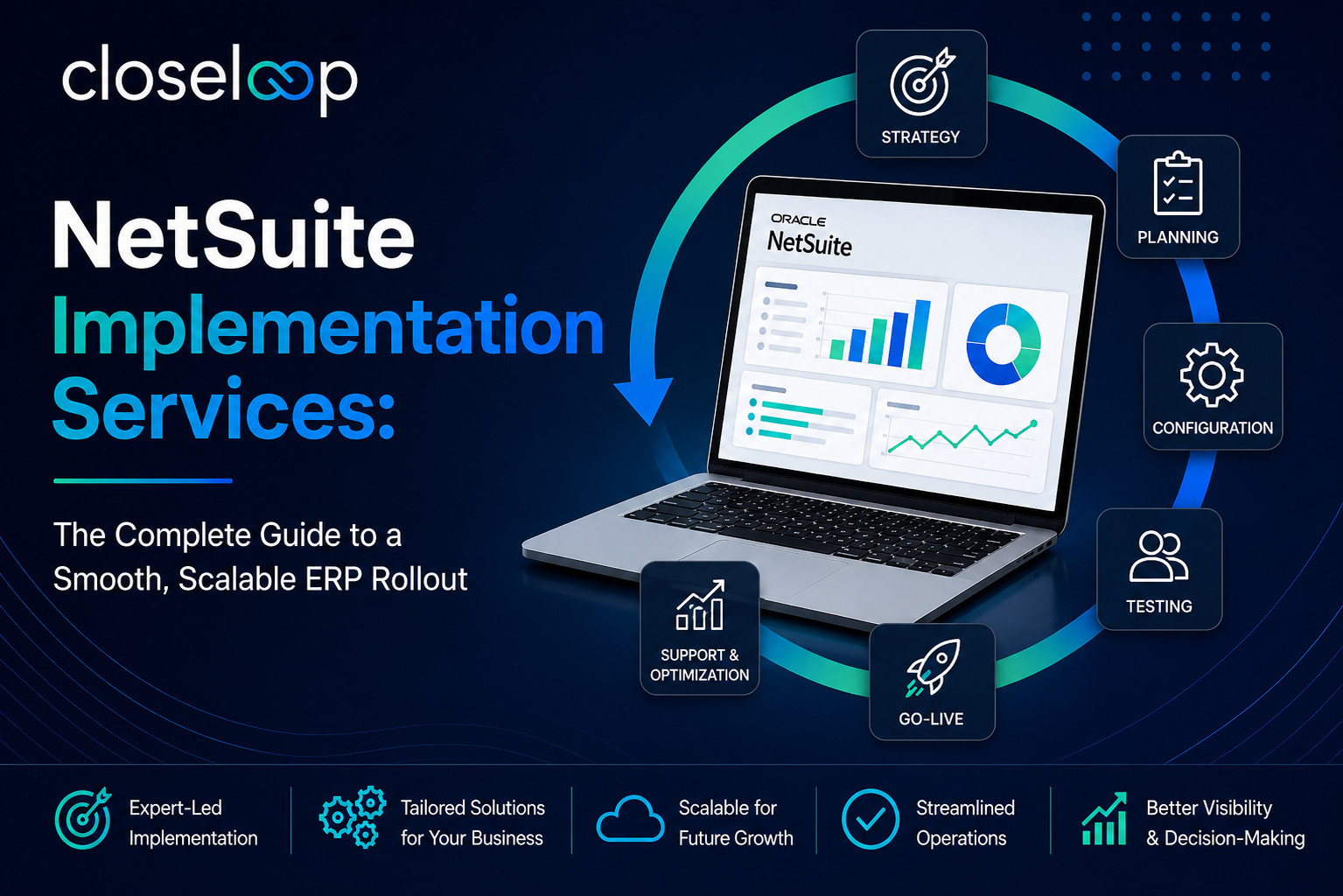
A proper implementation includes requirement gathering, system design, data migration, integrations, user training, and post-launch support. Skipping any of these steps usually leads to adoption problems later.
Why Businesses Are Moving to NetSuite
Companies outgrow entry-level accounting tools or disconnected systems faster than they expect. NetSuite consolidates financials, inventory, order management, and reporting into one cloud platform, which reduces manual work and improves visibility across departments.
For growing businesses already using tools like CRM or e-commerce platforms, NetSuite's flexibility is a major draw. It's built to scale alongside multi-entity, multi-currency, and multi-subsidiary operations.
Many finance leaders also cite the shift from reactive to proactive decision-making as a key reason for switching. When financial data lives in disconnected spreadsheets or outdated systems, leadership is often reacting to problems after they've already affected the business. A properly configured ERP changes that dynamic by surfacing issues in real time, before they compound.
There's also a talent and process angle worth mentioning. Manual, spreadsheet-driven finance operations tend to depend heavily on a handful of people who know the workarounds. That creates risk when key employees leave or take time off. A well-implemented system documents processes into the platform itself, making operations less dependent on institutional memory.
Also Read: How Closeloop Delivered a Seamless NetSuite Integration for BioStem Technologies - Scalable ERP for a Growing Healthcare Organization
The Role of NetSuite Integration Services in Connected Operations
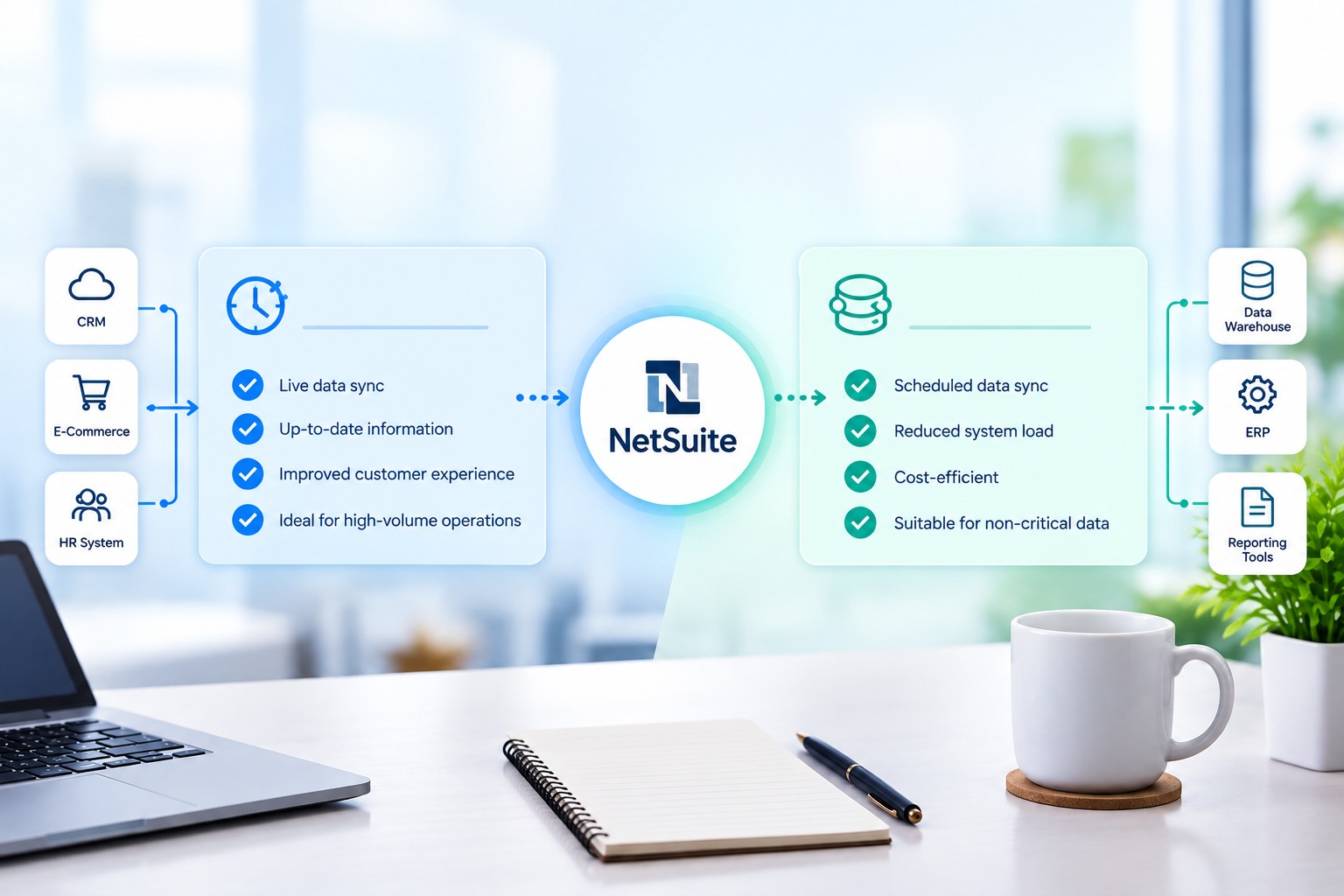
Most businesses don't run on NetSuite alone. Sales teams rely on CRM platforms, marketing runs on automation tools, and e-commerce stores need real-time inventory sync. This is where NetSuite Integration Services become critical.
Integration ensures data flows automatically between NetSuite and the other systems your teams already use, eliminating duplicate data entry and reducing costly errors.
Common Systems Businesses Integrate with NetSuite
Some of the most frequent integration requests include:
- CRM platforms for unified customer and sales data
- E-commerce platforms for real-time order and inventory sync
- Marketing automation tools for lead-to-cash visibility
- Third-party logistics and shipping software
If your sales team runs on a CRM, connecting it properly to NetSuite closes the gap between sales and finance. Businesses evaluating this often start by reviewing dedicated CRM services to understand how customer data should flow into their ERP.
Companies using platforms like HubSpot or Salesforce frequently need these systems synced with NetSuite for accurate revenue reporting. Specialized HubSpot implementation and Salesforce implementation support can simplify this connection considerably.
For businesses running on highly specific workflows, a custom CRM development approach may integrate more cleanly with NetSuite than an off-the-shelf tool.
Custom NetSuite Development: When Standard Configuration Isn't Enough
Out-of-the-box NetSuite works well for many businesses, but industry-specific processes often require deeper adjustments. Custom NetSuite Development allows teams to build workflows, scripts, and modules that match exactly how the business operates.
This might include custom approval workflows, specialized reporting dashboards, or automation scripts (SuiteScript) that handle unique business logic NetSuite doesn't support natively.
Signs You May Need Custom Development
A business likely needs custom development if:
- Standard NetSuite modules don't match core operational workflows
- Reporting requirements go beyond built-in dashboards
- Manual workarounds are still required after go-live
- Industry-specific compliance needs aren't covered by default settings
Retail and manufacturing businesses, for example, often need custom logic for order routing or production tracking. E-commerce businesses running on platforms like Adobe Commerce frequently require custom sync logic between product catalogs and NetSuite inventory, which is where Adobe Commerce services intersect with ERP customization.
Custom development also plays a role in reporting. Standard dashboards work for general visibility, but finance and operations teams frequently need saved searches, custom KPIs, or role-based dashboards built around how their specific business measures performance. Investing in this early tends to reduce the volume of manual reporting requests later, since the data is already structured the way stakeholders need it.
It's worth noting that custom development should be approached carefully. Over-customizing a system can make future upgrades harder and increase long-term maintenance costs. A good implementation partner will typically recommend standard configuration wherever possible and reserve custom development for genuine gaps rather than every minor preference.
NetSuite Data Migration: Getting the Foundation Right
NetSuite Data Migration is one of the most underestimated parts of any implementation. Moving historical financial records, customer data, and inventory history incorrectly can create reporting errors that persist for years.
A structured migration plan typically includes data auditing, cleansing, mapping, test migrations, and validation before final go-live.
Best Practices for a Clean Data Migration
- Audit existing data for duplicates and inconsistencies before migration
- Map legacy fields to NetSuite fields carefully, not just by best guess
- Run test migrations in a sandbox environment first
- Validate totals and reconciliations before the final cutover
- Keep a rollback plan in case issues surface post-migration
Rushed data migration is one of the top reasons ERP projects experience delays. Taking extra time here saves far more time later in troubleshooting.
It also helps to think of migration in phases rather than a single event. A common approach is to migrate a limited data set first, validate it thoroughly, then move on to the full historical record once the process is proven. This reduces the risk of discovering a mapping error only after all the data has already been moved.
Teams should also decide early how far back historical data needs to go. Migrating years of legacy transaction history "just in case" often adds unnecessary complexity. In many cases, archiving older records separately while migrating only what's operationally necessary keeps the new system cleaner and easier to maintain.
Also Read: How Closeloop Streamlined NetSuite Implementation for Cordance's Multi-Entity Operations
Key Benefits of Professional NetSuite Implementation
When implementation is handled properly, businesses typically see:
Improved financial visibility through real-time dashboards and consolidated reporting across entities.
Reduced manual work as data flows automatically between connected systems instead of requiring repeated entry.
Better scalability since NetSuite is built to support growth into new subsidiaries, currencies, and business units.
Stronger compliance through automated tax, revenue recognition, and audit-ready reporting.
Faster decision-making because leadership gets accurate, up-to-date data instead of static, delayed reports.
Also Read: How Closeloop Transformed Financial Systems for LastPass Improving Accuracy, Visibility, and Reporting at Scale.
How NetSuite Implementation Fits into Broader Digital Transformation
ERP implementation rarely happens in isolation. It's usually one piece of a larger digital transformation strategy that includes CRM modernization, e-commerce upgrades, and system-wide automation.
Businesses evaluating their overall technology stack often benefit from understanding how ERP fits alongside other systems. For a broader view of how companies approach this shift, this guide on digital transformation service providers offers useful context.
Similarly, industries with complex supply chains such as logistics depend heavily on connected ERP and operations software. Companies in this space may find it helpful to review logistics software development companies for related insights.
Also Read: How Connected ERP and Operations Software Drives Supply Chain Efficiency.
The NetSuite Implementation Process: Step by Step
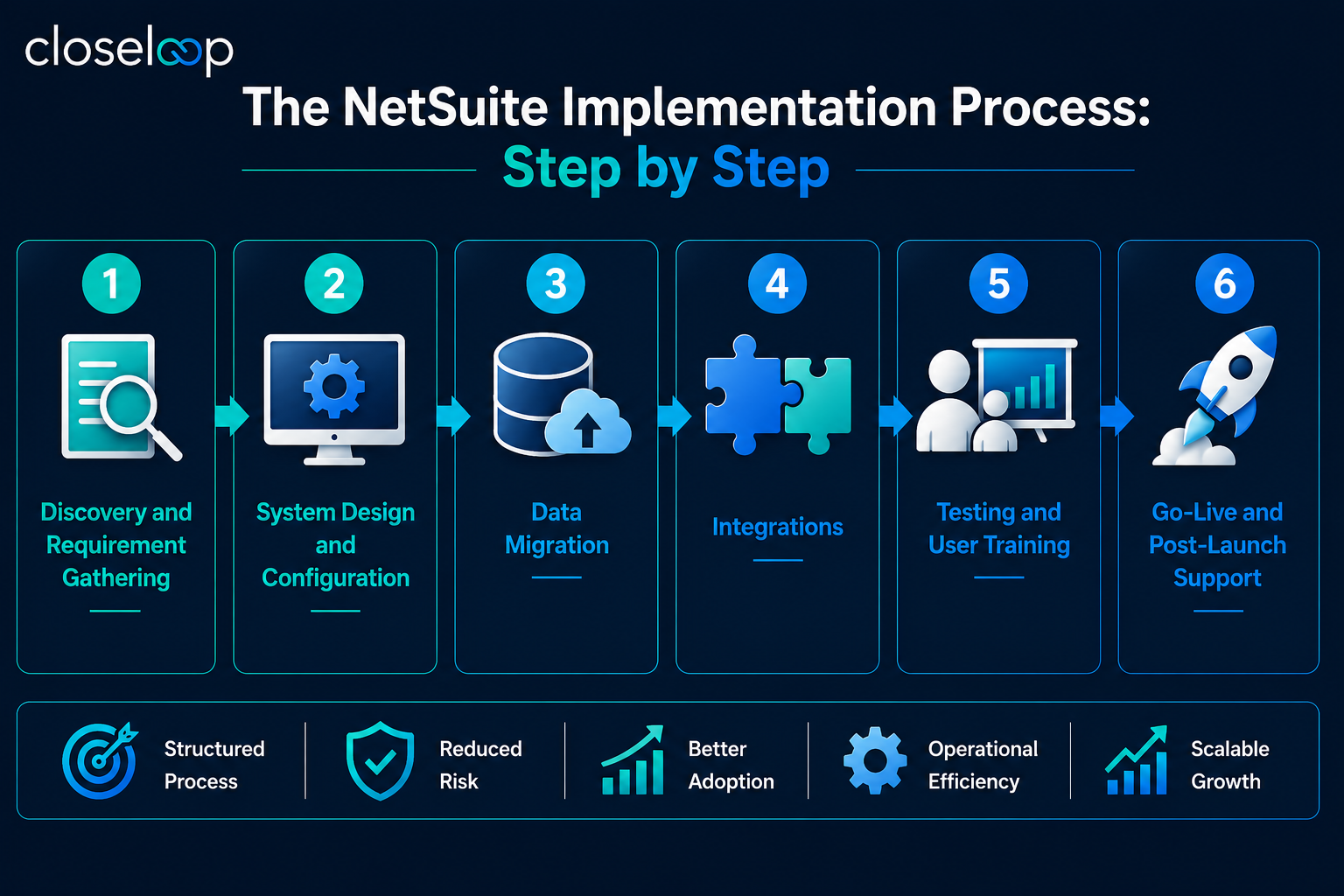
A dependable implementation generally follows these phases:
1. Discovery and Requirement Gathering
The implementation partner reviews current workflows, pain points, and business goals to define project scope clearly.
2. System Design and Configuration
NetSuite modules are configured to match approved workflows, including roles, permissions, and reporting structures.
3. Data Migration
Historical data is cleaned, mapped, tested, and migrated following the best practices outlined earlier.
4. Integrations
Connections to CRM, e-commerce, or other third-party tools are built and tested, often through a broader system integration approach that ensures all business tools communicate reliably.
5. Testing and User Training
End users test workflows in a sandbox environment while the team receives structured training before go-live.
6. Go-Live and Post-Launch Support
After launch, ongoing support addresses issues quickly and fine-tunes workflows based on real usage.
NetSuite vs. Traditional ERP Systems
Many businesses evaluating NetSuite are comparing it against older, on-premise ERP systems. Traditional ERP often requires heavy infrastructure investment and slower update cycles.
For companies weighing broader ERP options beyond NetSuite, it's worth reviewing general ERP services to compare deployment models, costs, and long-term scalability before committing.
Common Mistakes to Avoid During NetSuite Implementation
Even experienced teams run into avoidable issues. The most common include:
- Underestimating the time needed for data cleansing
- Skipping user training, leading to poor adoption
- Choosing a partner without relevant industry experience
- Failing to plan integrations early in the project
- Treating go-live as the finish line instead of an ongoing process
Avoiding these pitfalls comes down to planning realistically and working with a team that has handled similar implementations before.
Another mistake worth calling out separately is scope creep during the project. It's common for stakeholders to request "just one more" customization mid-implementation, which can push timelines and budgets significantly. Locking scope after the design phase, and handling new requests as a phase two project, keeps the initial rollout on track.
Choosing the Right NetSuite Implementation Partner
Not every implementation partner has the same depth of experience. Businesses should look for a provider with:
- A proven track record across similar industries
- Transparent project timelines and communication
- In-house expertise in both NetSuite configuration and custom development
- Experience handling complex data migrations
- Post-launch support, not just go-live assistance
Companies exploring vendors more broadly may also find it useful to review best custom software development companies as part of their vendor evaluation process, especially when custom development is a likely requirement.
For businesses that also manage mobile-first operations alongside ERP, this custom mobile app development guide offers additional planning context.
Conclusion
A successful NetSuite rollout depends less on the software itself and more on how well implementation, integration, customization, and migration are planned and executed. Businesses that invest in the right strategy upfront avoid the rework and adoption issues that derail so many ERP projects.
If your business is evaluating NetSuite Implementation Services, working with a team that understands both the technical configuration and the broader business context makes the transition considerably smoother. Closeloop has helped growing businesses plan, migrate, and integrate NetSuite in a way that fits how they actually operate, not just how the software is designed by default.
Author

Swetha GP

VP of Delivery
She is a VP of Delivery at Closeloop. A communicator, business analyst, and engineering aficionado. Besides handling client relations, and engineering duties, she loves to pour her thoughts on paper. She writes about engineering, technologies, frameworks, and everything related to the software domain. She reads, spends time with family, and enjoys a good walk in nature in her free time. Her dream destination is Greece.
Frequently Asked Questions
Ready to transform your business with custom software solutions? Connect with our experts to discuss your requirements and explore the best approach for your organization. For any queries, reach out to sales@closeloop.com
Stay abreast of what's trending in the world of technology
The Role of APIs and Integrations in Modern Custom Software Development
No application works alone anymore. Your CRM talks to your billing tool, your mobile app...
How Software Development Companies Help Businesses Modernize Legacy Systems
Outdated software quietly drains budgets, slows teams down, and blocks growth. Many...
Real-Time vs. Batch NetSuite Integration: Which Architecture Fits Your Workflow?
Every NetSuite project eventually hits the same question: should data move the instant...
Custom Software Development for Startups vs. Enterprises: Key Differences
Building software for a startup is very different from building it for a large enterprise....