Businesses increasingly depend on digital systems to manage applications, store information, support employees, and deliver services to customers. However, traditional IT infrastructure can become difficult to maintain as data volumes increase, applications become more complex, and organizations expand across locations.
Cloud technology provides an alternative by allowing businesses to run applications and manage infrastructure through cloud platforms. However, moving existing workloads requires careful planning, technical assessment, and ongoing management. Cloud Migration Services help organizations transition applications, databases, and workloads from existing environments to suitable cloud infrastructure.
What Are Cloud Migration Services?
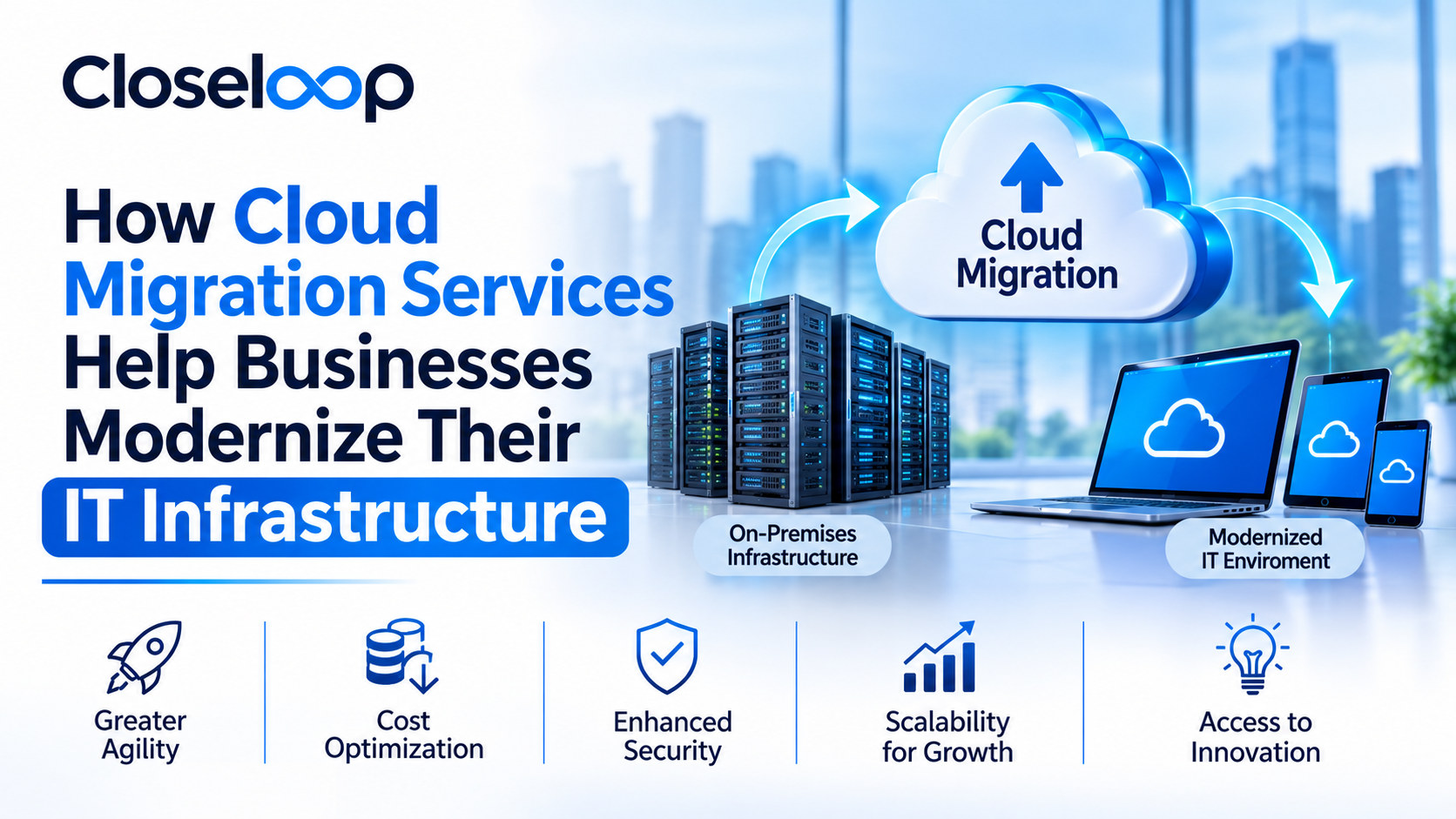
Cloud migration services involve planning and moving an organization's applications, data, databases, and IT workloads from on-premises infrastructure or another hosting environment to a cloud platform.
The migration may involve moving complete applications, transferring databases, modernizing existing systems, or adopting a hybrid cloud architecture.
A successful migration considers application dependencies, security requirements, infrastructure costs, performance expectations, and business continuity.
The objective is not simply to move workloads. It is to establish an infrastructure environment that supports the organization's current operations and future technology requirements.
Why Businesses Are Moving to the Cloud
Traditional infrastructure can require significant effort to maintain. Businesses may need to manage physical servers, hardware upgrades, storage capacity, backup systems, and infrastructure availability.
Cloud platforms provide flexible infrastructure options that can help organizations address these challenges.
Some important benefits include:
- Infrastructure Scalability: Adjust computing and storage resources according to workload requirements.
- Operational Flexibility: Support employees and applications across different locations.
- Improved Availability Options: Use cloud architecture and recovery capabilities to support business continuity.
- Infrastructure Modernization: Adopt managed services and modern application environments.
- Centralized Management: Manage resources, workloads, and access through cloud management tools.
- Technology Innovation: Build a foundation for analytics, automation, and modern application development.
Cloud adoption does not automatically reduce costs or improve performance. Results depend on architecture, workload selection, resource management, and ongoing optimization.
Types of Cloud Migration Strategies
Businesses can choose different migration strategies depending on application complexity, infrastructure limitations, and modernization objectives.
1. Rehosting
Rehosting involves moving an application to cloud infrastructure with minimal changes to its existing architecture.
It can be useful when an organization needs to relocate workloads without undertaking extensive redevelopment. However, the application may not immediately benefit from all cloud-native capabilities.
2. Replatforming
Replatforming involves making selected changes to an application during migration. These changes may improve compatibility, performance, or infrastructure management without completely redesigning the application.
3. Refactoring
Refactoring involves modifying an application's architecture or code to take better advantage of cloud capabilities.
This approach may be appropriate when existing applications have limitations that prevent them from meeting future performance, scalability, or integration requirements.
4. Repurchasing
Repurchasing involves replacing an existing application with a cloud-based software service. This may reduce the need to maintain certain applications internally, although businesses must assess data migration and integration requirements.
5. Retaining or Retiring
Not every application needs to move to the cloud. Some workloads may remain in their existing environments because of technical, regulatory, or business constraints. Others may be retired if they are no longer required.
How Cloud Migration Services Modernize IT Infrastructure
A structured migration process helps businesses reduce disruption and make informed technology decisions.
Step 1: Assess Existing Infrastructure
Begin by reviewing servers, applications, databases, networks, storage, and security controls.
Identify application dependencies, workload requirements, performance limitations, and systems that may require modernization.
Step 2: Define Cloud Migration Objectives
Establish what the organization expects to achieve through migration. Objectives may include improving scalability, reducing infrastructure maintenance, supporting remote access, modernizing applications, or improving disaster recovery capabilities.
Clear objectives help guide platform selection and migration priorities.
Step 3: Select the Right Cloud Platform
Choose a cloud platform based on workload requirements, technical compatibility, security needs, available services, and operational capabilities.
Organizations should compare infrastructure options, managed services, networking, storage, identity management, and cost structures before making a decision.
Step 4: Plan Data and Application Migration
Develop a migration roadmap that identifies workload dependencies, transfer methods, testing requirements, backup procedures, and deployment schedules.
Data migration requires particular attention to integrity, access permissions, encryption, and validation.
Step 5: Execute Migration and Testing
Move applications and data according to the approved plan. Test functionality, integrations, performance, security, and connectivity before relying on the migrated environment for regular operations.
Testing should also include recovery procedures and validation of critical business workflows.
Step 6: Monitor and Optimize
After migration, monitor resource utilization, application performance, security events, and infrastructure costs.
Cloud environments require ongoing management. Regular reviews can identify underutilized resources, configuration issues, and opportunities for further modernization.
Cloud Platforms and Migration Capabilities
AWS Cloud Migration
Amazon Web Services provides cloud infrastructure and managed services for computing, storage, databases, networking, security, and application deployment.
Businesses considering AWS can explore AWS Consulting Services to evaluate cloud architecture, workload requirements, and implementation approaches.
Azure Cloud Migration
Microsoft Azure provides services for infrastructure hosting, application development, databases, identity management, analytics, and enterprise integration.
Azure Cloud Migration Services can support organizations planning to move applications and data into Azure environments. The migration approach should account for existing Microsoft technologies, application dependencies, security requirements, and operational needs.
Cloud Engineering
Migration is only one part of building a modern cloud environment. Organizations also need appropriate architecture, infrastructure automation, deployment processes, monitoring, and ongoing optimization.
Cloud Engineering Services can help businesses design and manage cloud environments that support their applications and workloads.
Common Cloud Migration Challenges
Cloud migration can introduce technical and operational challenges if the project is not planned carefully.
Application Compatibility: Older applications may depend on specific hardware, operating systems, or legacy configurations. These dependencies should be evaluated before migration.
Data Security: Transferring sensitive information requires secure connections, encryption, appropriate permissions, and data validation.
Downtime and Business Disruption: Poorly planned migration activities can interrupt business operations. Scheduling, testing, backups, and rollback planning help reduce this risk.
Unexpected Costs: Cloud spending can increase when resources are oversized, unused services remain active, or workloads are not optimized.
Integration Complexity: Applications may depend on databases, third-party services, and internal systems that need to continue communicating after migration.
Businesses can reduce these challenges through workload assessments, phased migration, testing, and continuous monitoring.
Also Read: Migration to Cloud Computing - Why Amazon Web Services (AWS) is the Best Choice
Cloud Migration and Custom Software Development
Moving infrastructure to the cloud may reveal limitations in existing applications. Some systems may need code changes, API development, database updates, or architectural improvements to operate effectively in the new environment.
Working with a Software Development Company in USA can help businesses address application-level requirements alongside infrastructure migration.
Custom development may include modernizing legacy applications, developing cloud-ready features, improving integrations, and creating new digital solutions.
For businesses planning a move from traditional infrastructure, the guide on migrating to the cloud from on-premise solutions provides additional context on the transition process.
How AI and Automation Support Cloud-Based Operations
Cloud infrastructure can provide a foundation for applications that use automation, analytics, and artificial intelligence.
For example, logistics organizations can use connected cloud applications to process operational information, coordinate workflows, and improve access to shipment data. Explore how AI automation is transforming logistics operations to understand how intelligent technologies can support modern business processes.
AI and automation should be introduced according to business requirements, data readiness, and security considerations.
Choosing the Right Cloud Migration Partner
Selecting a cloud migration partner requires evaluating both technical expertise and project management capabilities.
Consider these factors:
- Infrastructure Experience: Knowledge of cloud platforms, networking, storage, and databases.
- Migration Planning: Ability to assess workloads and develop a structured migration roadmap.
- Security Practices: Experience with identity management, encryption, access controls, and compliance requirements.
- Application Modernization: Capability to address legacy application dependencies and integration requirements.
- Testing and Monitoring: Processes for validating migrated workloads and monitoring production environments.
- Ongoing Optimization: Support for performance, resource management, and cloud cost reviews.
A suitable partner should explain the migration options, identify potential risks, and recommend an approach based on the organization's infrastructure and business priorities.
Modernize Your IT Infrastructure With Closeloop
Cloud migration can help businesses move beyond infrastructure limitations and establish more flexible technology environments. However, successful modernization requires more than transferring applications and data. It involves evaluating existing systems, selecting appropriate cloud services, planning integrations, and optimizing the environment after deployment.
Closeloop helps businesses explore cloud migration and engineering solutions aligned with their infrastructure and application requirements.
Planning to modernize your IT infrastructure? Contact Closeloop to discuss your cloud migration requirements and identify a suitable approach for your organization.
Author

Swetha GP

VP of Delivery
She is a VP of Delivery at Closeloop. A communicator, business analyst, and engineering aficionado. Besides handling client relations, and engineering duties, she loves to pour her thoughts on paper. She writes about engineering, technologies, frameworks, and everything related to the software domain. She reads, spends time with family, and enjoys a good walk in nature in her free time. Her dream destination is Greece.
Stay abreast of what's trending in the world of technology
Salesforce Consulting Services: A Buyer's Guide to Scope, Risk and Choosing a Partner
Logistics and Transportation Software Development: A Practical Guide for US Operators
Logistics and transportation software development is the work of designing, building and...
Generative AI Development Services: How Enterprises Can Turn AI Ideas Into Business Applications
Generative AI is changing how enterprises approach software development, customer engagement,...
NetSuite Integration Challenges and How Businesses Can Overcome Them
Most NetSuite projects do not struggle because of NetSuite itself. They struggle at the...