Logistics and transportation software development is the work of designing, building and connecting the software that runs freight, fleet, warehouse and last-mile operations. That usually means transportation and warehouse management, driver and scanner apps, tracking, quoting, billing and the ERP behind them. The projects that pay off start with the handoffs between those systems, not with a feature list. This guide shows how to find those handoffs, decide what to build, buy or extend, connect the result to NetSuite, and choose among the top software development companies in USA without trusting a ranked list blindly. Closeloop's logistics software development team offers a free 30 to 45 minute consultation covering problem analysis and a build-versus-buy view.
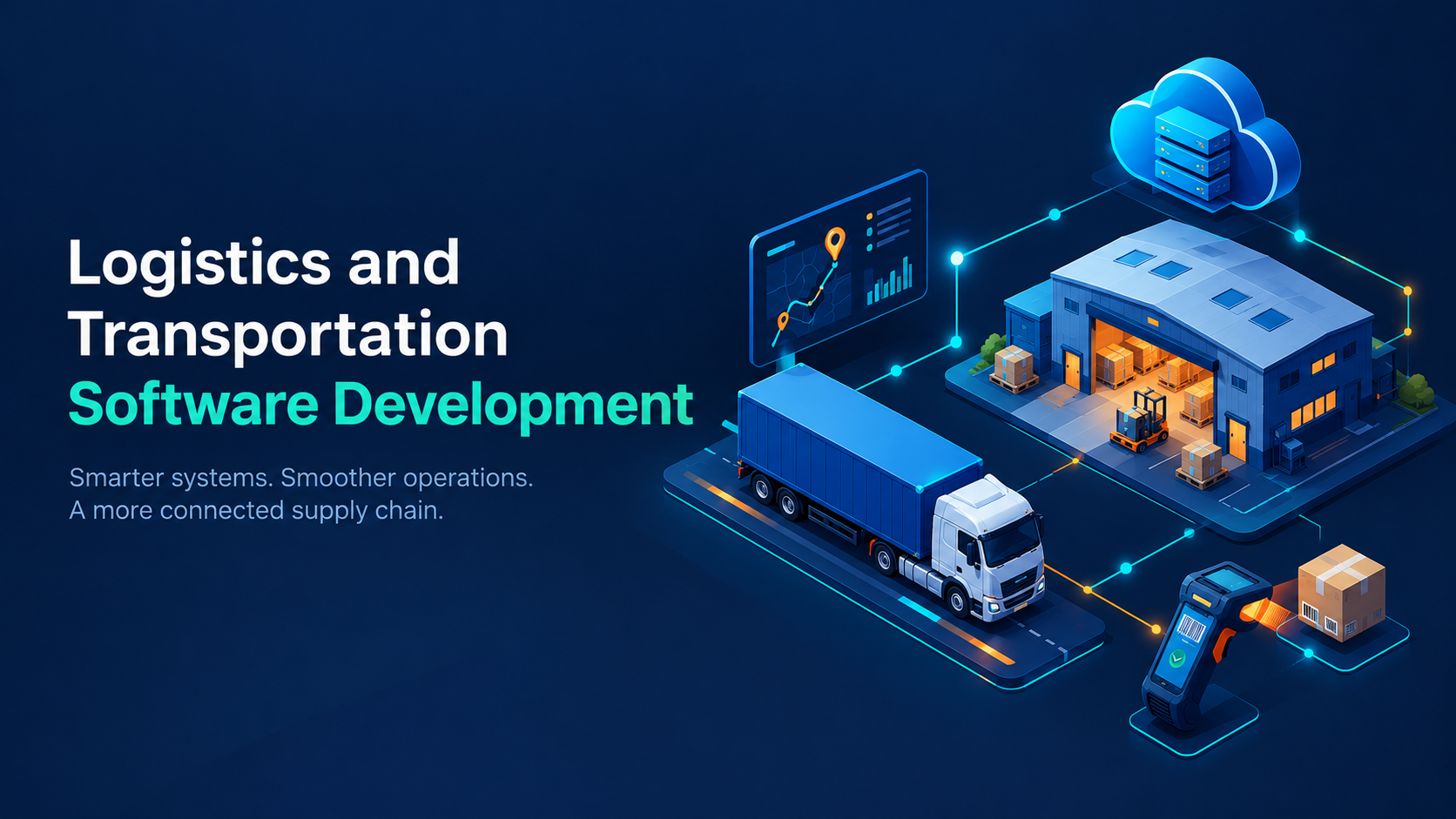
What logistics and transportation software development includes
Most operators do not need one giant platform. They need a handful of connected tools: a TMS for planning and carrier management, a WMS for inventory and picking, a yard or dock tool, mobile apps for drivers and warehouse staff, a customer-facing tracking view, a quoting and billing layer, and reporting on top. Closeloop's logistics practice groups its work the same way: warehouse management, transportation management, supply chain integration, analytics, mobile applications and automation.
The development part is rarely about drawing screens. It is about deciding which pieces deserve custom code, which should be bought, and how data moves between them. A good Logistics Software Development Service therefore begins with a map of your operation, not a quote for features.
Why cost pressure makes this a software problem
Fuel gets the headlines, but it is not where the squeeze is. ATRI put the average cost of running a truck at a record $2.336 per mile in 2025, a 3.4% rise on the previous year. Strip out fuel and the figure still climbed 4.2%, to $1.854 per mile. You can read the full ATRI Operational Costs of Trucking report for the category breakdown. ATRI also notes that empty mileage can be the single biggest drain on operating cost. Truck Operating Costs Hit Record $2.34 Per Mile +2 .
Software cannot change the price of diesel, but it can change empty miles, detention, paperwork lag and billing delay. Those sit in the controllable part of the cost stack.
One point buyers often miss: ELD compliance is not visibility. Mandatory ELD use began on December 16, 2019, and FMCSA states plainly that the rule does not require real-time tracking of vehicles. A fully compliant carrier can still have no live view of a shipment. Real tracking needs telematics data brought into your own systems, which is a software job. On the paperwork side, FMCSA estimated the ELD rule would deliver more than $1 billion in annual net benefit, largely by cutting paperwork, which gives a sense of how much cost paper carries across the industry. See the FMCSA ELD fact sheet for the exact rule details.
The Four Seams framework: where logistics software projects win or fail
This is our own working model, an opinion rather than an industry standard. Every shipment crosses four handoffs. Each one is a place where a person re-types, re-checks or chases information. Fix the expensive handoff first and the rest of the roadmap gets easier.
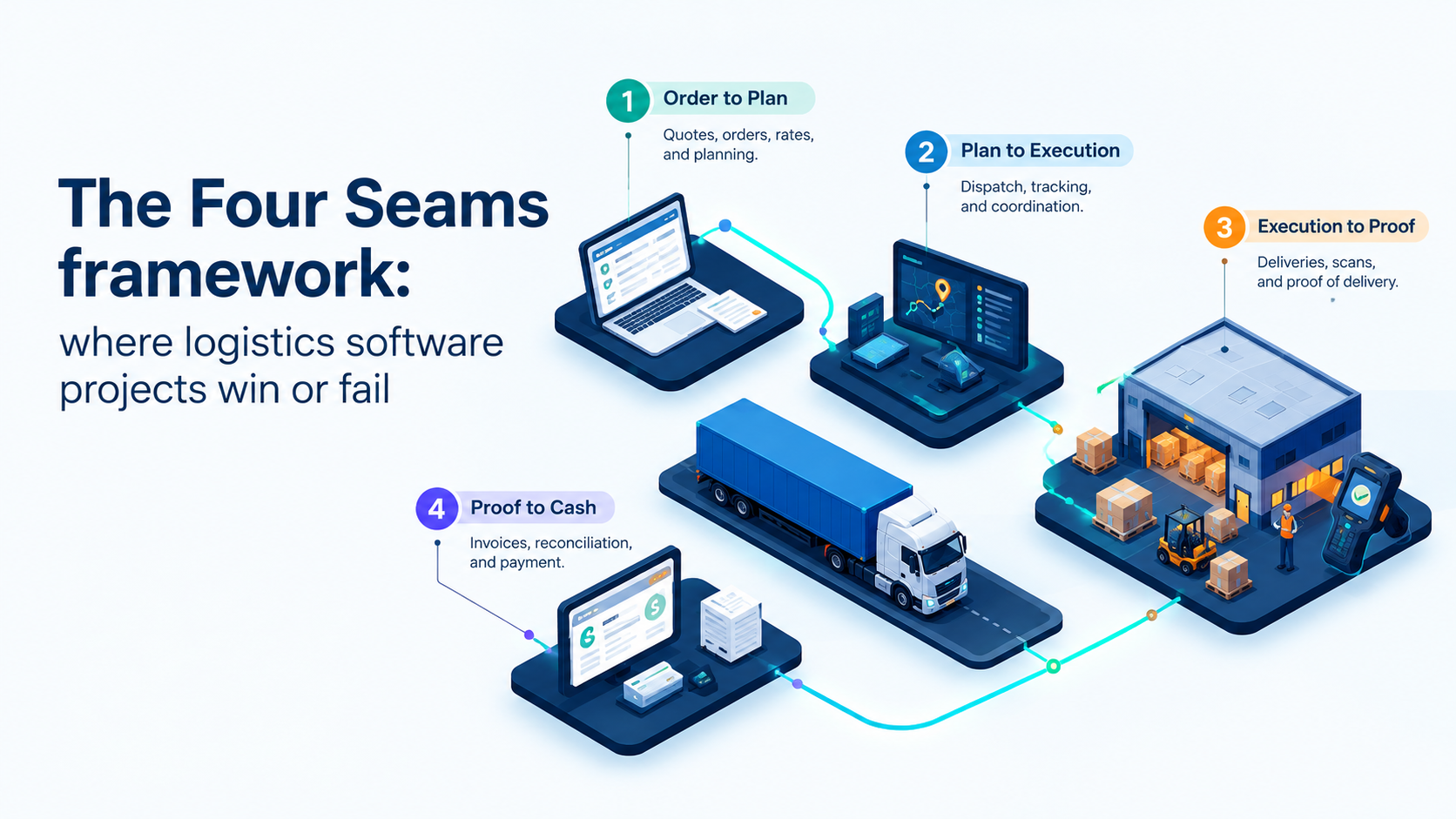
Seam 1: Order to plan. Quotes live in spreadsheets, orders arrive by email, rates are looked up by hand. The symptom is slow quoting and margin leakage. Closeloop reports that for D2D Global it replaced Excel-based workflows with D2DLoop, a cloud logistics platform, and saw 30% faster quoting cycles, 25% higher quote-to-cost accuracy and 40% less planning effort.
Seam 2: Plan to execution. Dispatch decisions reach drivers and warehouse staff by phone, text or printed sheets. The symptom is a dispatcher spending the day chasing status.
Seam 3: Execution to proof. Proof of delivery, damage notes, yard check-ins and scans. The symptom is paper, photos stuck on personal phones and disputes weeks later. Closeloop reports that its custom proof-of-delivery app for Grocery Supply Company eliminated paper-based delivery logs, and that its AutoTrace yard platform for Autotech Consulting Group cut manual data entry by 95% with 100% accuracy in service and damage logging. Both are vendor-reported results.
Seam 4: Proof to cash. Invoices, accessorial charges and reconciliation into the ERP. The symptom is late billing and disputed invoices.
A practical test: pick one real shipment and trace it from quote to cash. Count every time a person re-types or re-checks the same data. Multiply that count by shipment volume and the seam with the highest total goes first. It is a heuristic, not a formula, but it beats choosing a roadmap by whichever department shouts loudest.
Build, buy or extend: a decision model
Most buyers frame this as build versus buy. There is a third option that matters for any company already running NetSuite or Salesforce: extend the platform you own.
Build, buy or extend decision matrix for logistics software with criteria and risks
Decision matrix: when to build, buy or extend.
Ask five questions about each capability:
- Does this workflow differentiate us from competitors?
- Does an existing product fit about 80% of it without a fight?
- Which system should own the record (customer, item, invoice)?
- How many other systems must it talk to?
- Can we staff ongoing maintenance for it?
If the answer to the first is no and the second is yes, buy. If a platform you already own should hold the record, extend it. If the workflow is your edge, or nothing fits, build. The trade-offs are real: custom code adds a maintenance obligation, and bought software adds vendor pricing risk. Closeloop's own build vs buy guide for logistics software goes deeper on the cost side.
Where NetSuite fits: implementation, integration and custom development
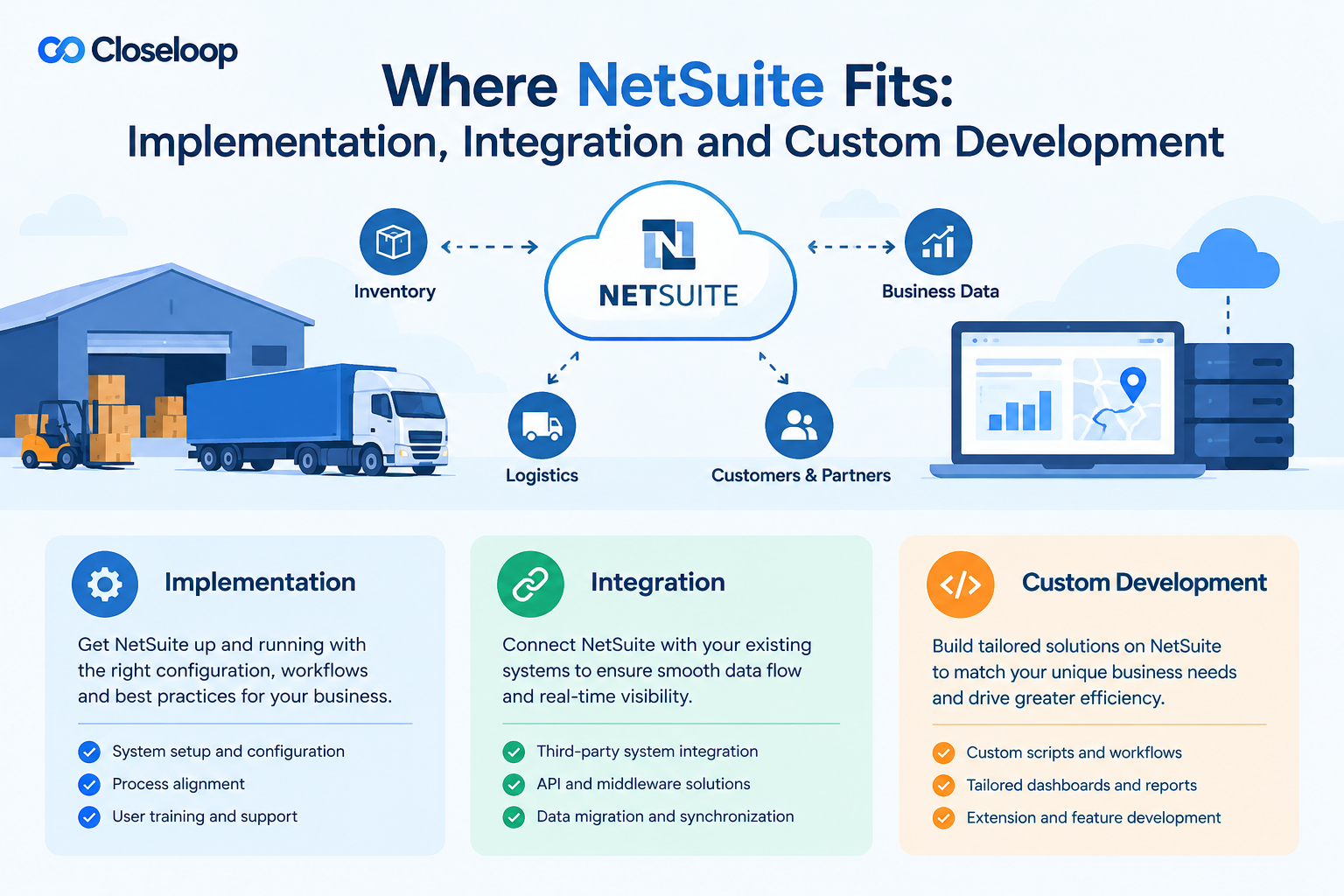
NetSuite Implementation Services, NetSuite Integration Services and Custom NetSuite Development belong in a logistics conversation because NetSuite often holds the financial truth: customers, items, vendors, invoices and the general ledger. Your logistics apps generate events such as delivered, damaged or detained. NetSuite should receive them as clean financial records.
Architecture diagram of logistics apps connecting to NetSuite through an integration layer
Reference architecture: logistics apps, integration layer and NetSuite.
Closeloop's NetSuite implementation services cover consulting, custom development, implementation and data migration. Its integration work runs on Boomi, Celigo and MuleSoft, which act as iPaaS middleware between NetSuite and other systems. Here is what matters in practice.
Respect concurrency limits. Oracle documents a governanceLimits operation in NetSuite's REST web services that lets an integration check how many concurrent requests it may send, and advises every integration to use it so it does not exceed the available threads. One third-party analysis reports that these limits depend on service tier and apply across SOAP, REST and RESTlet calls combined. Check your own account before designing anything chatty, such as a GPS ping that writes a record every few seconds. oraclehouseblend
Choose real-time or batch per data type. Delivery confirmation feeding an invoice may justify near real time. Item and customer masters usually do fine in batch. Closeloop's article on real-time vs batch NetSuite integration walks through the trade-off.
Design for retries. A failed call that retries and creates a second invoice is a classic bug. Use idempotency keys or a unique external ID on every inbound transaction.
Keep custom NetSuite development light. SuiteScript is the right tool for logic that must run inside NetSuite. Our rule of thumb, and it is only that: configure first, use middleware second, script third. Every script is something you test on each NetSuite release.
Set timeline expectations carefully. Closeloop's own FAQ gives 3 to 12 months and a typical $10,000 to $100,000 range for NetSuite implementation, with larger businesses exceeding it. That is a vendor estimate, not an independent benchmark. In a Salesforce and NetSuite integration built on Celigo for Cordance, Closeloop reports a 90% reduction in data inaccuracy. Their post on NetSuite integration challenges covers the common failure points.
Running NetSuite or planning to? Talk to Closeloop about NetSuite integration and custom development for your logistics workflows.
Also Read: The Hidden Cost of Disconnected Logistics Systems: A Software Architecture Approach to End-to-End Visibility
AI and data: start where a human can check the output
Closeloop's logistics page lists document processing (OCR, EDI, barcode scanning, signature verification, damage assessment) alongside forecasting and dynamic pricing. Our opinion is that the first group should come first. Document intake and exception triage have bounded inputs, and a person can verify the result. Forecasting and dynamic pricing need clean history, and that is where a data engineering effort (pipelines, warehouse, lakehouse work such as Databricks) pays for itself before any model is trained.
Closeloop's Generative AI and AI integration work describes a guarded approach: permission-aware retrieval over enterprise data, RAG grounding, evaluation, monitoring and human approval for sensitive actions. For freight, that last item matters. An assistant that drafts a rate quote is fine. One that sends it unreviewed is a liability. For more, see the post on the role of AI in logistics software development.
The rest of the stack, and how each service maps to a logistics build
A logistics platform touches more than one discipline. Here is how Closeloop's service lines map to real logistics needs. The graphic below summarizes it.
Table graphic mapping Closeloop services to logistics problems
- Custom software development and software engineering: the core of any Custom Software Development Companies in USA shortlist. Closeloop's custom software development service builds the quoting, dispatch and portal layers, and its software engineering work covers Java, MERN and LAMP stacks.
- Mobile app development: driver, warehouse and field apps on Android and iOS, including React Native and Flutter, progressive web apps, and Bluetooth-enabled apps for scanners and sensors. A smart TV app can even serve as a dispatch-center wallboard, though that one is our suggestion rather than a standard use case.
- Systems integration and business process automation: system integration connects TMS, WMS, ERP and carrier systems, and business process automation removes manual steps such as invoice triggers and exception routing.
- Cloud engineering and DevOps: cloud engineering on AWS, Azure or Google Cloud, plus migration, cloud-native builds, DevOps and MLOps, platform engineering and cost optimization.
- Legacy modernization: legacy app modernization matters when your dispatch system is a twenty-year-old desktop application nobody wants to touch.
- CRM and digital commerce: Salesforce implementation, HubSpot and custom CRM for shipper and carrier relationships, and digital commerce for distributors who sell through B2B ordering portals.
- Product strategy and consulting: product strategy and consulting, including conceptualization, feature ideation, UX design, wireframing and interactive prototyping, which lets drivers and dispatchers test an idea before anyone writes production code.
How to choose among the top software development companies in USA
Search for the Best Software Development Company in USA and you will find pages of ranked lists. Many are published by the companies they rank, and some include their own publisher. One list, from Cleveroad, does state its criteria openly: a Clutch rating of 4.8 or higher and at least 45 verified client reviews. That is better than most, but it is still a vendor's list. "Best" depends on your fit, not on a universal ranking. Use any list to build a shortlist, then score the shortlist yourself. cleveroad
Vendor scorecard for choosing a logistics software development company with weighted criteria
The weights in that scorecard are our suggestion: domain fit 20, integration depth with ERP, CRM and carrier APIs 20, engineering practices 15, delivery governance and communication 15, post-launch support 10, references you can actually call 10, and commercial terms 10. Adjust them to your risk.
Questions that separate firms quickly:
- Can you show a shipment-level data model you have built before?
- How do you handle duplicate events and retries?
- Who owns the code and the cloud accounts at the end?
- What happens to support when the lead engineer leaves?
- How much working-hour overlap will we have?
Red flags: a fixed price for a complex integration before discovery, nobody asking which ERP you run, a portfolio of percentages without baselines, and reluctance to provide references. Closeloop's post on how to evaluate custom software development companies in the USA adds more criteria.
Seven common mistakes
- Starting with the dashboard. A dashboard on top of re-keyed data shows you wrong numbers faster.
- Treating ELD data as visibility. See above: compliance logging is not tracking.
- Skipping master data cleanup. Duplicate customers, inconsistent item codes and messy locations break integrations on day one.
- Designing the driver app for the office. Drivers need big targets, glare-proof screens and offline mode. Test in a cab, not a conference room.
- No exception path. Real operations are mostly exceptions: missed windows, refused loads, damage. Plan for them first.
- Big-bang rollout. Pilot one lane, yard or warehouse and measure.
- Ignoring integration limits. Hitting a concurrency ceiling in production is a bad way to learn about it.
A 90-day starting plan
90-day roadmap for logistics software development from seam mapping to measured pilot
A phased 90-day plan from seam mapping to a measured pilot.
Days 1 to 15: trace a few shipments, count re-keys and record baselines (quote time, delivery-to-invoice time, manual entries per shipment). Days 16 to 30: run the build, buy or extend questions and audit master data. Days 31 to 75: build a thin slice for the costliest seam at one site or lane, and integrate to the ERP in batch first. Days 76 to 90: compare against baseline, harden, and decide on the next seam. This is a suggested sequence, not a guarantee of timing, because scope and integrations change it.
Conclusion
Closeloop is a Silicon Valley software development company in USA, listed on the Inc. 5000, with 175+ engineers and consultants, 70+ enterprise and growth-stage clients, 250+ projects across 15+ industries and four offices across the US and India. Accounts are managed from California with a global engineering team.
What it brings to logistics specifically: custom builds, NetSuite and Salesforce expertise, data and cloud engineering and AI integration under one contract. That matters when your TMS, ERP and driver app must work as one system. Closeloop describes its process as discovery first, with AI-assisted engineering under human review. Its quality practices include test-driven development, daily code reviews, CI/CD pipelines, CAST-scanned code and user acceptance testing. Pricing guidance on its FAQ: MVPs typically start around $50K, end-to-end platforms may range from $150K to $400K, and estimates are milestone-based.
Honest trade-offs to evaluate: Closeloop is a broad engineering partner rather than a packaged TMS vendor, so it fits best when you need custom or integrated work. And with US management plus global engineering, ask about working-hour overlap on day one. Verify claims against reviews and reference calls, as you would with any of the Top Software Development Companies in USA. For cost detail, see the custom logistics software cost breakdown.
Author

Swetha GP

VP of Delivery
She is a VP of Delivery at Closeloop. A communicator, business analyst, and engineering aficionado. Besides handling client relations, and engineering duties, she loves to pour her thoughts on paper. She writes about engineering, technologies, frameworks, and everything related to the software domain. She reads, spends time with family, and enjoys a good walk in nature in her free time. Her dream destination is Greece.
Frequently Asked Questions
Connect with our experts to discuss your requirements. For any queries, reach out to sales@closeloop.com
Stay abreast of what's trending in the world of technology
Salesforce Consulting Services: A Buyer's Guide to Scope, Risk and Choosing a Partner
Generative AI Development Services: How Enterprises Can Turn AI Ideas Into Business Applications
Generative AI is changing how enterprises approach software development, customer engagement,...
Cloud Migration Strategies for Secure and Scalable Business Operations
Businesses increasingly depend on digital systems to manage applications, store information,...
NetSuite Integration Challenges and How Businesses Can Overcome Them
Most NetSuite projects do not struggle because of NetSuite itself. They struggle at the...