Generative AI is changing how enterprises approach software development, customer engagement, content creation, and business operations. From intelligent chatbots to automated document processing, businesses are exploring ways to use AI to improve productivity and create new digital experiences. However, turning an AI concept into a practical business application requires more than choosing a model or connecting an API.
This is where Generative AI Development Services become valuable. These services help organizations identify suitable use cases, develop AI-powered applications, integrate models with existing systems, and establish solutions that address real business requirements.
What Are Generative AI Development Services?
Generative AI development services involve designing, building, integrating, and maintaining applications that use generative artificial intelligence to produce or process content such as text, images, code, and other outputs.
These applications can use large language models (LLMs), retrieval-augmented generation (RAG), machine learning frameworks, and other AI technologies to perform tasks that traditionally require substantial manual effort.
For enterprises, the objective is not simply to introduce AI into existing workflows. It is to develop applications that improve specific processes, support employees, and deliver measurable operational value.
Why Are Enterprises Investing in Generative AI?
Enterprise adoption of generative AI is driven by the need to improve efficiency, access information faster, and create more responsive digital services.
Some important business applications include:
- Automated Content Generation: Generate drafts, product descriptions, reports, and other business content.
- Intelligent Customer Support: Use AI assistants to answer common questions and help customers navigate services.
- Knowledge Management: Make internal documents and organizational information easier to search and retrieve.
- Developer Productivity: Assist software teams with code suggestions, documentation, and debugging.
- Document Processing: Extract, summarize, and organize information from business documents.
- Decision Support: Help employees analyze information and identify relevant insights.
The value depends on selecting appropriate use cases and integrating AI into workflows where it can genuinely improve existing processes.
Key Generative AI Development Services for Enterprises
Organizations can implement different types of AI solutions depending on their objectives, data environment, and technical requirements.
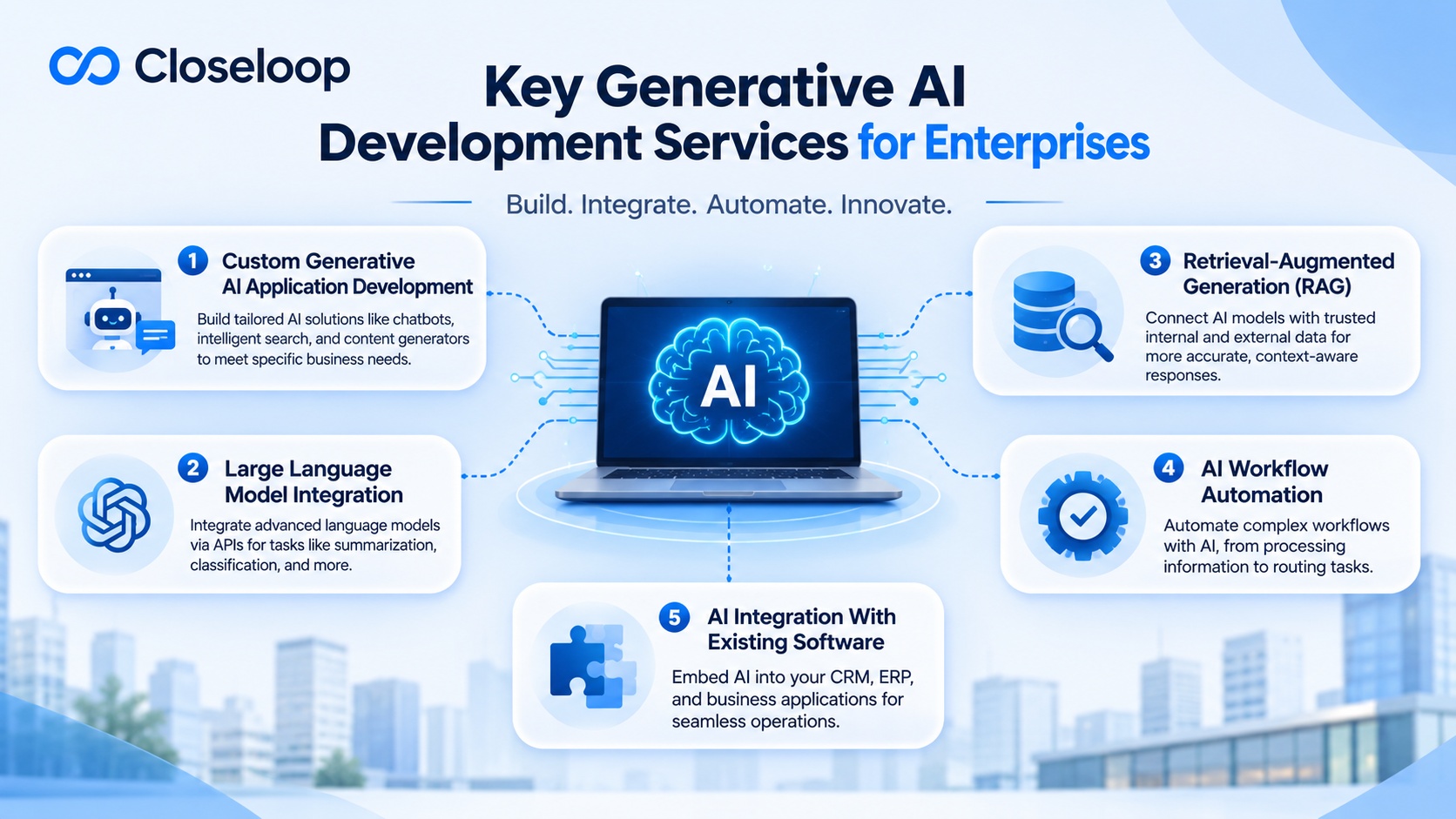
1. Custom Generative AI Application Development
Custom AI applications are designed around specific business needs. They may include internal assistants, customer-facing chatbots, intelligent search tools, content generation systems, and automated reporting applications.
Custom development allows organizations to control application functionality, user access, integrations, and business-specific workflows.
2. Large Language Model Integration
Large language models can understand and generate human-like text, making them useful for conversational applications, summarization, classification, and information extraction.
Enterprise applications can integrate suitable models through APIs or other deployment approaches. Model selection should consider performance, cost, privacy, scalability, and the complexity of the intended task.
3. Retrieval-Augmented Generation (RAG)
RAG connects generative AI models with relevant external or internal information sources. Instead of relying only on information learned during training, the application retrieves relevant content from approved knowledge sources before generating a response.
This approach is useful for enterprise knowledge assistants, internal documentation search, product support, and policy-related applications.
4. AI Workflow Automation
Generative AI can support workflows that involve understanding unstructured information, generating responses, summarizing documents, and routing tasks.
When combined with Business Process Automation Services, AI capabilities can become part of broader workflows involving business applications, approvals, notifications, and data processing.
5. AI Integration With Existing Software
Enterprises often have established CRM platforms, ERP systems, databases, and custom applications. AI solutions need to work within these environments rather than operate as disconnected tools.
Integration may involve APIs, authentication, data pipelines, application interfaces, and workflow orchestration.
How Enterprises Can Turn AI Ideas Into Business Applications
Successful AI development requires a structured process. The following steps help organizations move from an initial concept to a usable application.
Step 1: Identify the Business Problem
Start by identifying a specific operational challenge. Examples include slow customer support responses, time-consuming document reviews, or difficulty searching internal knowledge.
A clearly defined problem makes it easier to evaluate whether generative AI is an appropriate solution.
Step 2: Evaluate Data and Technical Requirements
AI applications depend on the quality, availability, and accessibility of relevant information. Assess existing databases, documents, APIs, security requirements, and data permissions before selecting a technical approach.
Step 3: Select the Right AI Model and Architecture
Choose a model and architecture according to the application requirements. Consider response quality, latency, cost, deployment options, and data privacy.
Not every business application requires a complex custom model. Existing models, combined with appropriate integrations and retrieval systems, may be sufficient.
Step 4: Develop and Test an MVP
Build a minimum viable product to test the core functionality with a limited group of users. Evaluate response accuracy, usability, processing time, and the application's ability to handle real-world inputs.
Step 5: Integrate and Deploy
Connect the application with the relevant business systems and deploy it in an environment that meets operational and security requirements.
Step 6: Monitor and Improve
AI applications require ongoing evaluation. Monitor output quality, user feedback, security, performance, and operating costs. Update prompts, retrieval sources, integrations, and model configurations as requirements change.
Also Read: Why Customized Software Development Services Are Essential for Business Growth and Digital Transformation
Security and Reliability Considerations
Enterprise AI applications may process confidential documents, customer information, and business data. Security should therefore be included throughout development.
Important considerations include access controls, data encryption, secure API management, audit logging, input validation, and protection against prompt injection.
AI-generated responses also require evaluation because models can produce inaccurate or unsupported information. Human review, appropriate guardrails, and testing can reduce the risk of unsuitable outputs.
Businesses developing AI-powered software should also understand AI code security considerations for enterprise applications when introducing AI into development and production environments.
Choosing the Right Generative AI Development Partner
Selecting a development partner involves evaluating more than its familiarity with AI models. Enterprises should look for experience in application architecture, software engineering, data integration, security, and deployment.
A capable Software Development Company in USA can help businesses connect AI functionality with existing applications and develop solutions around specific operational requirements.
Evaluate potential partners based on:
- Experience with generative AI technologies and integrations.
- Understanding of enterprise workflows.
- Data security and governance practices.
- Ability to build scalable applications.
- Testing, monitoring, and maintenance capabilities.
- Transparent communication and project planning.
Turn Your AI Ideas Into Practical Business Applications
Generative AI can support enterprise innovation when it is connected to clearly defined business objectives. The right development approach helps organizations move beyond experimentation and build applications that fit their workflows, systems, and user requirements.
Closeloop helps businesses explore and develop AI-powered software solutions, from application planning and integration to implementation and ongoing improvement.
Ready to explore generative AI for your business? Contact Closeloop to discuss your requirements and identify practical opportunities for AI adoption.
Author

Swetha GP

VP of Delivery
She is a VP of Delivery at Closeloop. A communicator, business analyst, and engineering aficionado. Besides handling client relations, and engineering duties, she loves to pour her thoughts on paper. She writes about engineering, technologies, frameworks, and everything related to the software domain. She reads, spends time with family, and enjoys a good walk in nature in her free time. Her dream destination is Greece.
Frequently Asked Questions
Connect with our experts to discuss your requirements. For any queries, reach out to sales@closeloop.com
Stay abreast of what's trending in the world of technology
NetSuite Integration Challenges and How Businesses Can Overcome Them
Most NetSuite projects do not struggle because of NetSuite itself. They struggle at the...
How AI and Automation Are Transforming Modern Logistics Operations
A shipment that leaves the warehouse on time can still arrive late. A truck can run full on...

The Hidden Risks of AI-Generated Code in Enterprise Applications
AI coding assistants have moved from experiment to everyday tool in many engineering teams....

When Standard NetSuite Workflows Fall Short: Implementation, Integration, and Customization...
NetSuite is one of the most capable cloud ERP platforms available, but no out-of-the-box...