Salesforce Service Cloud Implementation for Cordance
This case study explores how Closeloop implemented Salesforce Service Cloud for Cordance to unify fragmented customer support processes and disparate CRM systems by standardizing workflows integrating CPQ and DocuSign enabling real-time data visibility and automation resulting in improved agent productivity faster response times streamlined operations and more accurate data-driven decision-making.
Cordance employs a distinctive 'acquire and scale' business model, catering primarily to vertical B2B Software-as-a-Service (SaaS) companies. As the company underwent expansion through acquisitions, it encountered significant challenges in efficiently managing customer support inquiries across its diverse range of products.
With a growing portfolio of acquired SaaS companies, each serving its own customer base through fragmented support systems, Cordance needed a unified platform to standardize support operations, improve response times, and scale without compromising service quality.
Closeloop was engaged to implement Salesforce Service Cloud as the centralized customer support platform across all of Cordance's business units, delivering automation, intelligent routing, and data-driven insights for the entire portfolio.
Core Support Obstacles
Cordance's rapid acquisition growth exposed serious gaps in its customer support infrastructure — fragmented channels, siloed data, and an inability to scale across its expanding SaaS portfolio.
Inefficient Communication
Customer inquiries were being addressed through multiple disconnected communication channels, resulting in a lack of coordination, inconsistent responses, and prolonged resolution times across business units.
Absence of Centralized Data
Customer information, purchase history, and interaction records were dispersed across various systems, impeding the ability to deliver a unified and personalized support experience to any customer.
Resource Allocation Gaps
The support team grappled with effective resource allocation due to insufficient visibility into case volumes, agent performance, workload distribution, and response time metrics across the portfolio.
Scalability Limitations
As Cordance's customer base continued to expand through new acquisitions, the existing support infrastructure proved inadequate in handling escalating support volumes without compromising on resolution quality.
Unified Support Operations Platform
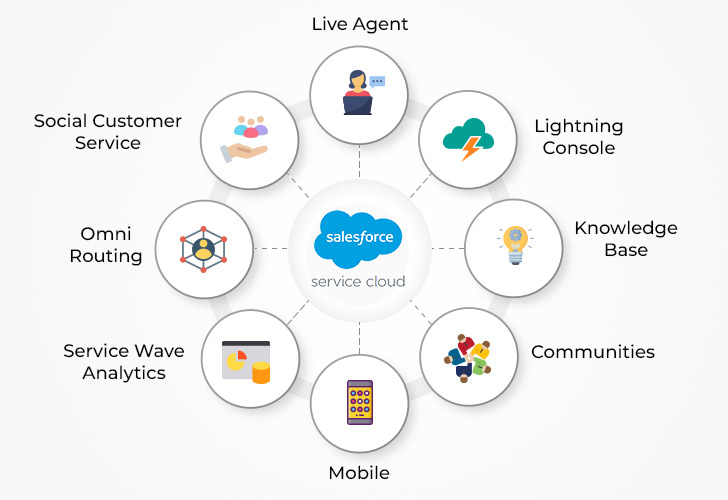
Closeloop implemented a comprehensive Salesforce Service Cloud solution tailored to Cordance's multi-entity model, covering automated case management, intelligent routing, proactive notifications, and unified analytics.
Case Management & Automation
-
Centralized Support Hub Established a single access point within Service Cloud for managing customer interactions across all acquired entities, giving agents a complete view of cases, history, and customer context.
-
Email-to-Case Integration Configured Email-to-Case to automatically convert inbound customer emails into support cases, eliminating manual intake and ensuring no inquiry was missed or delayed.
-
Omni-Channel Routing Set up intelligent case routing based on agent skill set, availability, and workload to ensure the most capable agent handled each case for faster, more accurate resolution.
-
Automated Case Escalation Built automation workflows to escalate urgent or unresolved cases to designated teams or management based on predefined criteria, ensuring critical issues received prompt attention.
Communication, Data & Analytics
-
Automated Customer Notifications Configured automated email notifications to keep customers informed on case assignment, status changes, and closures — improving transparency and satisfaction proactively.
-
Customer Data Integration Integrated customer data repositories with Service Cloud so agents could access full customer profiles, purchase history, and interaction records during every support interaction.
-
Analytics & Reporting Dashboards Built custom reports and dashboards covering response times, resolution rates, agent performance, and customer satisfaction metrics to guide data-driven support decisions.
-
Scalable Architecture for New Acquisitions Designed the Service Cloud configuration to allow seamless onboarding of new acquired companies, supported by change management strategies and ongoing improvement processes.
Testing & Validation
Closeloop conducted a comprehensive multi-phase QA process across all Service Cloud modules to verify configuration accuracy, automation correctness, and user readiness before go-live.
Requirement Validation
QA specialists collaborated with Cordance to validate gathered requirements, ensuring clarity, completeness, and alignment with the organization's customer service objectives across all business units.
Service Cloud Configuration & Process Testing
Thorough testing of all Service Cloud customizations, workflows, and automations with end-to-end coverage of case management, customer interactions, and resolution procedures.
Case Management & Escalation Testing
Meticulous testing on case creation, assignment, and escalation processes, including Omni-Channel Routing accuracy and timely escalation logic for critical cases.
Automated Notifications Testing
Validated the automated notification system to confirm customers received timely updates on case assignment, status changes, and closures throughout the support lifecycle.
Reporting & Analytics Validation
QA experts verified that all Service Cloud reports and dashboards provided accurate insights into support performance, agent productivity, and customer satisfaction metrics.
Usability & UAT Support
Provided extensive support during the User Acceptance Testing phase, working directly with end-users to address queries, gather feedback, and fine-tune the system for adoption readiness.
Closeloop delivered a comprehensive Salesforce Service Cloud implementation for Cordance, centralizing customer support across multiple business units with automated case management, intelligent routing, and real-time performance analytics.
Tech Stack
Built entirely on Salesforce's enterprise cloud platform, leveraging Service Cloud's native automation, routing, and analytics capabilities.




Business Impact and Results
The Service Cloud implementation delivered a streamlined, centralized customer support ecosystem — improving operational efficiency, customer satisfaction, and portfolio-wide visibility for Cordance.
A single Salesforce Service Cloud org replaced fragmented tools, giving every support agent across every acquired entity one consistent platform.
Intelligent routing matched cases to the most skilled available agent, reducing time-to-resolution and improving first-contact quality.
Every inbound email was automatically converted into a tracked case, eliminating manual intake and ensuring no customer request was overlooked.
Automated notifications kept customers informed at every stage — assignment, status updates, and closure — boosting satisfaction and reducing inbound follow-ups.
Custom dashboards gave leadership live visibility into response times, resolution rates, agent workload, and customer satisfaction metrics across the entire portfolio.
The Service Cloud architecture was built to onboard new companies with minimal friction, making customer support a competitive advantage as Cordance continues to grow.
Explore the complete journey from problem to results—backed by real data and insights.

Client Value & Feedback
Client feedback reflects not just satisfaction with technical execution but appreciation for the strategic partnership and business outcomes achieved.
"Closeloop delivered a Service Cloud implementation that centralized our customer support, automated our case workflows, and gave our teams the visibility and tools needed to serve our entire portfolio of companies effectively."
Matt Cantando
VP of Revenue Operations, CordanceFrequently Asked Questions
No questions match your search.
Timeline depends on the number of business units, the complexity of routing rules and integrations, and the volume of data migration required. A focused Service Cloud implementation covering Email-to-Case, Omni-Channel Routing, account data integration, escalation workflows, and custom dashboards typically takes 3–6 months for a multi-entity organization. Closeloop Technologies scopes each engagement through a discovery phase, delivering milestone-based timelines so clients always have clarity on what is being delivered and when.
When customer information is scattered across multiple systems, agents spend valuable time switching between tools to piece together context before they can even begin addressing an issue. A centralized platform like Salesforce Service Cloud consolidates full interaction history, account details, open and closed cases, and product information into a single agent view. This means agents arrive at every support interaction already informed — reducing handle time, eliminating repeat questions, and enabling more personalized, effective support from the first response.
Service Cloud's reporting layer supports real-time dashboards that surface case volumes, average resolution times, agent performance metrics, SLA compliance rates, and customer satisfaction trends — all filterable by business unit, product, or time period. For leadership managing multiple portfolio companies, this replaces guesswork with data-driven operational planning. Closeloop builds these executive dashboards as a dedicated workstream within every Service Cloud engagement, ensuring leadership has immediate visibility into support health across the entire portfolio from a single screen.
Service Cloud's architecture allows new business units to be onboarded into an existing org by adding new queues, routing rules, email addresses, and permission sets — without rebuilding the core platform from scratch. Standardized case processes, shared dashboards, and centralized account data mean each newly acquired company inherits a proven support framework on day one. Closeloop designed the implementation with scalability as a core requirement, so each new portfolio acquisition can be onboarded quickly using the same standardized processes and shared support metrics already in place.
Closeloop ran a structured multi-phase quality assurance process before go-live. This covered requirements validation to confirm all configured components matched documented business needs; end-to-end case workflow testing including Email-to-Case creation, Omni-Channel routing, and escalation logic; integration testing to verify account data sync accuracy; reporting and dashboard verification to confirm data aggregation and real-time refresh; and full User Acceptance Testing in collaboration with the client's support team to validate real-world scenarios and gather feedback before production launch.
Before the implementation, support emails sent to various business units were handled manually — meaning they could be missed, delayed, or inconsistently logged depending on who picked them up. Email-to-Case automatically converts every inbound support email into a tracked case the moment it arrives — with no manual step required. For a multi-portfolio company, this meant that regardless of which portfolio company a customer contacted, their inquiry became a fully trackable case immediately, with routing, SLA timers, and visibility applied consistently across the entire customer base.
Omni-Channel Routing is a native Salesforce Service Cloud capability that automatically assigns incoming support cases to the right agent or queue based on predefined rules such as agent skill, availability, and workload — replacing manual case assignment entirely. For a multi-portfolio business, this was critical because support requests were coming from customers of different products, and ensuring the agent best equipped to handle a specific issue received it first reduced back-and-forth handoffs, cut time-to-resolution, and improved customer satisfaction without requiring manual triage by team leads.
Closeloop delivered a full Service Cloud implementation tailored to a multi-entity portfolio model. This included deploying a centralized support hub giving agents a complete view of cases and customer context across all portfolio companies; configuring Email-to-Case to automatically convert inbound support emails into tracked cases; setting up Omni-Channel Routing to assign cases based on agent skill, availability, and workload; building automated escalation workflows for urgent issues; integrating account data repositories for full interaction history during support calls; and creating custom analytics dashboards for leadership visibility across all business units.
multi-portfolio SaaS company trying to solve with Salesforce Service Cloud?The company operates an "acquire and scale" model, growing its portfolio by acquiring vertical B2B SaaS businesses. As the portfolio expanded, customer support became increasingly difficult to manage — support requests arrived through scattered communication channels, customer data was siloed across different systems, and agents had zero visibility across business units. Management had no insight into case volumes, resolution speed, or team performance. The company needed a single centralized platform to standardize operations, reduce resolution times, and deliver a consistent support experience across all portfolio companies.