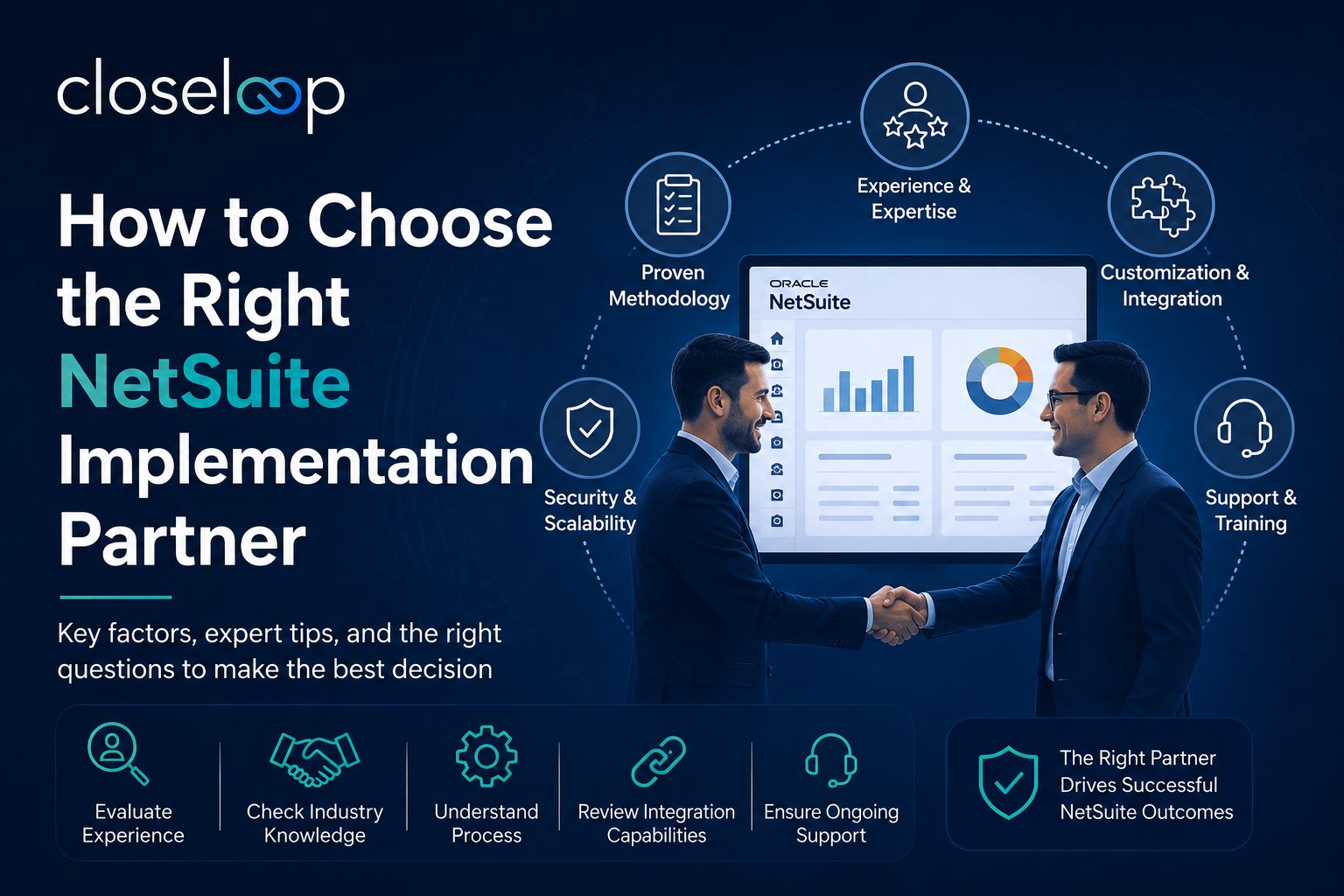
The right NetSuite Implementation Partner is a firm with proven NetSuite experience, relevant industry expertise, strong technical and integration capabilities, a structured implementation methodology, and a track record of reliable post-launch support, chosen based on overall fit and long-term value rather than the lowest quote. Selecting this partner is one of the most consequential decisions a business makes during an ERP rollout, because the partner's skill directly shapes how smoothly the system is configured, how well it fits real workflows, and how much value the business gets from NetSuite Implementation Services for years afterward.
This guide breaks down what a NetSuite implementation partner actually does, the factors that separate strong partners from weak ones, the questions to ask before signing a contract, and the mistakes that derail otherwise promising ERP projects.
What Does a NetSuite Implementation Partner Do?
A NetSuite implementation partner is a certified consulting firm that helps businesses plan, configure, customize, integrate, and deploy NetSuite ERP. Beyond simply "turning on" the software, a qualified NetSuite consulting partner maps the platform to a company's actual business processes, migrates historical data, connects third-party systems, and trains internal teams so the organization can operate independently after go-live.
Typical responsibilities of a NetSuite implementation partner include:
- Requirements gathering and business process analysis
- Solution design and system configuration
- NetSuite customization (scripts, workflows, custom fields, SuiteApps)
- NetSuite integration with CRM, eCommerce, payroll, and other business tools
- NetSuite data migration from legacy systems
- User training and change management
- NetSuite support and maintenance after deployment
Why Choosing the Right Partner Matters
NetSuite is a highly configurable platform, which means the quality of implementation depends heavily on the expertise of the people configuring it. A partner with shallow experience may deliver a system that technically works but doesn't reflect how the business actually operates, leading to workarounds, data issues, and low user adoption.
A capable ERP implementation partner, by contrast, builds a foundation that scales as the business grows, integrates cleanly with existing tools, and reduces the operational risk that comes with any major software transition. Given the cost, time, and organizational effort involved in an ERP rollout, the partner selection decision has a direct and lasting impact on ROI.
Also Read: What Makes a Great NetSuite Implementation Company? A Buyer's Checklist
Key Factors to Evaluate in a NetSuite Implementation Partner
When comparing NetSuite implementation services, evaluate potential partners across these core dimensions:
- NetSuite experience: Number of years working with the platform and volume of completed implementations
- Industry expertise: Familiarity with your sector's workflows, compliance needs, and reporting requirements
- Business process understanding: Ability to translate real operational needs into system configuration
- Customization capabilities: Depth of SuiteScript, SuiteFlow, and SuiteApp development experience
- Integration expertise: Experience connecting NetSuite to CRM, eCommerce, and third-party platforms
- Data migration experience: A proven, tested approach to moving and validating legacy data
- Implementation methodology: A documented, repeatable process rather than an ad hoc approach
- Security practices: Role-based access, data protection protocols, and compliance awareness
- Scalability: Ability to support future modules, entities, and business growth
- Communication and project management: Clear timelines, regular updates, and a single point of accountability
- Training and post-launch support: Structured user training and ongoing NetSuite support and maintenance
10 Things to Look for in a NetSuite Implementation Partner
1. Verified NetSuite Certification and Partner Status
Confirm the firm holds active NetSuite partner status and that consultants carry relevant certifications. This is a baseline indicator of platform competency, not a guarantee of quality on its own.
2. Relevant Industry Experience
A NetSuite implementation company that has worked with businesses in your industry will already understand common workflows, terminology, and reporting needs, reducing the learning curve during discovery.
3. A Documented Implementation Methodology
Ask to see the actual NetSuite implementation process the partner follows, including phases, deliverables, and checkpoints. Vague answers here are a warning sign.
4. Strong Customization Track Record
Review examples of NetSuite customization work, including custom scripts, workflows, and SuiteApps built for other clients with needs similar to yours.
5. Integration Depth
Ask which platforms the partner has connected to NetSuite before, such as CRM, eCommerce, payroll, or middleware tools like Boomi, Celigo, or MuleSoft, since integration quality affects daily operations significantly.
6. A Real Data Migration Plan
Data migration is one of the riskiest parts of any ERP project. A qualified partner should explain how they extract, cleanse, map, and validate data before go-live.
7. Transparent Communication and Governance
Look for partners who assign a dedicated project lead, hold regular status meetings, and provide clear visibility into progress and risks.
8. Scalability Planning
The partner should design the initial implementation with future growth in mind, including additional users, subsidiaries, modules, or business lines, rather than a one-time, rigid setup.
9. Structured Training Programs
Confirm that end-user and admin training is built into the project plan, not treated as an afterthought squeezed in before go-live.
10. Reliable Post-Launch Support
Ask what NetSuite support and maintenance looks like after deployment, including response times, support tiers, and how future optimization requests are handled.
Questions to Ask a NetSuite Implementation Partner Before Hiring
Before signing a contract, ask potential partners:
- How many NetSuite implementations have you completed in our industry?
- Can you walk us through your implementation methodology step by step?
- Who will be on our project team, and what are their certifications?
- How do you approach data migration and data validation?
- Which third-party systems have you integrated with NetSuite before?
- What does your customization process look like, and how do you document it?
- How do you handle scope changes during the project?
- What training do you provide, and for which user roles?
- What support options are available after go-live?
- Can you share references from clients with similar business complexity?
How to Compare NetSuite Partners (Not Just on Price)
Choosing a partner on price alone is one of the most common, and costly, mistakes businesses make. A lower quote often reflects a narrower scope, less experienced staff, or minimal post-launch support, all of which can lead to higher costs later.
| Evaluation Criteria | What to Look For |
|---|---|
| Experience | Years on the platform, number of completed implementations |
| Industry Knowledge | Familiarity with your sector's processes and compliance needs |
| Technical Capabilities | Customization, scripting, and NetSuite integration skills |
| Implementation Process | Documented, phased methodology with clear deliverables |
| Communication | Dedicated project lead, regular updates, responsiveness |
| Support | Defined SLAs and ongoing NetSuite optimization services |
| Scalability | Ability to support future modules and business growth |
| Overall Value | Total cost against expertise, quality, and long-term reliability |
Evaluating partners across all these dimensions gives a far more accurate picture of long-term value than comparing quotes side by side.
Common Mistakes to Avoid When Choosing a NetSuite Partner
- Choosing based on cost alone: The cheapest bid rarely accounts for the full scope of a proper implementation.
- Skipping experience checks: Failing to verify relevant project history and industry familiarity.
- Ignoring integration needs: Underestimating how many systems need to connect to NetSuite.
- Underestimating data migration: Treating data migration as a simple export or import rather than a structured process.
- Overlooking scalability: Selecting a setup that fits today's needs but can't grow with the business.
- Not discussing post-launch support: Assuming support is included without confirming scope, response times, or cost.
For a deeper look at partner evaluation, this NetSuite implementation services guide and this roundup of top NetSuite implementation companies in the USA offer additional context for comparing vendors.
Also Read: Transforming Finance Systems for LastPass on NetSuite ERP
The Typical NetSuite Implementation Process
A well-run NetSuite ERP implementation generally follows these phases:
- Discovery and Requirements Gathering: Understanding current workflows, pain points, and business goals.
- Solution Design: Mapping requirements to NetSuite modules, roles, and configuration.
- Configuration: Setting up core NetSuite modules based on the approved design.
- Customization: Building custom fields, workflows, scripts, or SuiteApps for unique requirements.
- Integration: Connecting NetSuite to CRM, eCommerce, payroll, and other systems.
- Data Migration: Extracting, cleansing, mapping, and importing legacy data.
- Testing: Validating configuration, integrations, and data accuracy before go-live.
- Training: Preparing end users and administrators to operate the system confidently.
- Deployment: Going live with structured hypercare support.
- Ongoing Optimization: Refining workflows, adding modules, and improving performance over time.
The NetSuite implementation timeline varies widely based on scope. Simple, single-entity rollouts may take a few months, while complex, multi-entity implementations with heavy customization and multiple integrations can take considerably longer.
What Influences NetSuite Implementation Cost
Rather than a fixed price, NetSuite implementation cost depends on several variables:
- Number of users and licenses required
- Number and complexity of NetSuite modules deployed
- Volume and complexity of integrations
- Amount of custom development needed
- Complexity and volume of data being migrated
- Overall business complexity, including multiple entities or subsidiaries
Because these factors vary so much from one business to another, a responsible NetSuite implementation consultant will provide a scoped estimate only after understanding your specific requirements. Treat any generic, one-size-fits-all quote with caution.
Why Businesses Choose Closeloop for NetSuite Services
Businesses evaluating a NetSuite partner often look for a team that combines platform expertise with genuine software engineering depth. Closeloop's NetSuite Implementation Services cover the full project lifecycle, from discovery and solution design through configuration, deployment, and support, with an approach centered on understanding each client's actual business processes before making configuration decisions.
The team's capabilities extend across NetSuite Consulting Services, NetSuite Customization using SuiteScript and SuiteFlow, and NetSuite Integration Services that connect NetSuite with CRM platforms, eCommerce systems, and middleware tools including Boomi Integration Services, Celigo Integration Services, and MuleSoft Integration Services. For businesses migrating from legacy systems, the team's Data Migration Services focus on data accuracy and validation throughout the transition.
Closeloop also supports broader technology needs alongside NetSuite work, including Business Process Automation, Custom Software Development Services, and complementary platform implementations such as Custom CRM Development, HubSpot Implementation, and Salesforce Implementation. This combination allows businesses to address NetSuite implementation and adjacent system needs without coordinating across multiple disconnected vendors.
Closeloop approaches every NetSuite engagement with an emphasis on practical business fit, clear communication, and long-term reliability, rather than a one-size-fits-all rollout.
Conclusion
Choosing the right NetSuite implementation partner comes down to verifying real experience, relevant industry knowledge, strong technical and integration capabilities, a clear implementation methodology, and dependable post-launch support, evaluated together, not judged on price in isolation. A thoughtful, well-researched selection process upfront reduces risk and sets the foundation for a NetSuite system that genuinely supports the business as it grows.
Author

Swetha GP

VP of Delivery
She is a VP of Delivery at Closeloop. A communicator, business analyst, and engineering aficionado. Besides handling client relations, and engineering duties, she loves to pour her thoughts on paper. She writes about engineering, technologies, frameworks, and everything related to the software domain. She reads, spends time with family, and enjoys a good walk in nature in her free time. Her dream destination is Greece.
Frequently Asked Questions
Connect with our experts to discuss your requirements. For any queries, reach out to sales@closeloop.com
Stay abreast of what's trending in the world of technology
The Role of APIs and Integrations in Modern Custom Software Development
No application works alone anymore. Your CRM talks to your billing tool, your mobile app...
How Software Development Companies Help Businesses Modernize Legacy Systems
Outdated software quietly drains budgets, slows teams down, and blocks growth. Many...

Real-Time vs. Batch NetSuite Integration: Which Architecture Fits Your Workflow?
Every NetSuite project eventually hits the same question: should data move the instant...
Custom Software Development for Startups vs. Enterprises: Key Differences
Building software for a startup is very different from building it for a large enterprise....