A great NetSuite implementation company combines verified platform experience, relevant industry knowledge, strong customization and integration skills, a documented implementation process, transparent communication, and dependable post-launch support. This checklist walks through exactly what to verify before signing a contract with a NetSuite Implementation Services provider, so businesses can compare vendors on substance rather than sales pitches.
Buying an ERP implementation is different from buying most other software. You are not just evaluating a product, you are evaluating the team that will configure it, migrate your data, and support your business for years afterward. This checklist breaks that evaluation into clear, checkable criteria.
If you are earlier in the research process, our companion guide on how to choose the right NetSuite implementation partner covers the broader decision framework. This article focuses specifically on the checklist you can use during vendor evaluation calls and RFP reviews.
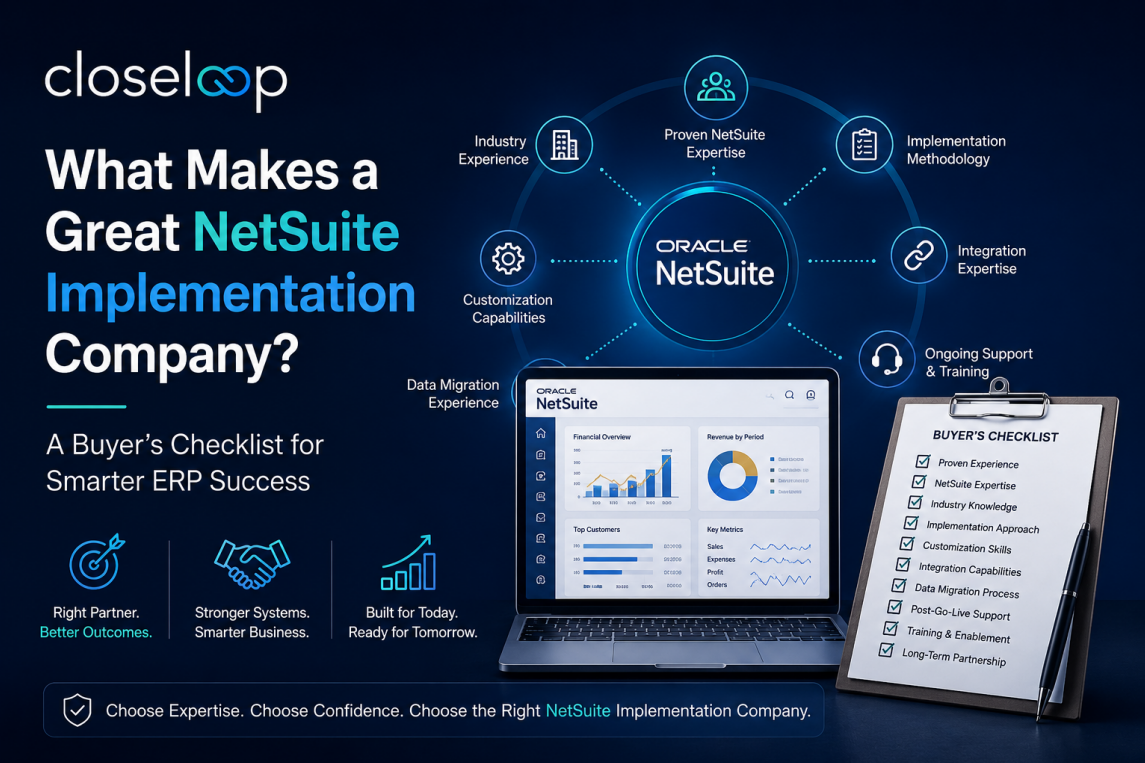
Why a Checklist Approach Works Better Than Gut Feel
NetSuite implementations involve dozens of moving parts: configuration, customization, integrations, data migration, testing, training, and support. Evaluating a vendor on a single call or a polished sales deck rarely surfaces the details that determine project success.
A structured checklist forces both sides of the conversation to get specific. Instead of asking "are you experienced with NetSuite," a checklist prompts questions like "how many implementations have you completed in our industry, and can you show us examples." That level of specificity is what separates a genuinely capable NetSuite implementation company from one that simply says the right things.
Also Read: A Comprehensive Guide to NetSuite ERP Implementation
The Buyer's Checklist: 12 Things to Verify
1. Active NetSuite Partner Status
Confirm the company holds current, verifiable NetSuite partner status rather than relying on general familiarity with the platform. Partner status is a baseline credibility check, not proof of quality by itself.
2. Certified, Experienced Consultants
Ask which specific consultants will work on your project and what certifications they hold. A company's overall experience means little if your project is staffed by junior team members with limited hands-on time.
3. Relevant Industry Track Record
Look for prior work in your industry or a closely comparable one. A NetSuite implementation consultant who understands your sector's processes, terminology, and compliance needs will move through discovery faster and configure the system more accurately.
4. A Clear, Documented Methodology
Ask the vendor to walk you through their actual implementation process step by step, including phases, milestones, and deliverables. Vague or improvised answers here are a red flag.
5. Demonstrated Customization Skill
Review real examples of NetSuite customization work, including SuiteScript development, SuiteFlow automation, and custom SuiteApps built for other clients with needs similar to yours.
6. Integration Experience With Your Tech Stack
Ask specifically which platforms they have connected to NetSuite before, such as CRM systems, eCommerce platforms, payroll tools, or middleware like Boomi, Celigo, or MuleSoft. NetSuite integration experience with tools you already use reduces project risk significantly.
7. A Real Data Migration Methodology
Data migration is where many implementations run into trouble. A strong partner should explain, in detail, how they extract, cleanse, map, and validate legacy data before go-live rather than treating it as a simple file transfer.
8. Transparent Project Governance
Look for a dedicated project lead, a defined communication cadence, and clear reporting on progress, risks, and budget. You should never be guessing where the project stands.
9. Realistic Timeline and Scope Estimates
Be cautious of vendors who promise unusually fast timelines without understanding your full scope. A credible NetSuite implementation timeline is based on your specific modules, integrations, and data complexity, not a generic template.
10. Built-In Scalability Planning
Ask how the initial implementation accounts for future growth, including additional users, subsidiaries, business units, or modules. A good partner designs for where your business is headed, not just where it is today.
11. Structured Training and Change Management
Confirm that user training is a defined phase of the project, with role-based training plans for different user groups, rather than a rushed session in the final week before launch.
12. Defined Post-Launch Support
Ask exactly what NetSuite support and maintenance looks like after go-live, including response time commitments, support tiers, and how future requests for NetSuite optimization are scoped and priced.
Quick Reference: The Buyer's Checklist at a Glance
| Checklist Item | What "Good" Looks Like |
|---|---|
| Partner status | Active, verifiable NetSuite partner |
| Consultant experience | Named, certified team members with relevant history |
| Industry track record | Prior projects in your sector or a close match |
| Methodology | Documented, phased process with clear deliverables |
| Customization | Demonstrated SuiteScript and SuiteFlow work |
| Integration | Experience with your specific tech stack |
| Data migration | Defined extract, cleanse, map, and validate process |
| Governance | Dedicated project lead and regular reporting |
| Timeline | Realistic estimate based on your actual scope |
| Scalability | Implementation designed for future growth |
| Training | Structured, role-based training plan |
| Support | Clear post-launch support terms and SLAs |
Questions to Ask During Vendor Evaluation Calls
Use these questions to test how a vendor responds, not just what they say:
- Walk us through a project similar to ours from start to finish.
- What went wrong on a past project, and how did you handle it?
- Who exactly will be assigned to our project, and for how many hours per week?
- How do you scope and price change requests once the project has started?
- What does a typical week of communication look like during implementation?
- How do you validate data accuracy after migration?
- What happens if we need additional customization after go-live?
- Can we speak directly with a current or recent client?
Vendors who answer these questions with specifics, including names, numbers, and concrete examples, are generally more trustworthy than those who respond only with general reassurances.
Navigational vs. Commercial Research: Where This Checklist Fits
Buyers researching NetSuite implementation companies are usually doing one of two things: trying to find a specific, known company (navigational intent) or comparing multiple vendors before shortlisting (commercial investigation intent). This checklist supports both.
If you already have a shortlist and want a broader market view, our roundup of top NetSuite implementation companies in the USA is a useful next step. If you are still learning what NetSuite implementation involves before evaluating vendors, the NetSuite implementation services guide covers the fundamentals in more depth.
Red Flags That Signal a Weak NetSuite Implementation Company
- Reluctance to provide references or discuss past project challenges
- No clear answer when asked about their implementation methodology
- Pricing that seems significantly lower than other quotes with no explanation
- Little to no mention of data migration planning or validation
- No dedicated project lead or unclear points of contact
- Vague or evasive answers about post-launch support terms
- No experience with the specific integrations or industry you need
Any one of these on its own may not be disqualifying, but multiple red flags together are a strong signal to keep looking.
Also Read: Transforming Finance Systems for LastPass on NetSuite ERP
Beyond NetSuite: Evaluating Full-Stack Capability
Many businesses need more than NetSuite configuration alone. If your project involves connecting NetSuite to a CRM or building custom functionality around it, it is worth asking whether the vendor can support that too. Companies offering Custom CRM Development, HubSpot Implementation, or Salesforce Implementation alongside NetSuite work can reduce the coordination overhead of managing multiple vendors for related systems.
Similarly, if your evaluation includes broader ERP Implementation Services beyond NetSuite specifically, it is worth confirming the vendor's experience across the wider enterprise resource planning category, not just NetSuite in isolation.
How to Use This Checklist During Vendor Comparison
- Send the checklist items as evaluation criteria in your RFP or discovery call agenda.
- Score each vendor against the 12 items rather than relying on overall impressions.
- Weight items based on your priorities. A company with heavy data complexity should weight data migration experience more heavily, for example.
- Compare scored results side by side rather than defaulting to the lowest quote.
- Validate top answers with reference calls before making a final decision.
This structured approach reduces the risk of choosing a vendor based on presentation quality alone, and helps surface the partner best equipped for your specific project.
Why Businesses Choose Closeloop for NetSuite Implementation
Businesses working through this kind of checklist often look for a partner that can speak concretely to each item rather than in generalities. Closeloop's NetSuite Implementation Services are structured around a defined, phased methodology covering discovery, configuration, customization, integration, data migration, testing, training, and go-live support.
The team's technical capabilities include NetSuite customization using SuiteScript and SuiteFlow, along with integration experience connecting NetSuite to CRM platforms, eCommerce systems, and middleware tools. Data migration is treated as a distinct, structured phase focused on accuracy and validation rather than a simple import step, and post-launch support is scoped clearly so businesses know what to expect after go-live.
Closeloop approaches NetSuite engagements the way this checklist recommends evaluating them: with specifics, transparency, and a focus on long-term fit rather than a one-size-fits-all pitch.
Conclusion
Choosing a great NetSuite implementation company comes down to verifying specifics, not accepting general reassurances. Use this checklist during vendor evaluation calls, score candidates against the same criteria, and validate top choices with reference calls before signing. A structured, criteria-based comparison consistently leads to better outcomes than choosing based on price or presentation alone.
Author

Swetha GP

VP of Delivery
She is a VP of Delivery at Closeloop. A communicator, business analyst, and engineering aficionado. Besides handling client relations, and engineering duties, she loves to pour her thoughts on paper. She writes about engineering, technologies, frameworks, and everything related to the software domain. She reads, spends time with family, and enjoys a good walk in nature in her free time. Her dream destination is Greece.
Frequently Asked Questions
Connect with our experts to discuss your requirements. For any queries, reach out to sales@closeloop.com
Stay abreast of what's trending in the world of technology
The Role of APIs and Integrations in Modern Custom Software Development
No application works alone anymore. Your CRM talks to your billing tool, your mobile app...
How Software Development Companies Help Businesses Modernize Legacy Systems
Outdated software quietly drains budgets, slows teams down, and blocks growth. Many...

Real-Time vs. Batch NetSuite Integration: Which Architecture Fits Your Workflow?
Every NetSuite project eventually hits the same question: should data move the instant...
Custom Software Development for Startups vs. Enterprises: Key Differences
Building software for a startup is very different from building it for a large enterprise....