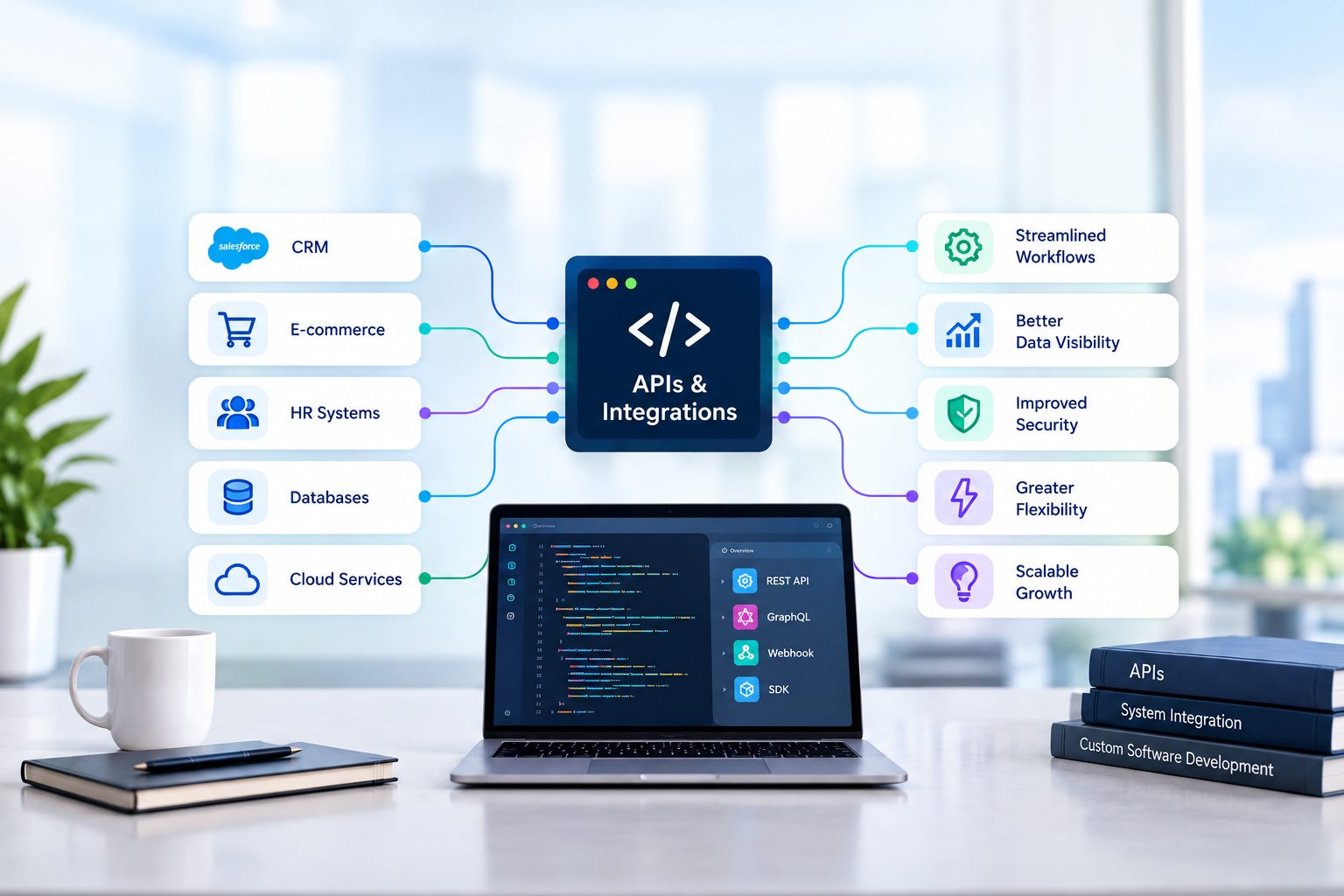
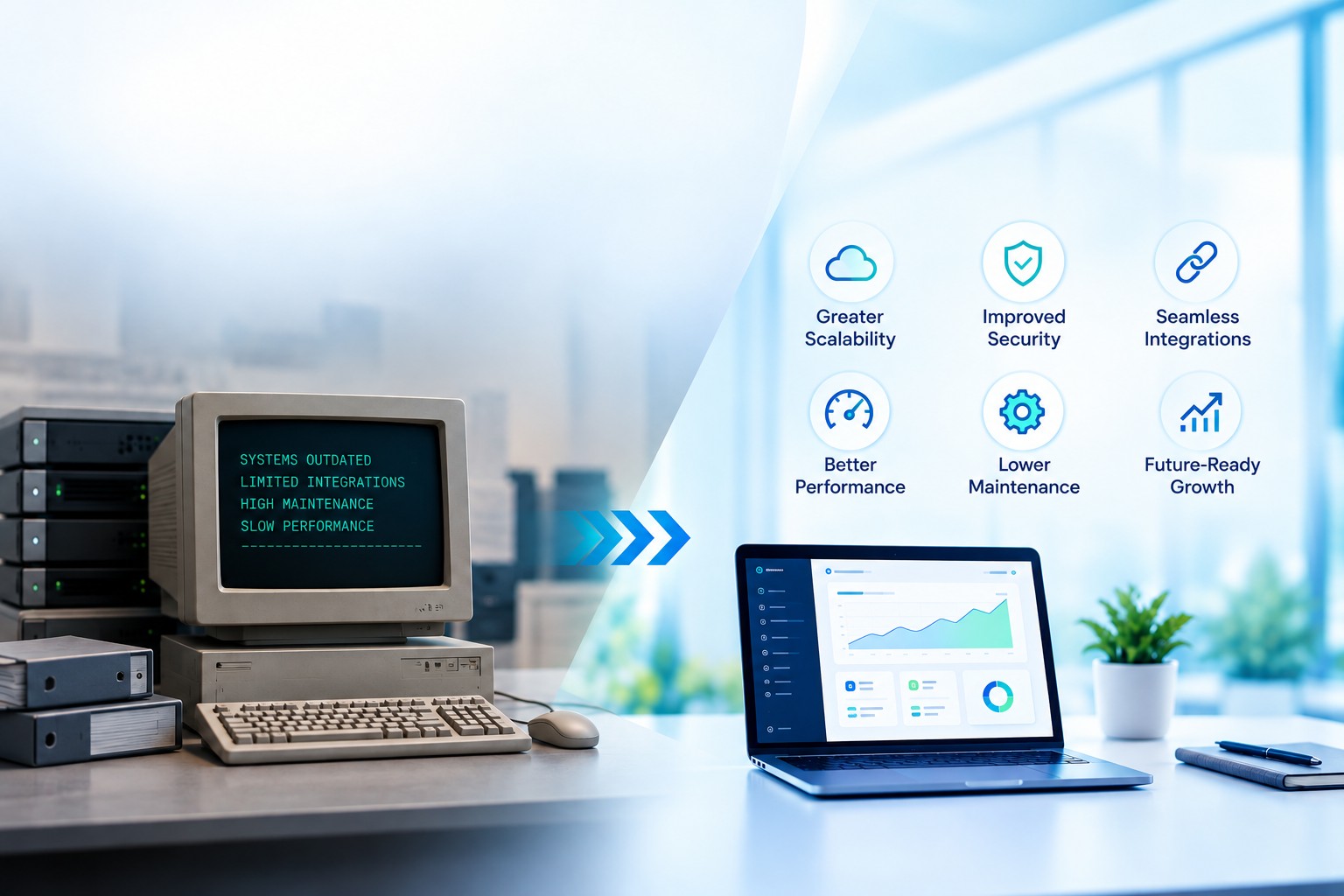
Running a growing business on disconnected systems is one of the fastest ways to lose visibility, waste hours on manual data entry, and make decisions based on outdated numbers. As companies scale, their CRM, e-commerce platform, finance tools, and HR systems often end up operating in silos each holding a piece of the picture, but none of them talking to each other. That's exactly the gap that professional NetSuite Integration Services are designed to close.
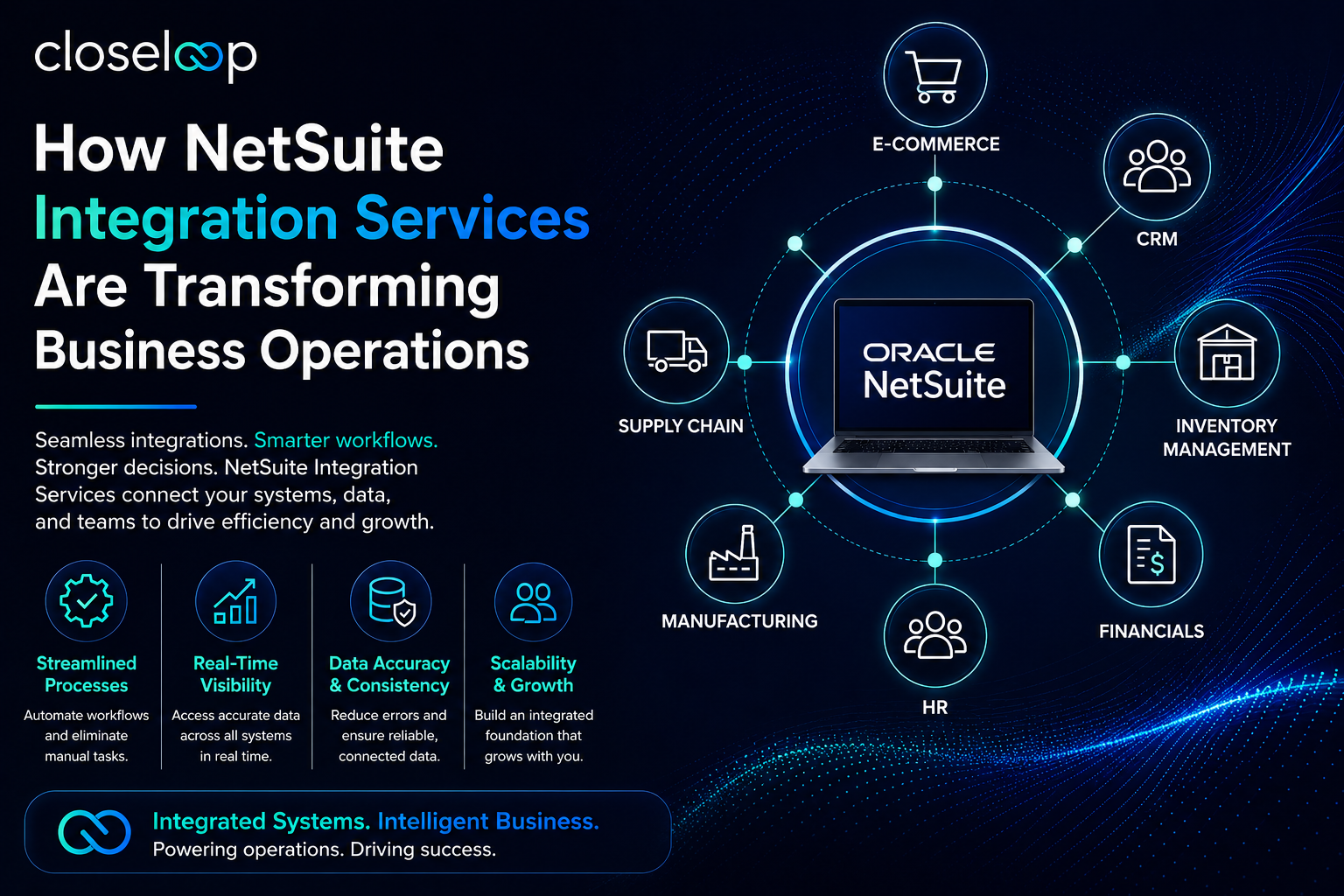
By connecting NetSuite ERP with the other applications a business already relies on, integration services turn scattered data into one unified, real-time source of truth. In this article, we'll look at how NetSuite integration is reshaping day-to-day business operations, the core systems it connects, the role of AI and automation, and what to consider when choosing an integration partner.
According to Oracle NetSuite, businesses that integrate their ERP with CRM, finance, eCommerce, and other business applications can automate manual processes, improve data accuracy, and gain real-time visibility across departments. By leveraging NetSuite Integration, organizations can eliminate data silos, streamline workflows, and ensure information flows seamlessly across every business function.
Why Businesses Are Investing in NetSuite Integration
Most companies don't set out to build a fragmented tech stack it happens gradually as new tools get added to solve immediate problems. A CRM here, an e-commerce platform there, a separate payroll system, a handful of spreadsheets holding everything together. Over time, this creates familiar pain points:
- Data silos that force teams to manually reconcile information across systems
- Duplicate data entry, increasing the risk of costly errors
- Delayed reporting, since numbers have to be pulled and combined manually
- Poor cross-department visibility, making it hard to see how sales, finance, and operations actually connect
- Scaling friction, where every new tool or process adds more manual overhead instead of less
NetSuite integration services solve this by linking ERP with the surrounding business applications through APIs and iPaaS (Integration Platform as a Service) middleware, so data moves automatically instead of being re-entered by hand.
Core Areas Where NetSuite Integration Makes an Impact
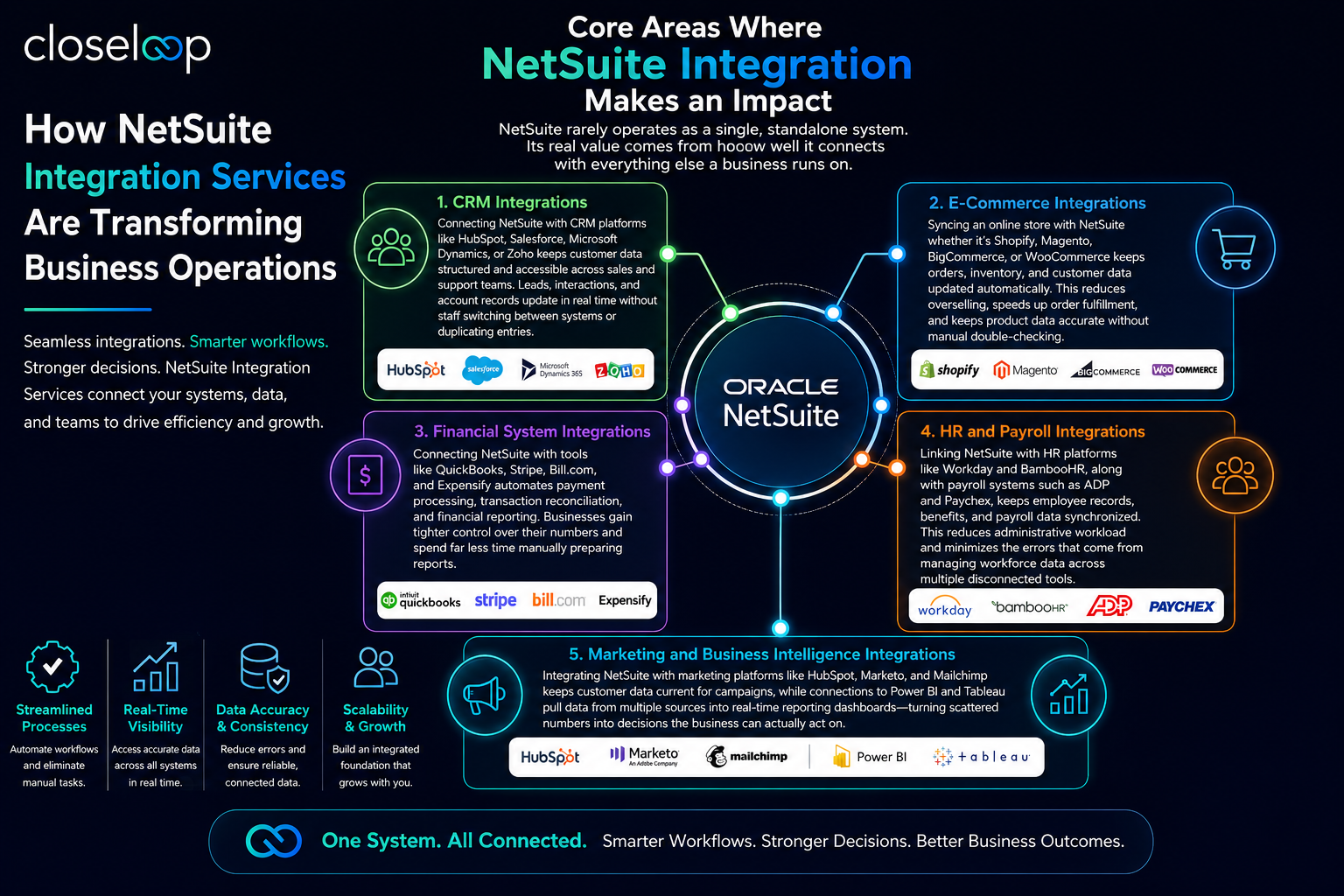
NetSuite rarely operates as a single, standalone system. Its real value comes from how well it connects with everything else a business runs on.
CRM Integrations
Connecting NetSuite with CRM platforms like HubSpot, Salesforce, Microsoft Dynamics, or Zoho keeps customer data structured and accessible across sales and support teams. Leads, interactions, and account records update in real time without staff switching between systems or duplicating entries. For businesses building or refining their CRM environment from the ground up, custom CRM development ensures the platform is built specifically to sync cleanly with NetSuite rather than forcing a generic tool to fit.
E-Commerce Integrations
Syncing an online store with NetSuite whether it's Shopify, Magento, BigCommerce, or WooCommerce keeps orders, inventory, and customer data updated automatically. This reduces overselling, speeds up order fulfillment, and keeps product data accurate without manual double-checking.
Financial System Integrations
Connecting NetSuite with tools like QuickBooks, Stripe, Bill.com, and Expensify automates payment processing, transaction reconciliation, and financial reporting. Businesses gain tighter control over their numbers and spend far less time manually preparing reports.
HR and Payroll Integrations
Linking NetSuite with HR platforms like Workday and BambooHR, along with payroll systems such as ADP and Paychex, keeps employee records, benefits, and payroll data synchronized. This reduces administrative workload and minimizes the errors that come from managing workforce data across multiple disconnected tools.
Marketing and Business Intelligence Integrations
Integrating NetSuite with marketing platforms like HubSpot, Marketo, and Mailchimp keeps customer data current for campaigns, while connections to Power BI and Tableau pull data from multiple sources into real-time reporting dashboards turning scattered numbers into decisions the business can actually act on.
Also Read: Measurable Benefits of NetSuite Integration Services
NetSuite Integration at a Glance
| Primary Purpose | Connect NetSuite ERP with CRM, eCommerce, finance, HR, and other business applications. |
| Business Challenge Solved | Eliminates data silos, duplicate data entry, and disconnected workflows. |
| Key Technologies | APIs, iPaaS platforms (Celigo, Boomi, MuleSoft), AI, and automation. |
| Core Benefits | Real-time data synchronization, improved visibility, automated workflows, and higher operational efficiency. |
| Common Integrations | Salesforce, HubSpot, Shopify, Magento, QuickBooks, Stripe, Workday, BambooHR, Power BI, Tableau. |
| Ideal For | Growing businesses, mid-sized companies, and enterprises managing multiple software platforms. |
| Business Impact | Faster decision-making, improved data accuracy, reduced manual work, and scalable operations. |
The Role of iPaaS Platforms in NetSuite Integration
Most modern NetSuite integrations are built on iPaaS middleware rather than custom point-to-point code, and two platforms consistently lead the way.
Celigo is widely used for its pre-built connectors and configurable workflows that simplify data exchange between NetSuite and other business systems without heavy custom development. A dedicated Celigo integration approach allows businesses to automate processes like order-to-cash and procure-to-pay with minimal manual intervention.
Boomi offers similar middleware capabilities, often favored for its flexibility across complex, multi-system environments. Boomi integration services are commonly used when a business needs to connect NetSuite with a broader mix of legacy and cloud-based applications simultaneously.
Both platforms reduce the need for custom coding by using pre-built connectors and APIs, which shortens implementation timelines and lowers long-term maintenance costs compared to fully custom integration builds.
AI's Growing Role in NetSuite Integration
Artificial intelligence is increasingly layered on top of NetSuite integrations to move businesses from simple data synchronization toward smarter, more predictive operations. Practical applications include:
- Automated anomaly detection in financial transactions and inventory records
- Predictive demand forecasting based on synchronized sales and inventory data
- Smart routing and prioritization of support tickets pulled from integrated CRM data
- Natural language reporting that surfaces insights from combined NetSuite and BI data sources
Working with an AI integration partner alongside your NetSuite implementation helps ensure these capabilities are built into the integration architecture from the start, rather than bolted on afterward as a separate project.
NetSuite Integration and the Bigger Data Picture
Integration doesn't stop at connecting applications the data flowing through those connections needs to be reliable, well-structured, and usable for analytics at scale. This is where broader data engineering capabilities come in, ensuring that data moving between NetSuite and other systems is clean, consistent, and ready for reporting rather than just "connected."
For businesses generating large volumes of operational data across NetSuite, CRM, and e-commerce platforms, Databricks consulting can help process and analyze that combined data at scale, powering more advanced forecasting and business intelligence than NetSuite's native reporting alone can support.
And for organizations dealing with multiple legacy systems alongside NetSuite, data platform modernization ensures the underlying infrastructure can actually support real-time integration instead of being held back by outdated databases and reporting tools.
Common Integration Challenges and How to Avoid Them
Even with the right platforms in place, NetSuite integration projects can run into predictable roadblocks if they aren't planned carefully. Understanding these challenges upfront makes it much easier to avoid costly rework later.
Inconsistent data formats across systems are one of the most common issues. A CRM might store customer names differently than an e-commerce platform, and without proper mapping and cleansing, integrated data can end up inaccurate or duplicated rather than unified.
Overly rigid integration architecture is another frequent problem. Point-to-point integrations built for today's tech stack can become brittle and expensive to maintain as new applications get added. Building on flexible iPaaS middleware from the start avoids having to rebuild connections every time the business adopts a new tool.
Skipping proper testing and validation before go-live is a shortcut that often backfires. Financial and inventory data errors that slip through untested integrations can be far more disruptive than the manual processes they were meant to replace.
Underestimating change management is easy to overlook but just as important as the technical build. Teams need training on how integrated workflows change their day-to-day processes, or adoption lags and manual workarounds creep back in.
Treating integration as a one-time project rather than an ongoing capability tends to cause integrations to age poorly as business needs evolve. Regular monitoring, along with a partner who understands both the technical and operational side of NetSuite, keeps integrations reliable as the business scales.
Avoiding these pitfalls typically comes down to working with a partner who plans the data architecture carefully upfront, tests thoroughly before deployment, and treats integration as an evolving system rather than a single deliverable.
Measurable Benefits of NetSuite Integration Services
Businesses that invest in proper NetSuite integration consistently see results that generic, disconnected setups can't match:
- Eliminated Data Silos All critical business applications feed into one connected source of truth.
- Improved Operational Visibility Real-time insights across finance, inventory, sales, and workforce performance, rather than reports pieced together after the fact.
- Reduced Manual Work Automated data transfers cut down on repetitive tasks and the errors that come with them.
- Faster Decision-Making Teams work from accurate, up-to-date information instead of waiting on manual reconciliation.
- Easier Scaling A flexible integration foundation supports new applications, users, and business requirements without a system overhaul.
In practice, these benefits show up as real numbers businesses that connect NetSuite with their CRM and financial systems have reported reductions in data inaccuracy of up to 90% and manual data entry drops of over 95% after implementation.
Choosing the Right NetSuite Integration Partner
Not every implementation partner has deep, hands-on experience with NetSuite's integration ecosystem. When evaluating a provider, look for:
- Certified NetSuite consultants with proven integration experience
- Direct expertise with iPaaS platforms like Celigo, Boomi, and MuleSoft
- A track record across CRM, e-commerce, financial, and HR integrations
- The ability to layer in AI and advanced analytics, not just basic data syncing
- Case studies showing measurable outcomes, not just completed projects
If you're planning a broader implementation, this NetSuite implementation services guide walks through the full process from planning to go-live. And if Celigo is part of your integration strategy specifically, this deep dive into Celigo NetSuite integration covers common use cases and implementation patterns worth reviewing before you scope your project.
Conclusion
NetSuite is only as powerful as the ecosystem it's connected to. Left as a standalone system, it still leaves gaps between departments and manual work between platforms. Properly integrated with CRM, e-commerce, financial, HR, and analytics tools, it becomes the true operational backbone of the business one where data moves automatically and decisions are based on real-time information instead of guesswork.
Closeloop has spent more than 15 years helping businesses implement and integrate NetSuite ERP with the applications that run their day-to-day operations, delivering measurable improvements in data accuracy, efficiency, and reporting speed. If disconnected systems are slowing your business down, NetSuite Integration Services built around your specific tech stack can turn that fragmented environment into one connected, scalable system.
Author

Swetha GP

VP of Delivery
She is a VP of Delivery at Closeloop. A communicator, business analyst, and engineering aficionado. Besides handling client relations, and engineering duties, she loves to pour her thoughts on paper. She writes about engineering, technologies, frameworks, and everything related to the software domain. She reads, spends time with family, and enjoys a good walk in nature in her free time. Her dream destination is Greece.
Frequently Asked Questions
Connect with our experts to discuss your requirements. For any queries, reach out to sales@closeloop.com
Stay abreast of what's trending in the world of technology
When Standard NetSuite Workflows Fall Short: Implementation, Integration, and Customization...
NetSuite is one of the most capable cloud ERP platforms available, but no out-of-the-box...

From Business Bottlenecks to Digital Products: How to Evaluate Software Development Partners in the...
Every growing business eventually hits a wall. Spreadsheets multiply, teams re-enter the same...

The Hidden Cost of Disconnected Logistics Systems: A Software Architecture Approach to End-to-End...
A shipment leaves the warehouse on time, yet the customer calls twice asking where it is....
The Role of APIs and Integrations in Modern Custom Software Development
No application works alone anymore. Your CRM talks to your billing tool, your mobile app...