Growth sounds exciting until the systems behind the business start struggling to keep up. A company may gain more customers, add new employees, expand into new markets, and introduce new services. Suddenly, spreadsheets become difficult to manage, manual approvals slow everything down, and employees spend too much time moving information between disconnected tools. This is where Customized Software Development Services can give growing businesses a more flexible way to handle increasing demands without forcing teams to rebuild their processes around rigid software.
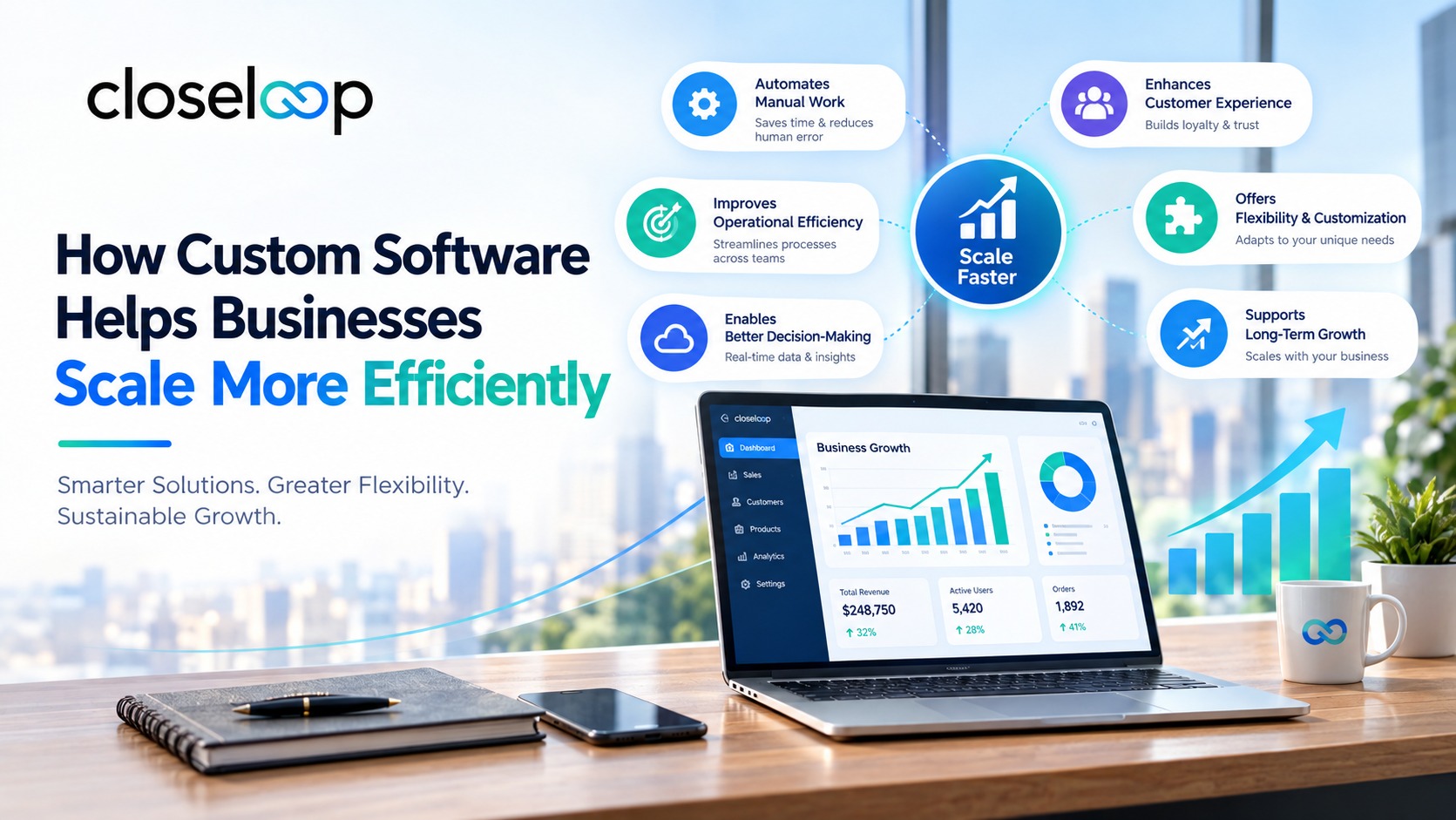
The real value is not simply having software built from scratch. It is having technology that can grow alongside the organization. When designed around actual business needs, custom software can improve workflows, connect systems, automate repetitive work, and give teams more room to focus on growth.
Why Scaling Creates Technology Problems
A business can operate comfortably with basic tools when it has a small team. But what happens when the customer base doubles? The answer is rarely as simple as buying more software.
Different departments may start using different platforms. Sales may maintain one database while operations use another. Finance may depend on spreadsheets. Customer service might have its own ticketing system. As the business expands, these gaps become harder to manage.
Employees spend more time searching for information. Managers have less visibility. Customers may experience slower service.
This is often called operational friction. It does not always appear as one major problem. Instead, small delays pile up until growth itself becomes harder.
1. Automating Repetitive Work
One of the clearest ways custom software supports growth is by reducing repetitive manual work.
Think about an employee who spends hours every week copying information between systems, checking documents, sending routine updates, or preparing the same reports. That work may seem manageable at first. With a larger customer base, though, the workload grows along with it. Custom software can automate workflows based on the company's specific rules.
For example, a new customer registration could automatically create the required records, notify the appropriate department, generate documents, and trigger the next step in the workflow.
This is where business process automation solutions can become useful alongside custom applications. Closeloop's automation services focus on reducing manual work, improving workflow visibility, connecting departments, and supporting scalable operations.
The result is not just faster work. Employees have more time for tasks that actually require judgment.
2. Building Around the Way Your Business Actually Works
Off-the-shelf software can be useful. In fact, it is often the right choice for common business requirements. But there are situations where the business has a workflow that does not fit neatly into a standard product.
Employees then create workarounds. They maintain separate spreadsheets. They export data manually. Someone keeps a personal tracker because the main system does not provide the information they need.
At that point, the software is shaping the business instead of supporting it. Customized Software Development Services allow companies to design applications around their actual processes. Closeloop's approach includes analyzing business processes, challenges, and objectives before developing solutions around those requirements. Its service portfolio covers custom applications, enterprise software, mobile and web applications, cloud solutions, and legacy modernization.
The important part is not customization for its own sake. Every custom feature should solve a real problem.
3. Connecting Disconnected Business Systems
As businesses grow, they often accumulate technology. A CRM may handle customer relationships. An ERP manages financial or operational information. A separate platform handles inventory. Another application supports marketing. The problem begins when these systems cannot share information effectively.
Employees may enter the same customer details several times. Data can become inconsistent. Managers may wait for reports because information is scattered across different platforms.
Custom software can act as a bridge between these systems by supporting integrations and creating unified workflows.
Closeloop also provides system integration services that can help organizations connect business applications and improve the movement of information across their technology environment. When systems communicate properly, scaling becomes less dependent on manual coordination.
4. Modernizing Systems Without Starting From Zero
Not every growing business needs a completely new application. Sometimes the existing system contains valuable business logic and data but has become outdated. Replacing everything at once can introduce unnecessary risk. Modernization offers another path.
Businesses can assess the existing application, identify weak areas, improve the architecture, migrate selected components, or introduce newer technologies gradually.
Closeloop's legacy application modernization services cover areas including system assessment, modernization, data migration, testing, deployment, and support.
This can be especially useful when an older application still supports an important business function but cannot keep pace with new requirements.
When Should a Business Consider Custom Software?
Custom development is not automatically the right answer for every company. A ready-made product may be more practical when the business has standard requirements, needs a quick deployment, or does not require extensive customization.
Custom software becomes more attractive when existing tools create repeated limitations. It can also make sense when a company has specialized workflows, needs deeper integrations, handles complex operational processes, or expects its technology requirements to change significantly.
Closeloop's own comparison of SaaS and custom software explains that businesses should consider factors beyond initial price when deciding between the two approaches.
The better question is not, "Should we build everything ourselves?"
It is, "Which technology approach will support our business as it grows?"
Also Read: Custom Software vs Off-the-Shelf Software: Which Is Better for Growing Businesses?
Planning Custom Software for Long-Term Growth
Building software for scale requires more than choosing a programming language and starting development. Begin with the business problem.
Map the existing workflow. Identify bottlenecks. Talk with the people who use the process every day. Define which tasks should be automated and which should remain under human control. Then establish measurable goals.
Maybe the objective is to reduce processing time. Perhaps the business wants to support more customers without adding the same number of employees. It could also be about improving data visibility or reducing errors. Once those goals are clear, technical decisions become easier.
This is also where Customized Software Development Services can provide value beyond coding. A capable technology partner can help evaluate requirements, select an appropriate architecture, plan integrations, consider scalability, and build a solution that can evolve over time.
Build for the Business You Are Becoming
Scaling efficiently is not about adding technology everywhere. It is about removing the friction that prevents people and processes from keeping up with growth.
Custom software can help businesses automate repetitive work, connect systems, improve data access, support larger customer volumes, and modernize outdated technology. More importantly, it can give the organization a technology foundation that evolves as its needs change.
Closeloop's custom development capabilities cover the full journey from software consulting and application development to enterprise solutions, cloud technologies, and modernization. That broader engineering perspective can be useful when growth involves more than building a single application.
For businesses considering a technology investment, the smartest starting point is not a list of features. Start with the bottleneck. Find where growth is creating pressure and understand why it is happening. Then build around the solution.
With the right strategy, Customized Software Development Services can become more than a technology investment. They can give a growing business the flexibility, efficiency, and operational foundation it needs to move forward without letting outdated processes hold it back.
Author

Swetha GP

VP of Delivery
She is a VP of Delivery at Closeloop. A communicator, business analyst, and engineering aficionado. Besides handling client relations, and engineering duties, she loves to pour her thoughts on paper. She writes about engineering, technologies, frameworks, and everything related to the software domain. She reads, spends time with family, and enjoys a good walk in nature in her free time. Her dream destination is Greece.
Stay abreast of what's trending in the world of technology
NetSuite Integration Challenges and How Businesses Can Overcome Them
Most NetSuite projects do not struggle because of NetSuite itself. They struggle at the...
How AI and Automation Are Transforming Modern Logistics Operations
A shipment that leaves the warehouse on time can still arrive late. A truck can run full on...

The Hidden Risks of AI-Generated Code in Enterprise Applications
AI coding assistants have moved from experiment to everyday tool in many engineering teams....
When Standard NetSuite Workflows Fall Short: Implementation, Integration, and Customization...
NetSuite is one of the most capable cloud ERP platforms available, but no out-of-the-box...