Artificial intelligence has moved far beyond being a buzzword in the technology industry. It is now a core part of how software gets designed, built, tested, and maintained. For any modern Software Development Company in USA, AI is no longer an optional add-on. It has become a foundational capability that shapes how teams write code, how businesses automate operations, and how enterprises make decisions with data. Companies like Closeloop are already helping organizations rethink their software strategy around this shift, using AI not as a feature bolted onto existing products but as a driver of how those products are conceived from the start.
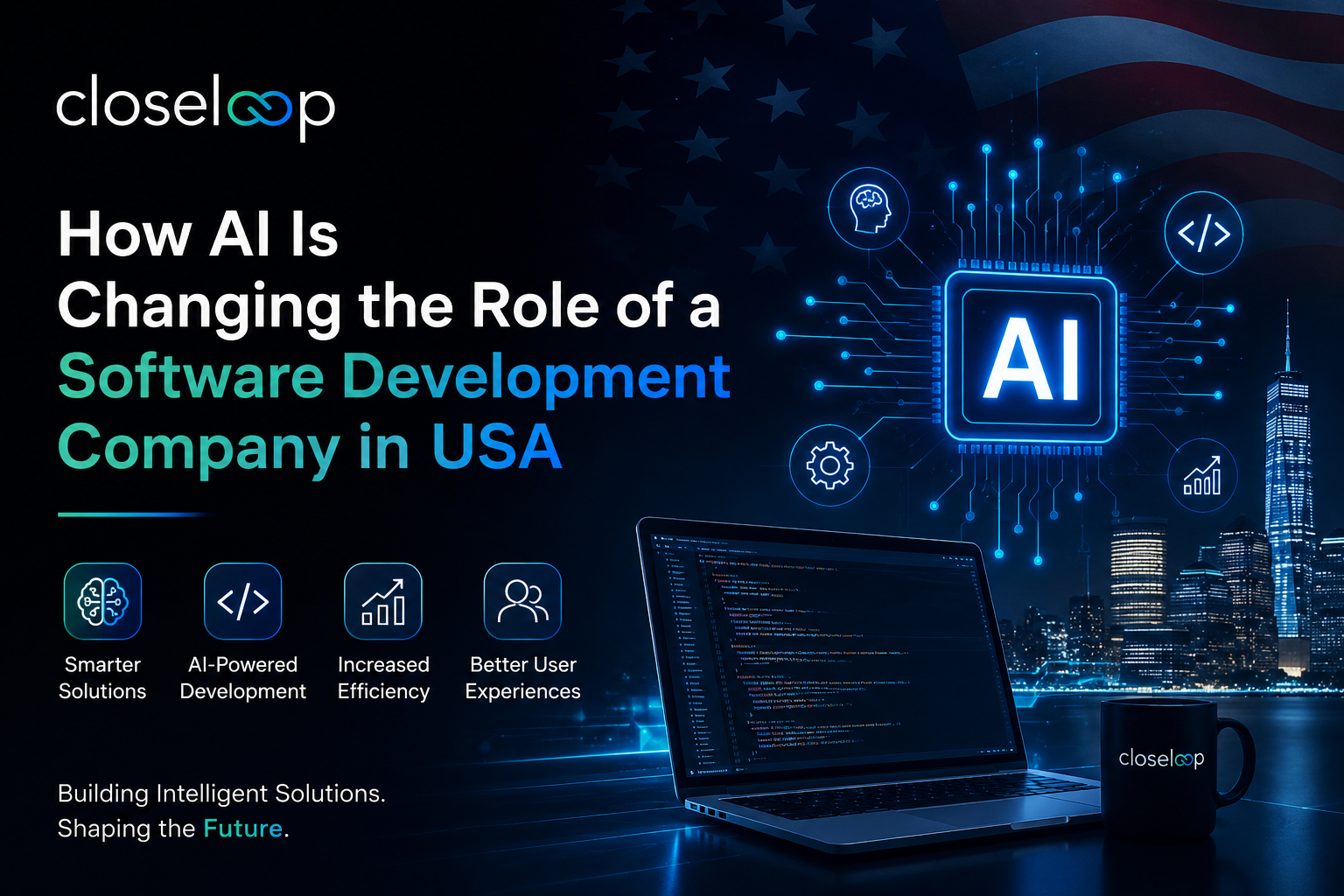
This article breaks down the practical ways artificial intelligence is reshaping software development, from automation and predictive analytics to data engineering, cloud infrastructure, and enterprise-grade applications, and explains what this means for businesses choosing a technology partner today.
AI Integration Is Reshaping the Software Development Lifecycle
Traditional software development followed a fairly linear path: gather requirements, design, code, test, deploy, and maintain. AI is compressing and reshaping that lifecycle at nearly every stage. Machine learning models can now assist with writing boilerplate code, suggesting architecture patterns, flagging bugs before they reach production, and even generating test cases automatically.
For a Custom Software Development team, this means faster iteration cycles and fewer manual errors. Developers spend less time on repetitive tasks and more time on solving actual business problems. AI-assisted coding tools also help junior developers ramp up faster, since the models can suggest best practices in real time rather than requiring every lesson to be learned through trial and error.
The result is software that reaches the market faster without sacrificing quality, a balance that used to be much harder to strike.
Automation Is Reducing Manual Work Across the Stack
Automation has always been part of software engineering, but AI has expanded what can actually be automated. It is no longer limited to running scripted test suites. AI-driven automation now covers intelligent monitoring, self-healing infrastructure, automated code reviews, and workflow orchestration that adapts based on real-time conditions rather than fixed rules.
This shift matters because it changes the day-to-day responsibilities of a development team. Instead of manually checking system logs or triaging every alert, engineers can rely on AI systems that detect anomalies, predict failures before they happen, and even trigger corrective actions on their own. This frees up human talent to focus on strategic problems, product design, and innovation, which is exactly where their expertise adds the most value.
Predictive Analytics Is Turning Data Into Decisions
One of the more transformative applications of AI in software today is predictive analytics. Businesses are no longer satisfied with dashboards that only show what already happened. They want systems that can forecast demand, flag potential churn, predict equipment failure, or identify fraud before it causes damage.
Building these capabilities requires more than just plugging in an algorithm. It requires clean data pipelines, well-structured models, and infrastructure that can serve predictions in real time. This is closely tied to the broader shift the industry has seen in sectors like supply chain and transportation, where predictive tools are already changing how operations are planned, as explored in this piece on how AI is reshaping logistics software. The same underlying principles, forecasting, optimization, and real-time decision support, apply across nearly every industry that runs on software today.
Also Read: AI Resume Parser Case Study
Data Engineering Is the Backbone of AI-Ready Software
None of these AI capabilities work without solid data foundations. Poorly structured, inconsistent, or siloed data will produce unreliable models no matter how advanced the algorithm is. This is why data engineering has become such a critical discipline within modern software development, rather than an afterthought handled by a separate team.
Strong Data Engineering practices involve designing pipelines that can ingest data from multiple sources, clean and transform it reliably, and make it available in formats that AI models can actually use. Businesses that invest in this groundwork early tend to see much faster and more reliable results when they start building AI features, because the hardest part of most AI projects is not the model itself but the data that feeds it.
Cloud Development Is Enabling AI at Scale
AI workloads are resource-intensive, and running them efficiently requires infrastructure that can scale up and down based on demand. This is where cloud platforms have become essential rather than just convenient. Training models, hosting inference endpoints, and managing large datasets all benefit from the elasticity that cloud environments provide.
Modern Cloud Development practices now routinely include managed AI services, serverless computing for on-demand inference, and hybrid architectures that balance cost with performance. For businesses, this means AI features can be deployed without the massive upfront investment in physical infrastructure that used to make such projects prohibitively expensive. It also means software can scale globally without a complete infrastructure overhaul each time demand grows.
AI in Enterprise Applications Is Changing How Businesses Operate
Enterprise software has traditionally been built around fixed workflows: approval chains, reporting structures, and rule-based logic. AI is introducing a layer of intelligence on top of these systems that allows them to adapt rather than just execute. Customer relationship platforms can now predict which leads are most likely to convert. Enterprise resource planning systems can forecast inventory needs before a shortage happens. Internal tools can summarize documents, answer employee questions, and automate approvals that used to require manual review.
This shift is pushing enterprises to look for partners who understand both the technical side of AI and the operational realities of large organizations, since deploying AI at enterprise scale involves data governance, security, and change management in addition to the engineering work itself.
The Evolving Role of a Software Development Company in USA
All of this points to a broader change in what businesses expect from a technology partner. A few years ago, a Software Development Company in USA was primarily judged on its ability to deliver functional, well-tested code on time and within budget. Those fundamentals still matter, but they are no longer sufficient on their own.
Today, businesses are looking for partners who can advise on AI strategy, build systems with data quality in mind from day one, architect for cloud scalability, and understand how automation can reduce operational overhead. This is a shift from being purely a vendor to becoming a strategic partner involved in decisions that go well beyond writing code. It mirrors a pattern that industry analysts have tracked closely, as described in this overview from Wikipedia's entry on software engineering, where the discipline itself has continually expanded to absorb new methodologies and technologies as they mature.
The companies that are adapting fastest are the ones treating AI as a core competency rather than a side offering, and businesses evaluating potential partners are increasingly asking pointed questions about AI experience, data infrastructure, and cloud expertise before signing on. A useful reference point for that evaluation process is this roundup of leading custom software development companies in the USA, which highlights the criteria businesses are now using to separate capable partners from the rest.
How Closeloop Helps Businesses Navigate This Shift
Closeloop works with businesses that need more than just code delivery. The team helps organizations plan and build software with AI, data, and scalability considered from the earliest stages of a project rather than added on afterward.
On the custom software side, Closeloop builds applications tailored to specific business workflows rather than forcing teams into rigid, one-size-fits-all platforms. This includes everything from internal operational tools to customer-facing products, all designed with long-term scalability in mind.
For AI integration, Closeloop helps businesses identify where AI can realistically add value, whether that is through recommendation engines, predictive models, natural language processing, or intelligent automation, and then builds those capabilities directly into existing or new software systems.
On the data side, Closeloop's data engineering work focuses on building the pipelines and infrastructure needed to make AI reliable. That includes data cleaning, integration across disparate sources, and setting up systems that can handle both batch and real-time processing.
Cloud development is handled with an eye toward both current needs and future growth, so businesses do not end up rebuilding their infrastructure every time they scale. And for enterprise clients, Closeloop brings experience in integrating AI into large, often complex systems that need to meet strict requirements around security, compliance, and governance.
The common thread across all of this work is a practical approach. Closeloop focuses on solutions that solve real business problems rather than adding AI for the sake of appearing innovative, which is ultimately what separates a useful technology partner from a purely transactional vendor.
Conclusion
AI is not replacing software developers or making traditional development practices obsolete. It is changing what good software development looks like, pushing teams to think about data quality, automation, and scalability as core parts of the process rather than afterthoughts. Businesses that understand this shift and choose partners equipped to handle it will be better positioned to compete as these technologies continue to mature.
If your business is exploring how AI, data, and cloud infrastructure can work together in your software, it is worth talking to a team that has already been building at that intersection. Reach out to Closeloop to discuss what an AI-ready approach to software development could look like for your organization.
Author

Swetha GP

VP of Delivery
She is a VP of Delivery at Closeloop. A communicator, business analyst, and engineering aficionado. Besides handling client relations, and engineering duties, she loves to pour her thoughts on paper. She writes about engineering, technologies, frameworks, and everything related to the software domain. She reads, spends time with family, and enjoys a good walk in nature in her free time. Her dream destination is Greece.
Stay abreast of what's trending in the world of technology
Custom Software Development for Startups vs. Enterprises: Key Differences
Building software for a startup is very different from building it for a large enterprise....
NetSuite Implementation for Startups vs. Enterprises: Key Differences
Choosing an ERP system is a big step for any business. For a startup, it may be the next move...
Common Salesforce CRM Challenges Businesses Face and How to Solve Them
Salesforce can bring sales, service, marketing, and customer data into one place. Yet simply...
How Custom Software Helps Businesses Scale More Efficiently
Growth sounds exciting until the systems behind the business start struggling to keep up. A...