Most businesses adopt an ERP system expecting it to grow with them, but out of the box software rarely fits every workflow, industry requirement, or long-term growth plan. This is where Custom NetSuite Development becomes valuable. Rather than forcing a business to adapt to rigid, generic processes, custom development reshapes NetSuite around how the business actually operates, which is a big part of why so many companies turn to a custom software development approach instead of settling for a one-size-fits-all setup.
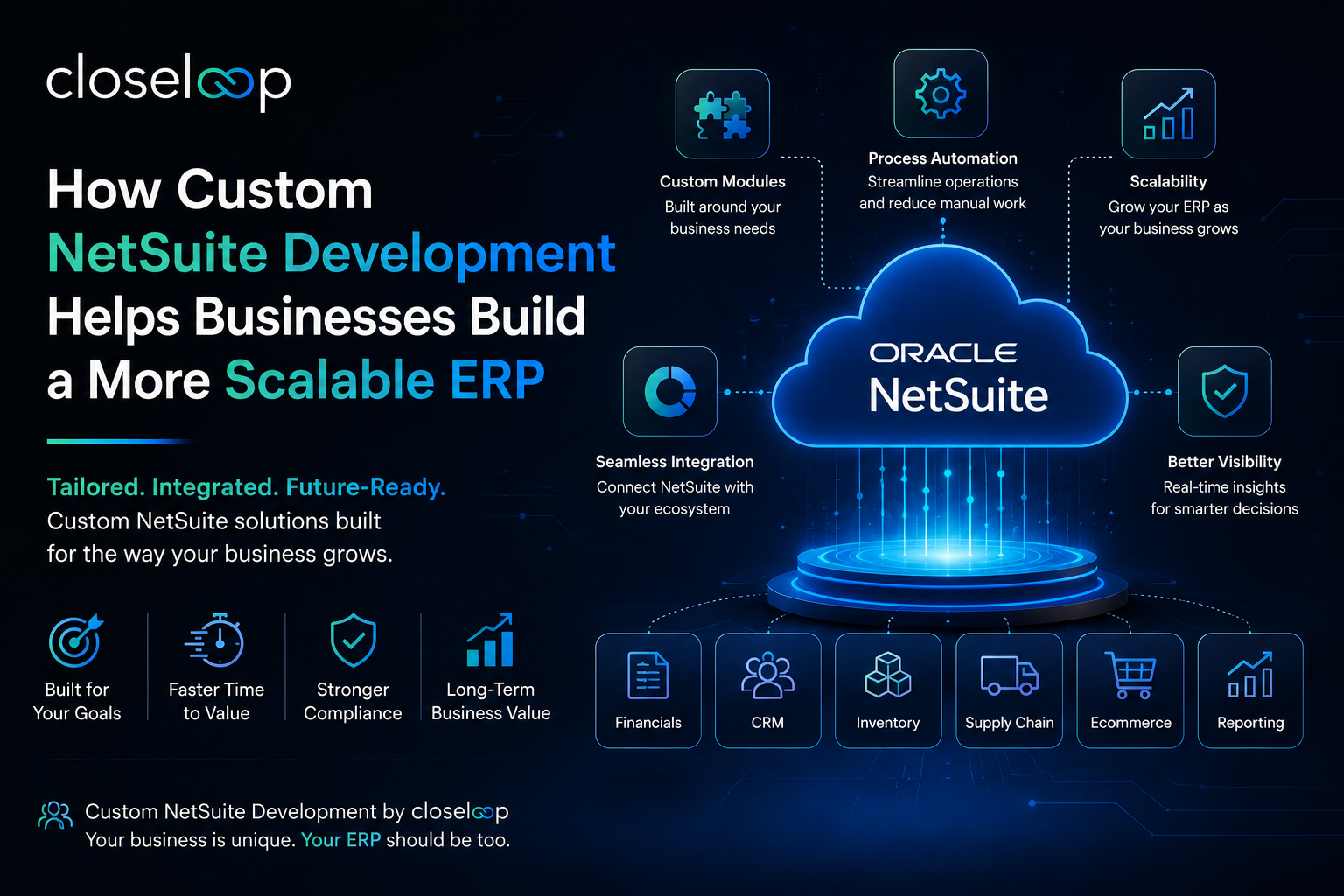
This article looks at how custom NetSuite development helps businesses overcome common ERP limitations, automate manual workflows, improve system integrations, and build a foundation that can scale as the business grows, along with practical considerations for anyone evaluating this path.
Why Standard ERP Setups Often Fall Short
Off-the-shelf ERP configurations are built to serve a broad range of industries, which means they are rarely optimized for any single one. A manufacturing company, a retail brand, and a professional services firm all have very different reporting needs, inventory logic, and approval chains, yet a default implementation often forces them into similar templates.
Over time, this creates friction. Teams build workarounds, rely on spreadsheets outside the system, or simply avoid using certain modules altogether because they do not match real workflows. A proper NetSuite implementation addresses this at the foundation by configuring the platform around actual business processes from the start, rather than trying to patch problems after go-live.
Understanding this gap is easier with some background on what ERP systems are meant to solve in the first place, a concept explained in more detail on Wikipedia's overview of enterprise resource planning, which outlines how these systems evolved to unify business functions under a single platform.
Automating Workflows Instead of Managing Them Manually
One of the clearest benefits of custom NetSuite development is workflow automation. Many businesses running standard NetSuite setups still handle approvals, notifications, and data entry manually, even though the platform is capable of automating most of that work with the right configuration.
Custom scripts and workflows can automatically route purchase orders for approval based on amount thresholds, trigger alerts when inventory drops below a set level, or sync data between departments without anyone needing to manually re-enter it. This is the kind of work covered under business process automation, and it tends to have an immediate, measurable impact because it removes hours of repetitive manual work every week.
Also Read: Cordance NetSuite Case Study
Improving Integrations Across Business Systems
Very few businesses run on NetSuite alone. Most also rely on CRM platforms, ecommerce systems, shipping providers, and financial tools that all need to communicate with the ERP. Poorly built integrations lead to data mismatches, duplicate records, and delays that ripple across departments.
Custom NetSuite development allows businesses to build integrations that are actually designed around their specific tech stack rather than relying on generic connectors that only cover basic use cases. For businesses that need to connect multiple systems reliably, Celigo integration is often part of the solution, since it allows data to flow accurately between NetSuite and other platforms without constant manual reconciliation. Businesses looking for a deeper breakdown of how these connections work in practice may find it useful to read this piece on how NetSuite integrations are transforming business operations.
Supporting Growth Without Rebuilding From Scratch
A major reason businesses invest in custom NetSuite development is scalability. As a company grows, adds new product lines, expands into new markets, or increases transaction volume, the ERP needs to keep up without requiring a complete overhaul every time something changes.
This is especially relevant for businesses selling online, where ERP and commerce systems need to stay tightly connected as order volume grows. Custom development that ties NetSuite closely to digital commerce platforms ensures inventory, pricing, and order data stay accurate in real time, even as sales channels multiply. Building this kind of flexibility in early avoids the costly re-platforming projects that many businesses face when their original ERP setup was never designed to scale.
Turning ERP Data Into Business Intelligence
Beyond day-to-day operations, a well-customized NetSuite instance can become a genuine source of business intelligence rather than just a transactional system. Businesses that layer analytics and data engineering on top of their ERP data can start forecasting demand, tracking margins in real time, and identifying trends that would otherwise stay buried in raw records.
For companies managing large volumes of data across systems, pairing NetSuite with Databricks consulting makes it possible to process and analyze that data at scale, turning years of transactional history into something genuinely useful for planning and decision-making. Oracle's own documentation on NetSuite, referenced on its Wikipedia entry, gives useful context on how the platform has expanded well beyond basic accounting into a full suite of business management tools.
Also Read: Best NetSuite Implementation Companies for Growing Businesses
Key Development Considerations
Businesses considering custom NetSuite development should keep a few practical factors in mind before starting a project. Customizations should be built with future NetSuite upgrades in mind, since poorly structured scripts can break during platform updates. It is also worth prioritizing configuration over heavy customization wherever possible, since native features are easier to maintain long term than custom code.
Choosing the right implementation partner matters just as much as the technical approach itself. Businesses evaluating vendors often compare experience, industry focus, and post-launch support before making a decision, criteria that are laid out clearly in this roundup of leading NetSuite implementation companies in the USA.
How Closeloop Helps Businesses Customize and Scale NetSuite
Closeloop works with businesses that need NetSuite to do more than run basic accounting and order management. The team focuses on configuring and customizing the platform around how a business actually operates, rather than pushing a generic template and hoping it fits.
This includes building custom workflows and automations that eliminate manual bottlenecks, developing integrations with CRM, ecommerce, and third-party logistics systems, and structuring the platform so it can handle growth without requiring a rebuild every few years. For businesses selling across multiple channels, Closeloop also helps connect NetSuite tightly with commerce platforms so inventory and order data stay accurate as volume increases.
On the data side, Closeloop helps businesses go beyond basic reporting by building pipelines that turn NetSuite data into forecasts, dashboards, and insights that actually inform decisions. Throughout all of this, the goal stays consistent: build a NetSuite environment that fits the business today and has room to grow without becoming a liability later.
Conclusion
A generic ERP setup can carry a business only so far. Custom NetSuite development gives companies the flexibility to automate real workflows, integrate the systems they actually use, and scale without hitting a wall every time the business changes shape. The businesses that treat NetSuite as a long-term platform, rather than a one-time implementation, tend to get far more value out of it over time.
If your team is running into limitations with your current NetSuite setup or planning a new implementation, it is worth talking to a partner who can build around your specific processes from the start. Get in touch with Closeloop to discuss how a custom-built NetSuite environment could support your business as it grows.
Author

Swetha GP

VP of Delivery
She is a VP of Delivery at Closeloop. A communicator, business analyst, and engineering aficionado. Besides handling client relations, and engineering duties, she loves to pour her thoughts on paper. She writes about engineering, technologies, frameworks, and everything related to the software domain. She reads, spends time with family, and enjoys a good walk in nature in her free time. Her dream destination is Greece.
Stay abreast of what's trending in the world of technology
Custom Software Development for Startups vs. Enterprises: Key Differences
Building software for a startup is very different from building it for a large enterprise....

NetSuite Implementation for Startups vs. Enterprises: Key Differences
Choosing an ERP system is a big step for any business. For a startup, it may be the next move...
Common Salesforce CRM Challenges Businesses Face and How to Solve Them
Salesforce can bring sales, service, marketing, and customer data into one place. Yet simply...
How Custom Software Helps Businesses Scale More Efficiently
Growth sounds exciting until the systems behind the business start struggling to keep up. A...