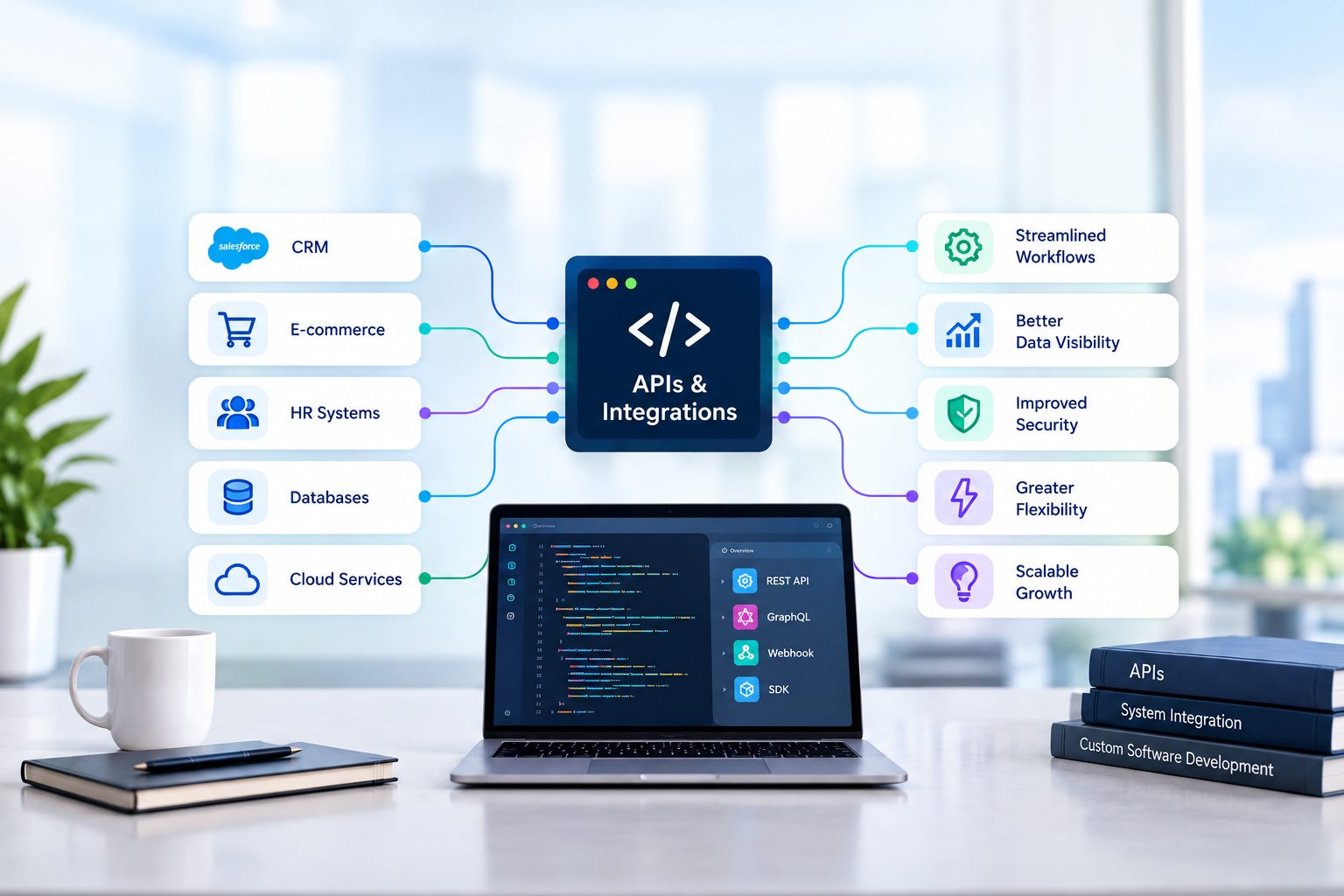
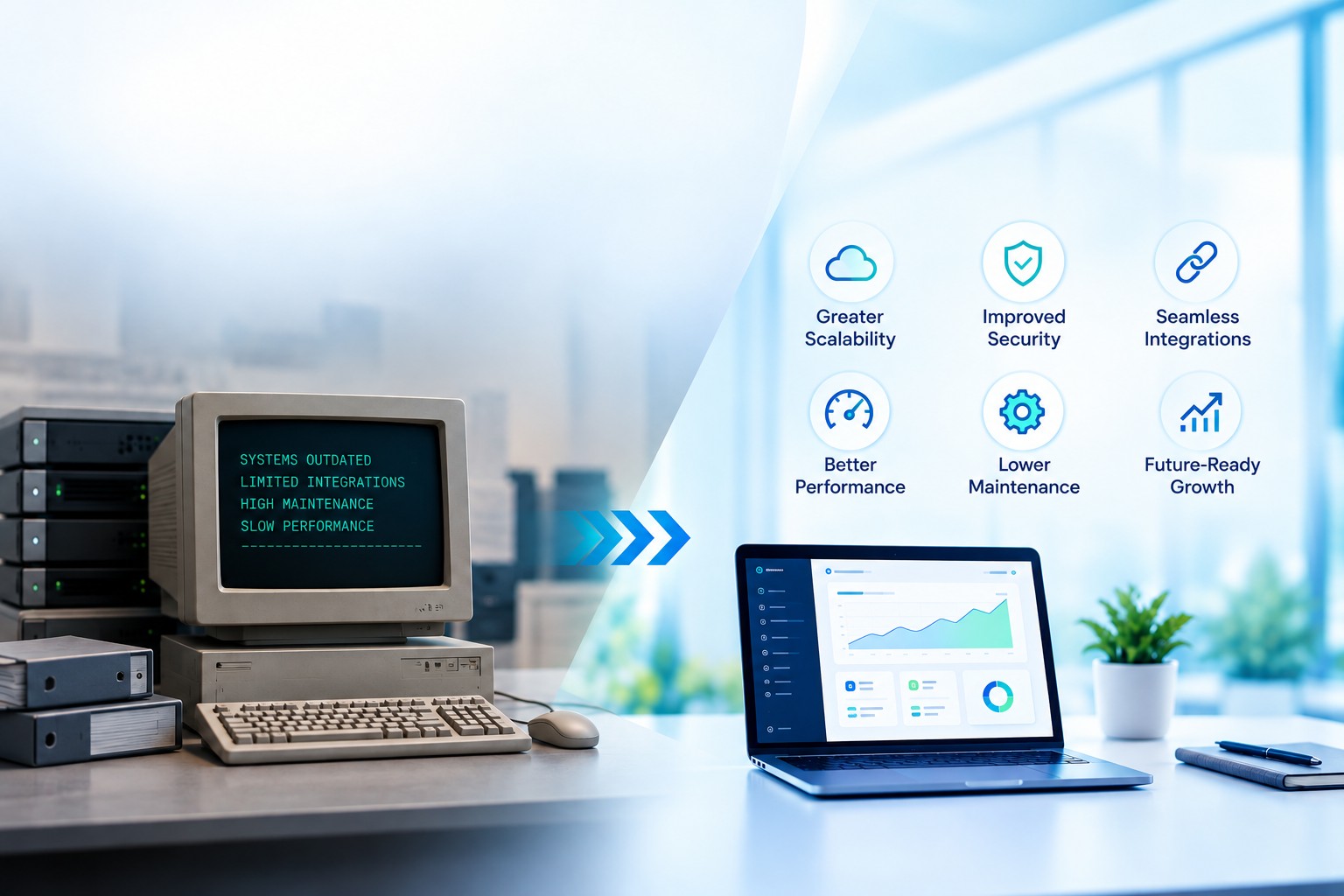
Modern businesses rely on multiple digital platforms to manage customers, products, orders, subscriptions, invoices, payments, support tickets, employee data, operational records, analytics, and AI-ready intelligence.
Executive Summary
As these systems grow, the same information often appears in many places, creating inconsistencies, duplicate records, conflicting reports, and unclear ownership.
At Closeloop, we help organizations design and implement source-of-truth systems that establish one trusted owner for every critical data entity. This creates clarity around where official data lives, which platforms can update it, how connected systems consume it, how conflicts are resolved, and how business teams can rely on consistent information.
This document consolidates the complete white paper/blog content along with flow diagrams, infographics, matrices, architecture visuals, image directions, captions, and website placement guidance for a polished Closeloop website article.
Introduction
Modern businesses operate across multiple digital systems. Customer information may live in a CRM, billing data may sit in a subscription platform, financial records may flow through an ERP, product information may be managed in a commerce platform, and operational data may be tracked through internal applications, support tools, analytics platforms, and third-party integrations.
As businesses grow, this creates a common challenge: the same data starts appearing in multiple places, often with different values, formats, update timings, and ownership. This leads to confusion, duplicate records, reporting mismatches, operational delays, and poor decision-making.
This is where a Source of Truth system becomes essential.
At Closeloop, we help organizations design, build, and modernize digital ecosystems where every critical data entity has a clearly defined source of truth.
This ensures that teams know which system owns the master record, which systems consume the data, how updates flow across platforms, and how business users can trust the information they rely on.
For us, source-of-truth architecture is not just a technical design choice. It is a foundation for operational clarity, data governance, system reliability, analytics accuracy, and business scalability.
What Is a Source of Truth System?
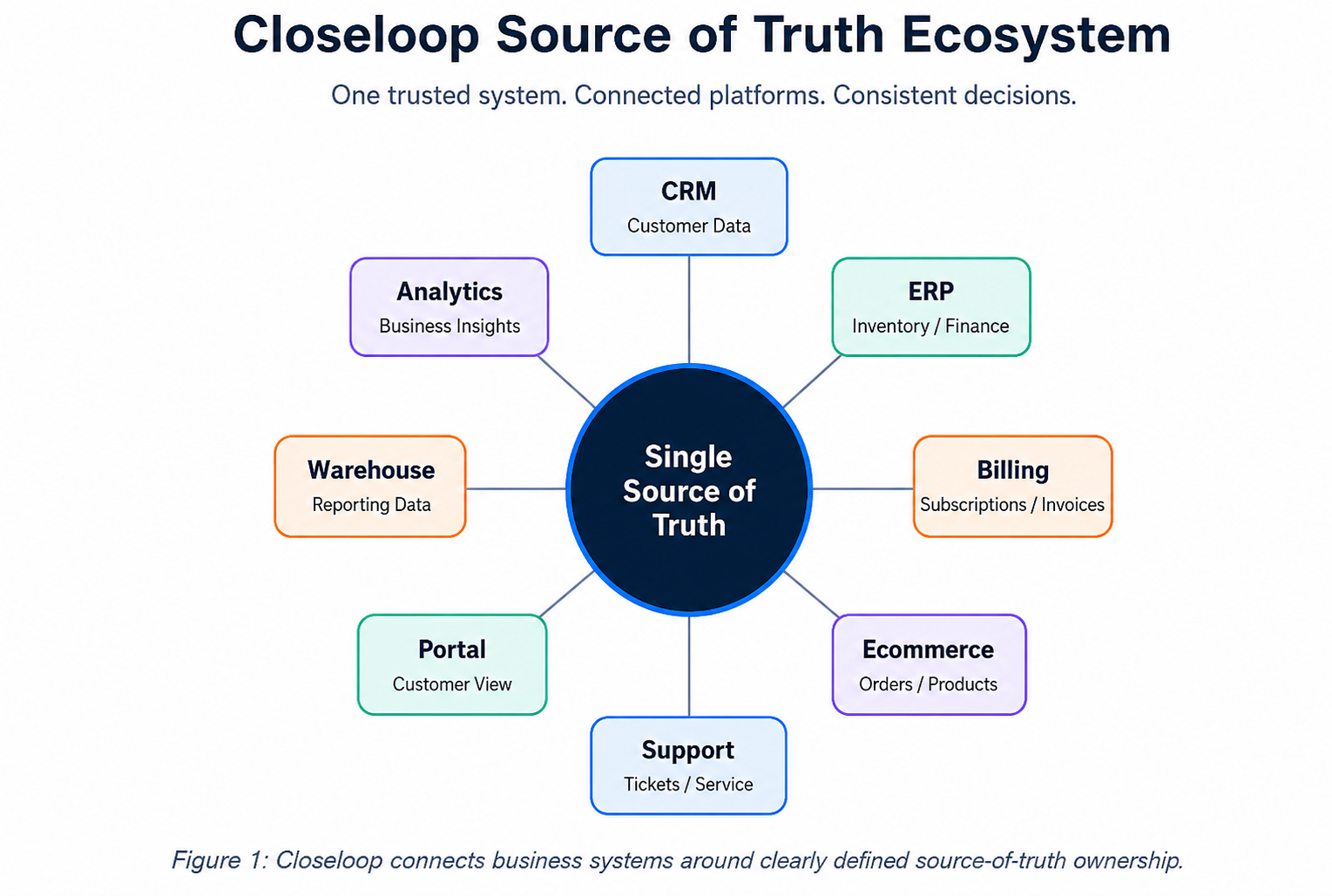
A Source of Truth system is the trusted system or platform that owns the official version of a specific type of data. This does not mean data cannot appear in other systems. It means that when data is copied, synchronized, displayed, or reported elsewhere, everyone understands where the official version lives.
| Data Type | Possible Source of Truth |
|---|---|
| Customer Records | CRM |
| Subscription Status | Billing Platform |
| Invoices and Payments | Finance or Billing System |
| Product Catalog | Product Information Management or Ecommerce Platform |
| Employee Records | HRMS |
| Support Tickets | Customer Support Platform |
| Inventory | ERP or Warehouse Management System |
| Business Reports | Data Warehouse or Analytics Layer |
At Closeloop, we design source of truth models that make data ownership clear, reduce duplication, and help connected systems work together more reliably.
System Ownership Matrix
Defining the right source of truth for every critical business entity.
| Data Entity | Source of Truth | Consuming Systems |
|---|---|---|
| Customer Profile | CRM | Billing, Support, Customer Portal, Analytics |
| Subscription Status | Billing Platform | CRM, Support, Customer Portal, Reports |
| Product Catalog | Ecommerce / PIM | Website, ERP, Analytics |
| Inventory | ERP / Warehouse System | Ecommerce, Operations, Reports |
| Invoices & Payments | Billing / Finance System | CRM, Customer Portal, Finance Reports |
| Support Tickets | Support Platform | CRM, Analytics |
| Revenue Metrics | Data Warehouse | Leadership Dashboards |
| Customer 360 | Governed Data Layer | Sales, Support, Success, Leadership |
Why Source of Truth Systems Matter
Without a defined source of truth, organizations often face data conflicts that create friction across teams and reduce confidence in the systems being used.
• A customer name is updated in the CRM but not reflected in the billing system.
• A subscription is cancelled in one platform but still appears active in another.
• A sales report shows different revenue numbers than a finance report.
• A product price is changed on the website but not updated in the backend system.
• A support team sees outdated customer information during service interactions.
• Leadership dashboards show inconsistent metrics from different systems.
A strong source-of-truth architecture helps organizations improve data accuracy, reduce duplicate records, create clear ownership, improve integration reliability, enable trustworthy reporting, reduce manual rework, strengthen audit readiness, and support automation and AI use cases.
Without Source of Truth
- Same data exists in multiple systems
- Teams see conflicting records
- Manual updates across platforms
- Duplicate customer or order records
- Reports show different numbers
- Integration failures are hard to trace
- Ownership is unclear
- AI and analytics are unreliable
With Closeloop Source of Truth
- Every data entity has a defined owner
- Teams work from trusted information
- Governed synchronization
- Standardized master data
- Consistent business metrics
- Sync logs and reconciliation
- Business and system ownership documented
- Data becomes analytics and AI-ready
Closeloop’s Approach to Source of Truth Systems
At Closeloop, we approach source-of-truth design through a combination of business analysis, system architecture, data governance, integration planning, and operational process alignment.
Our goal is to answer key questions early in the project lifecycle:
- Which system owns each data entity?
- Which systems are allowed to update that data?
- Which systems only consume or display the data?
- How often should data synchronize?
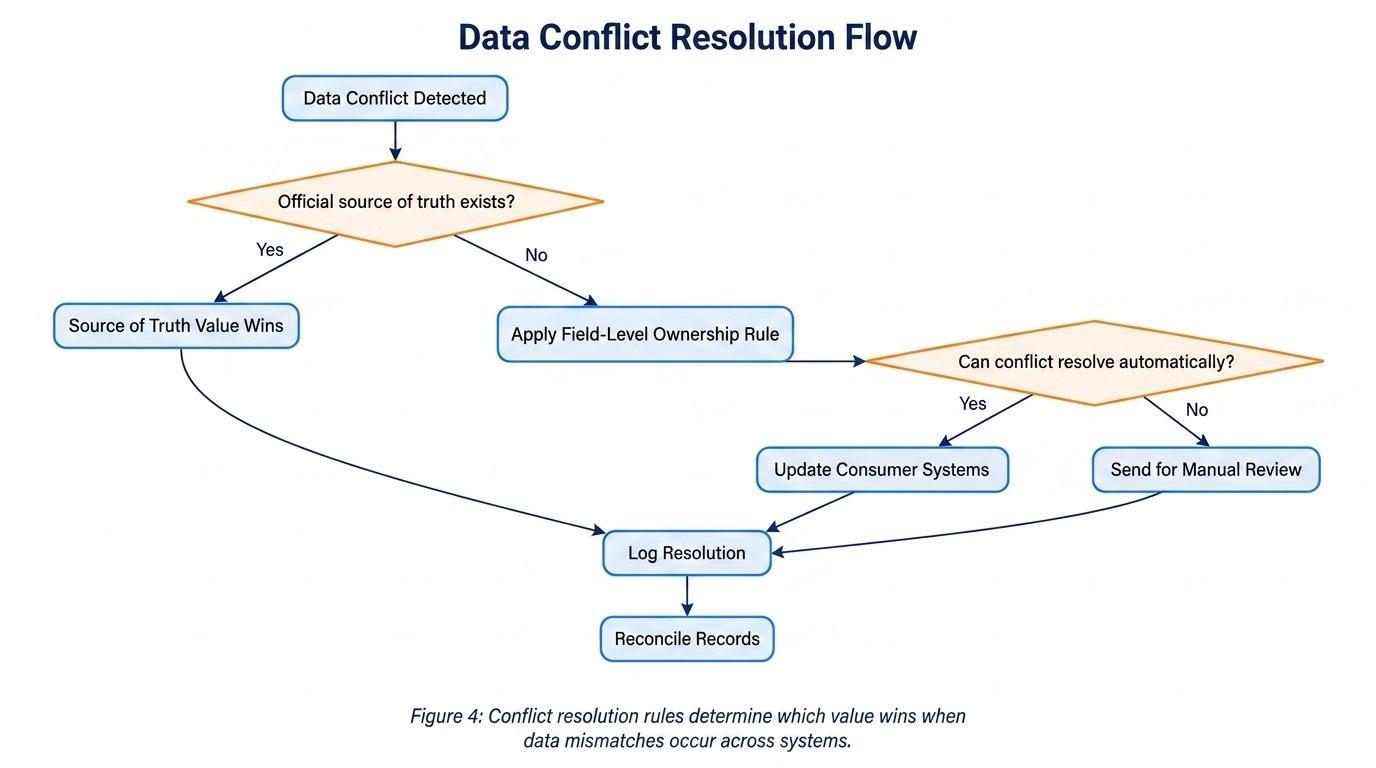
- What happens when two systems have conflicting values?
- How are changes logged and audited?
- How does the system recover from failed synchronization?
- How does the data support reporting, analytics, automation, and AI?
By answering these questions during discovery and architecture, we help clients avoid integration confusion and long-term data quality problems.
Core Principles of Source of Truth Systems at Closeloop
1. Business Ownership
Defines who owns data from a business process perspective.
2. System Ownership
Identifies the official platform responsible for master records.
3. Data Quality
Ensures records are complete, validated, standardized, and accurate.
4. Integration Control
Governs how data moves securely and reliably across systems.
5. Access & Security
Controls who can view, update, approve, export, or delete data.
6. Reporting & Intelligence
Enables trusted dashboards, automation, analytics, and AI readiness.
1. Clear Data Ownership
The first principle is ownership. Closeloop works with clients to identify who owns each type of data from both a business and technical perspective. This includes understanding which department, process, and platform should create, update, approve, and maintain key records.
2. Single System of Record for Critical Data
A source-of-truth model does not require one system to own everything. Instead, each major data entity should have its own system of record. The CRM may own customer profiles, the ERP may own inventory and financial operations, the billing platform may own subscriptions and invoices, and the data warehouse may own consolidated reporting.
3. Governed Data Flow Between Systems
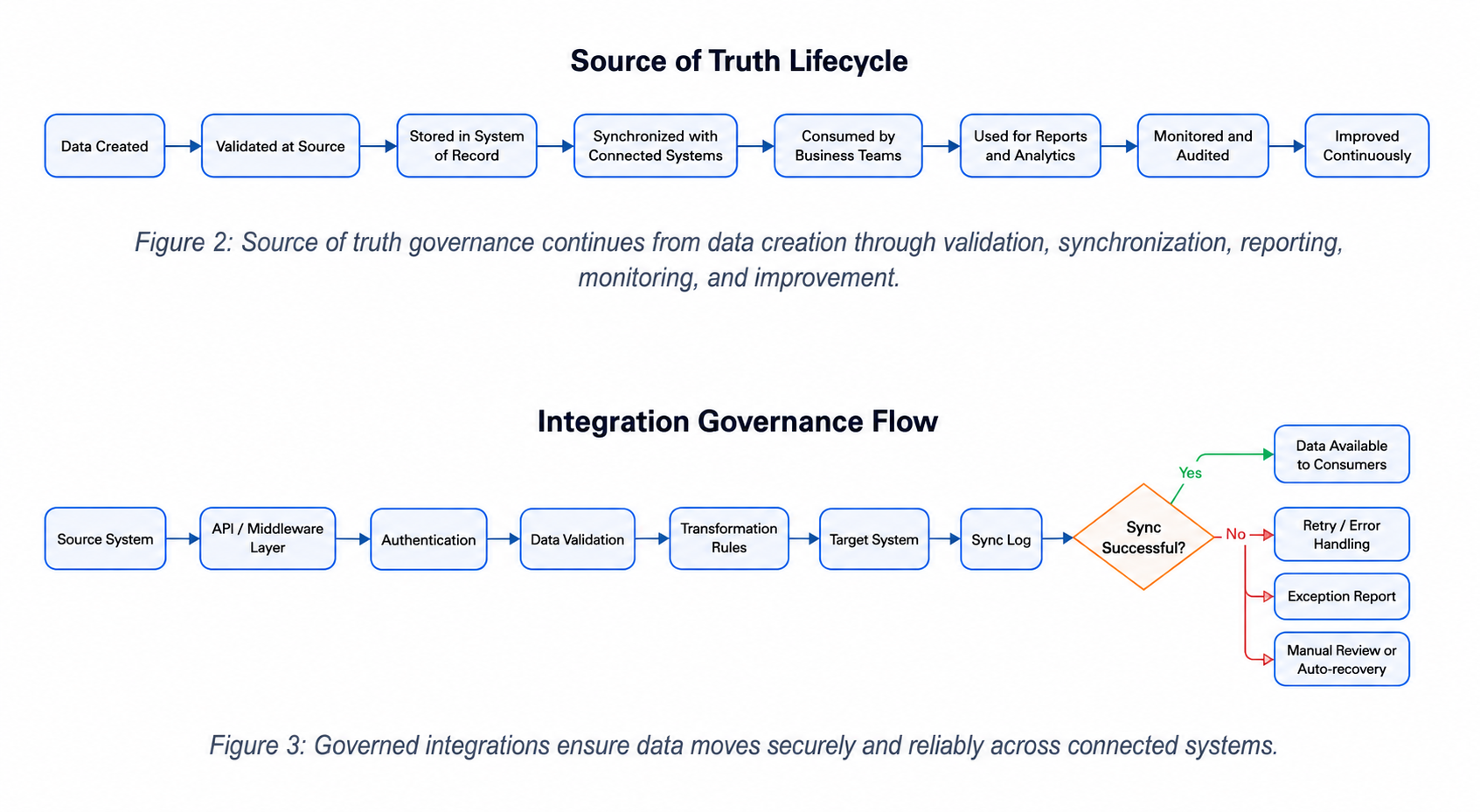
Once the source of truth is defined, data needs to move between systems in a controlled way. Closeloop designs integration flows that define how data is created, updated, synchronized, validated, logged, and reconciled.
4. Data Consistency Across the Business Ecosystem
Business users need consistent information across different platforms. Closeloop ensures consistency through structured data mapping, validation rules, synchronization logic, and conflict resolution practices.
5. Integration Governance and API Security
Source-of-truth systems depend heavily on integrations. Closeloop applies secure authentication, authorization, encrypted communication, API version awareness, rate-limit handling, logging, retry logic, and error alerts.
6. Data Validation and Quality Control
A source-of-truth system is only valuable when the data inside it is clean and reliable. Closeloop applies validation rules to ensure required fields, formats, business rules, and relationships are respected.
7. Auditability and Change Tracking
When critical data changes, organizations should know who changed it, when it changed, what changed, and why. Closeloop supports auditability through change logs, activity history, integration logs, timestamps, user tracking, approval workflows, and monitoring.
8. Conflict Resolution Rules
In connected ecosystems, conflicts can happen. Closeloop helps clients define rules such as source-system wins, most recent approved update wins, manual review required, field-level ownership, or system priority hierarchy.
9. Reporting and Analytics Alignment
Different teams may calculate the same metric differently. Closeloop helps define trusted reporting layers where data is consolidated, standardized, and transformed into business-ready insights.
10. Scalability for Future Systems
As companies grow, they add new tools, products, markets, integrations, and business models. Closeloop designs source-of-truth systems so new platforms become part of a governed ecosystem rather than another disconnected silo.
How Closeloop Implements Source of Truth Systems
1. Discovery and Current-State Assessment
Closeloop begins by understanding the client’s current digital landscape, including existing systems, key data entities, workflows, pain points, duplicates, manual processes, integration gaps, reporting inconsistencies, and security or compliance needs.
2. Data Entity Mapping
We map key business entities such as customers, leads, contacts, accounts, orders, subscriptions, payments, invoices, products, inventory, employees, vendors, tickets, contracts, and reports. For each entity, we identify where it is created, updated, consumed, and officially owned.
3. System Ownership Matrix
Closeloop creates a system ownership matrix that defines which platform owns which data and which systems consume it. This creates clarity for both technical teams and business users.
4. Integration Architecture Design
After ownership is defined, we design the integration architecture, including APIs, direct connections, middleware, event triggers, sync frequency, transformation logic, retry handling, failure logging, and exception reporting.
5. Data Validation and Transformation Rules
We define validation and transformation rules for each integration, including date formats, currency formats, required fields, status mappings, duplicate detection, and regional normalization.
6. Role-Based Access and Update Control
Not every user or system should be able to modify master data. Closeloop designs update permissions so only authorized users or systems can create or change specific records.
7. Testing and Data Reconciliation
We test whether data is created in the right system, updates flow to consuming systems, unauthorized edits are blocked, integration failures are logged, retry logic works, reports reflect correct data, and conflicts are handled properly.
8. Documentation and Operational Handover
Closeloop documents system ownership, data flows, integration rules, access permissions, field mappings, error handling, reporting logic, admin responsibilities, and operational support processes.
9. Continuous Improvement After Launch
Business systems evolve. Closeloop supports ongoing improvements including new integrations, access reviews, data cleansing, reporting enhancements, audit improvements, sync optimization, and AI readiness.
Source of Truth Systems and Data Governance
Source-of-truth systems and data governance are closely connected. Governance defines rules, ownership, quality standards, access controls, and compliance expectations.
- Reliable data
- Clear accountability
- Secure access
- Consistent reporting
- Controlled integrations
- Audit-ready operations
- Better business decisions
"At Closeloop, source-of-truth architecture is treated as one of the most important foundations of strong data governance."
Source of Truth Systems and AI Readiness
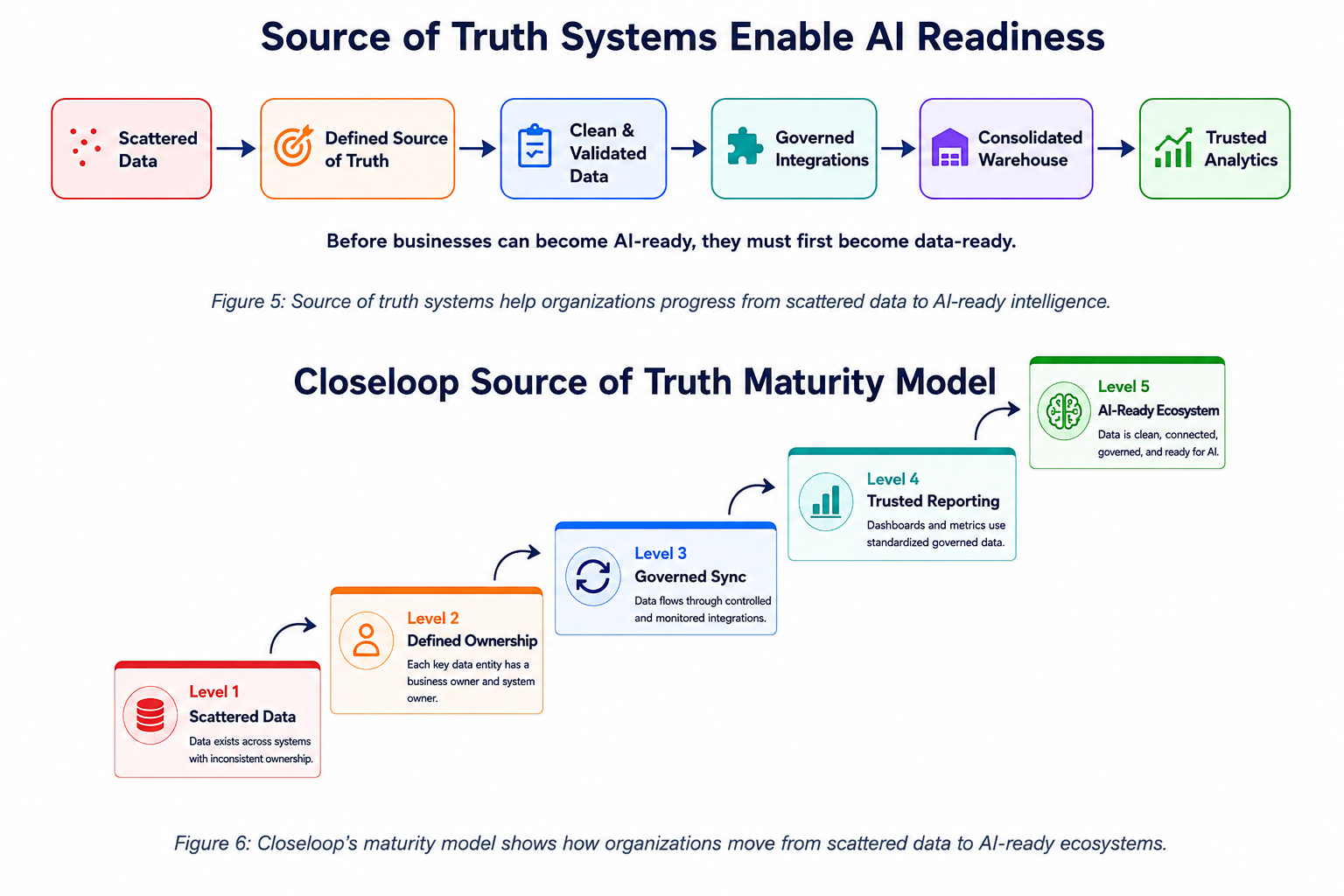
AI, automation, and predictive analytics depend on trusted data. If AI models receive inconsistent or duplicated information, their outputs become unreliable.
Closeloop helps organizations prepare for AI and automation by ensuring data sources are governed, clean, and clearly owned.
Before businesses can become AI-ready, they must first become data-ready.
Common Business Scenarios Where Source of Truth Matters
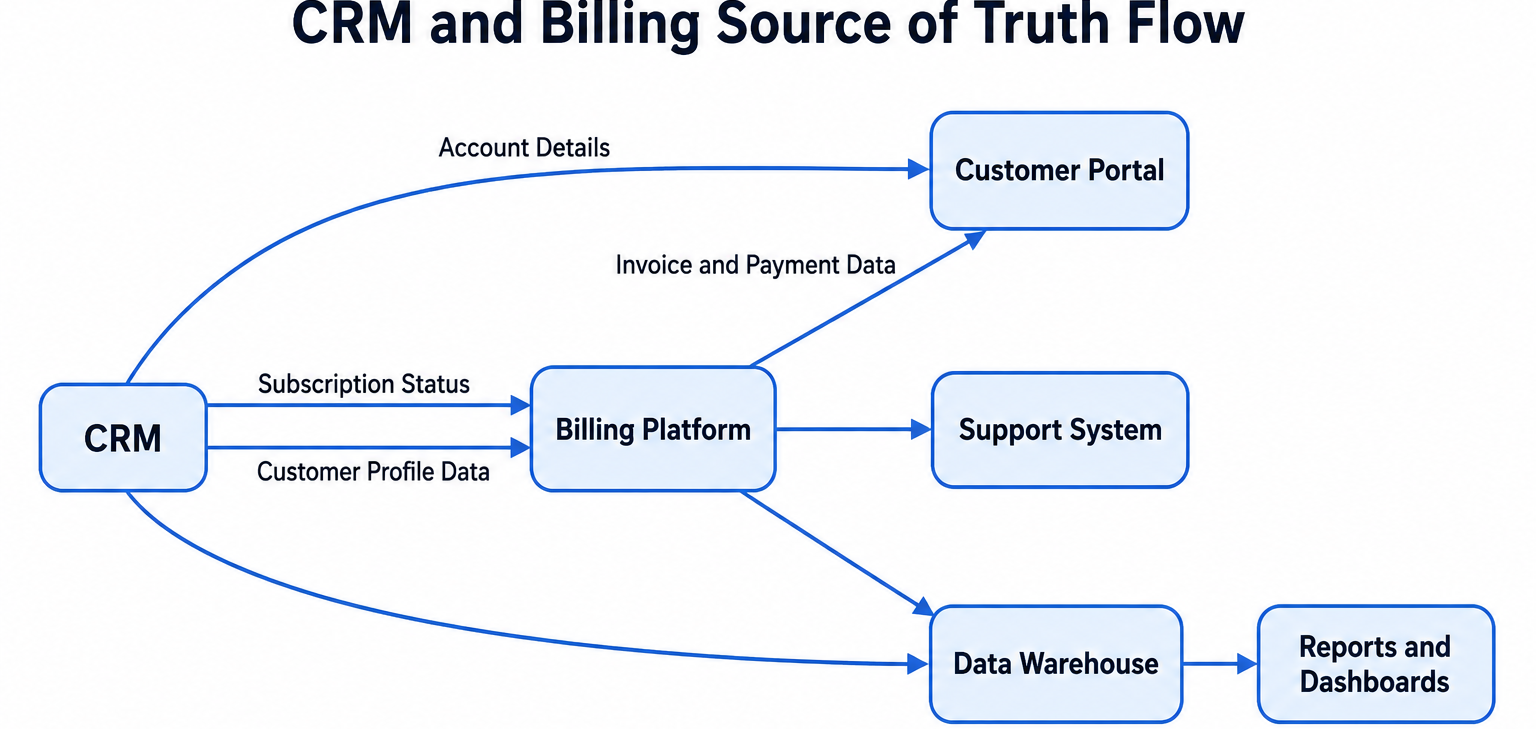
1. CRM and Billing Alignment
A sales team may use a CRM to manage customer relationships while finance uses a billing platform to manage subscriptions, invoices, and payments. Closeloop defines which system owns customer profile data, which system owns billing data, and how both stay synchronized.
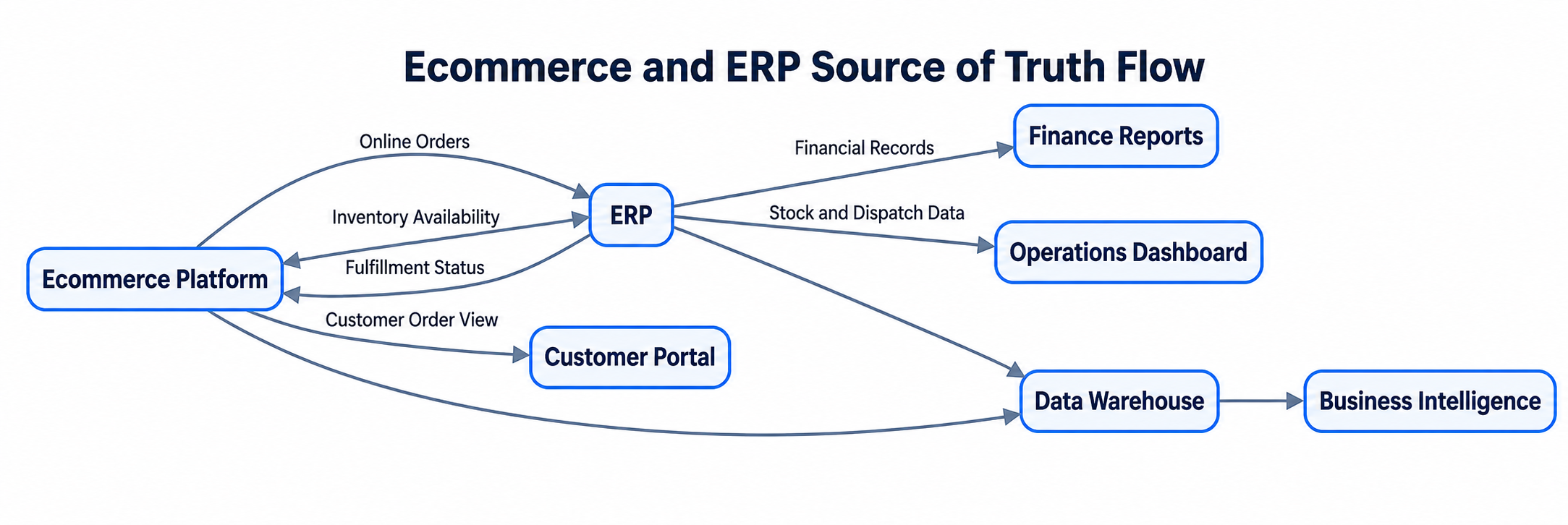
2. Ecommerce and ERP Integration
An ecommerce platform may manage online orders and product display while the ERP manages inventory, fulfillment, pricing, and financial records. Closeloop defines ownership for product, inventory, pricing, order, and fulfillment data.
3. Customer Support Visibility
Support teams need accurate customer information to resolve issues quickly. Closeloop helps connect support platforms with CRM, billing, order, and product systems so agents can access reliable information.
4. Leadership Reporting
Executives need dashboards they can trust. Closeloop establishes governed reporting layers that consolidate source-system data and apply consistent metric definitions.
5. Multi-System Digital Transformation
Many organizations modernize in phases. Closeloop helps manage transitions by defining temporary and long-term source-of-truth rules, migration paths, integration logic, and reconciliation processes.
Benefits of Source of Truth Systems
| Operational Benefits | Technical Benefits | Business Benefits |
|---|---|---|
| Reduced manual data correction | Cleaner integrations | More accurate reporting |
| Fewer duplicate records | Reduced system conflicts | Improved customer experience |
| Faster issue resolution | Better API architecture | Better compliance readiness |
| Clearer business workflows | Improved data synchronization | Faster decision-making |
| Better cross-team coordination | Easier troubleshooting | Higher trust in digital systems |
| Reduced dependency on spreadsheets | More scalable platforms | Better readiness for AI and automation |
Conclusion
Source-of-truth systems are essential for organizations that want reliable data, connected platforms, accurate reporting, and scalable digital operations.
At Closeloop, we design source-of-truth systems by combining business ownership, technical architecture, data governance, integration control, security, auditability, and continuous improvement.
Our approach helps clients understand which system owns which data, how information should move, who can update it, how conflicts should be resolved, and how trusted data can support reporting, automation, and AI.
“Without source-of-truth architecture, systems become fragmented. With it, organizations gain clarity, confidence, and control.”
For Closeloop, building source-of-truth systems means helping clients create digital ecosystems where data is reliable, connected, secure, and ready to support smarter decisions.
Author

Saurabh Sharma

VP of Engineering
VP of Engineering at Closeloop, a seasoned technology guru and a rational individual, who we call the captain of the Closeloop team. He writes about technology, software tools, trends, and everything in between. He is brilliant at the coding game and a go-to person for software strategy and development. He is proactive, analytical, and responsible. Besides accomplishing his duties, you can find him conversing with people, sharing ideas, and solving puzzles.
Stay abreast of what's trending in the world of technology
When Standard NetSuite Workflows Fall Short: Implementation, Integration, and Customization...
NetSuite is one of the most capable cloud ERP platforms available, but no out-of-the-box...

From Business Bottlenecks to Digital Products: How to Evaluate Software Development Partners in the...
Every growing business eventually hits a wall. Spreadsheets multiply, teams re-enter the same...

The Hidden Cost of Disconnected Logistics Systems: A Software Architecture Approach to End-to-End...
A shipment leaves the warehouse on time, yet the customer calls twice asking where it is....
The Role of APIs and Integrations in Modern Custom Software Development
No application works alone anymore. Your CRM talks to your billing tool, your mobile app...